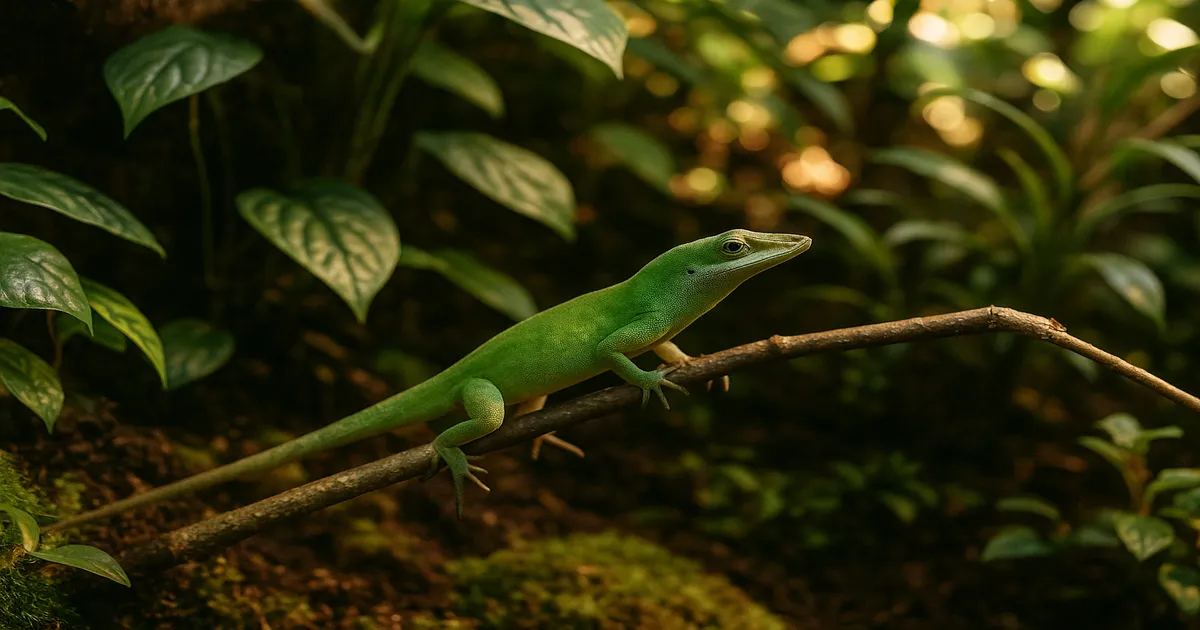
Quick Answer: Green anoles are small, diurnal lizards that need a tall, well-ventilated enclosure, proper UVB lighting, daily misting, and live insect prey to thrive. They’re best kept as display animals — not handled pets — and their care is more involved than their $5 price tag suggests. Get the lighting and humidity right and they’re genuinely rewarding to keep.
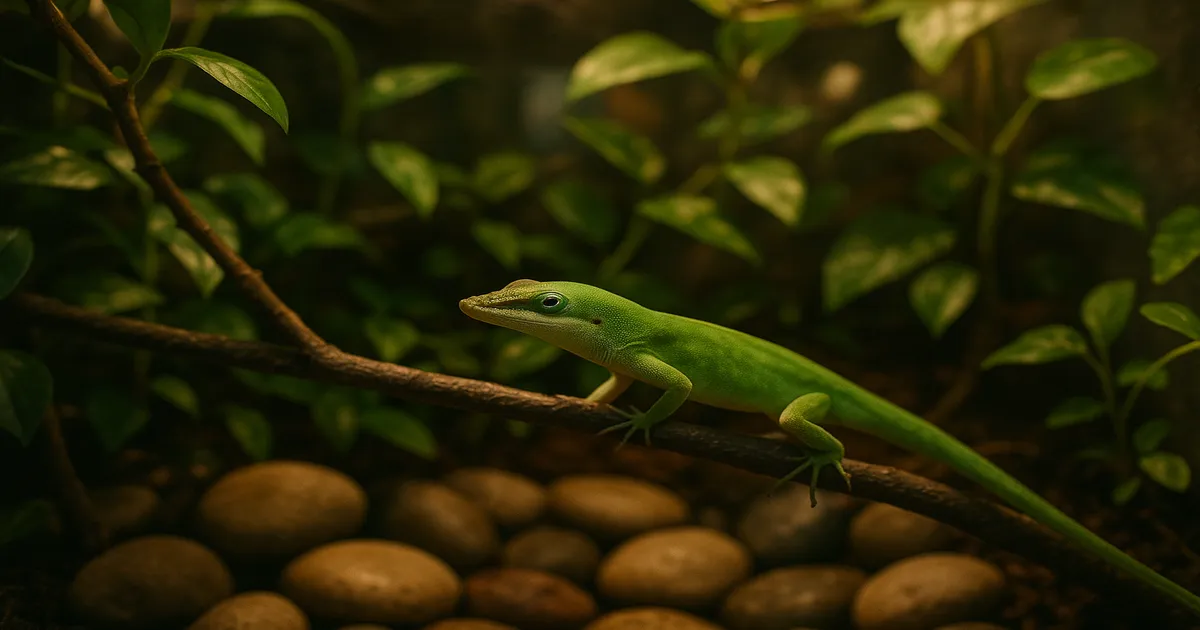
Green anoles (Anolis carolinensis) are one of the most commonly sold reptiles in the US, and one of the most commonly killed through bad husbandry. If you’re learning how to care for green anoles, the good news is it’s not complicated once you understand what they actually need. The bad news is that the gap between “pet store advice” and “what actually keeps them alive” is real — and wider than most people expect.
Green Anole Care at a Glance
Species Snapshot: Size, Lifespan, and Origin
Green anoles are native to the southeastern United States — from North Carolina down through Florida and west into Texas. Adults reach 5–8 inches (12–20 cm) total length, with roughly half of that being tail. In captivity with proper care, they live 3–7 years; wild individuals rarely make it past 3 due to predation.
They’re diurnal and highly arboreal, spending most of their time in shrubby vegetation and forest edges. That natural history matters a lot for how you set up their enclosure.
Is a Green Anole the Right Pet for You?
You might hear them called “American chameleons” — a misnomer based on their ability to shift between green and brown. They’re not chameleons, and that color change is driven by temperature, stress, and mood rather than background matching.
The honest answer on handling: green anoles don’t enjoy it, and frequent handling causes real physiological stress. If you want a lizard you can interact with daily, look elsewhere. If you want a beautifully active display animal that’s fascinating to watch, they’re excellent.
Enclosure Setup for Green Anoles
Minimum Enclosure Dimensions by Group Size
Vertical height is the priority — these are arboreal lizards that spend almost no time on the ground.
| Group | Minimum Dimensions |
|---|---|
| Single animal | 18”L × 18”W × 24”H (45 × 45 × 60 cm) |
| One male + one female | 18”L × 18”W × 36”H (45 × 45 × 90 cm) |
| One male + two females | 24”L × 18”W × 36”H (60 × 45 × 90 cm) |
Never house two males together. They’ll fight relentlessly, and the subordinate male will die — sometimes quickly, sometimes slowly through chronic stress.
Screen vs. Glass: Which Enclosure Is Better?
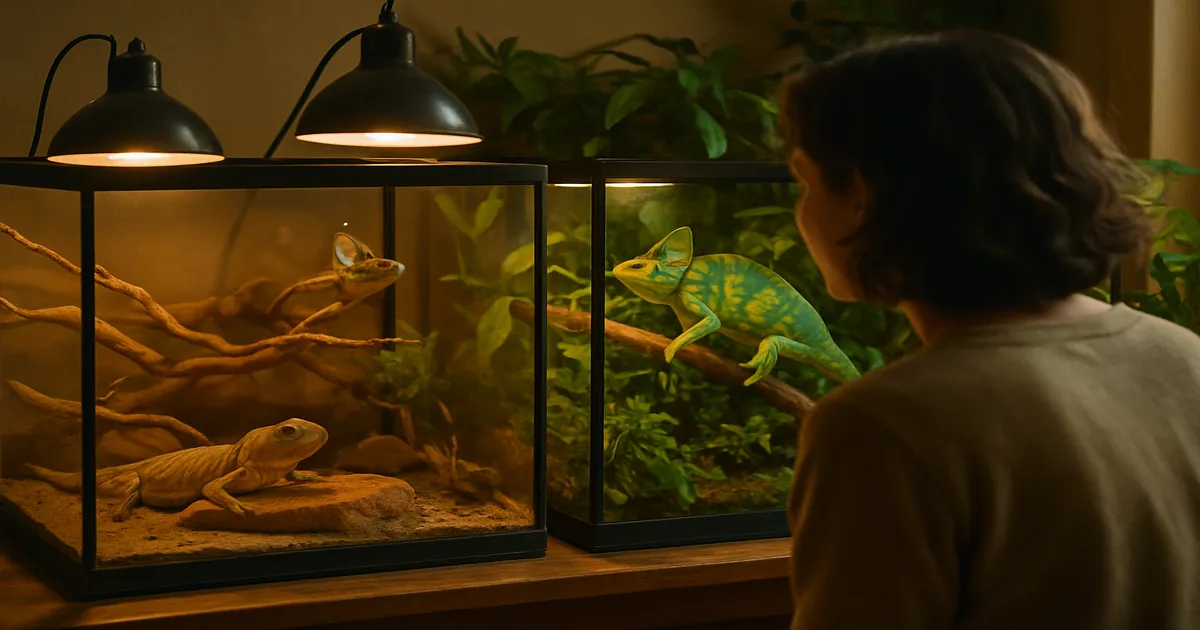
Screen or mesh enclosures are generally the better choice for green anoles. The airflow is excellent, misting is easy, and you won’t get the stagnant, hot-and-humid conditions that breed respiratory infections. (Zoo Med ReptiBreeze Open Air Terrarium)
Glass terrariums with full mesh tops work well too, especially in drier climates where you need to retain more humidity. What you absolutely want to avoid is an all-glass enclosure with a glass lid — heat and humidity become unmanageable fast.
Substrate Options
Good options:
- Coconut fiber — reliable, holds humidity well
- Organic topsoil/play sand/orchid bark mix (60/30/10) — great for bioactive
- ABG mix — the gold standard for bioactive tropical setups
- For bioactive: a drainage layer of LECA beneath a mesh separator
Avoid completely:
- Cedar or pine shavings — toxic
- Calcium sand — impaction risk
- Paper towels long-term — won’t hold humidity
Aim for at least 2–3 inches (5–7 cm) of substrate depth, 4+ inches if you’re going bioactive. Bioactive setups with live plants and microfauna are genuinely excellent long-term — they buffer humidity naturally and reduce maintenance. A simpler coconut fiber setup with live plants works fine too. Either way, you need something that holds moisture.
Temperature and Lighting for Green Anoles
Creating a Proper Thermal Gradient
Green anoles thermoregulate behaviorally — they move between warmer and cooler zones throughout the day. Without a proper gradient, they can’t do this, and health problems follow fast.
| Zone | Temperature |
|---|---|
| Basking spot | 85–90°F (29–32°C) |
| Warm side ambient | 78–82°F (26–28°C) |
| Cool side ambient | 70–75°F (21–24°C) |
| Nighttime low | 65–70°F (18–21°C) |
A 25–50W incandescent or halogen spot bulb positioned over one end of the enclosure handles basking. Run it through a dimmer thermostat to prevent overheating. (Inkbird ITC-306T Temperature Controller) Skip under-tank heaters entirely — arboreal lizards don’t thermoregulate from below.
Why UVB Lighting Is Non-Negotiable
Metabolic bone disease from UVB deficiency is probably the single most common way green anoles die in captivity. Soft jaw, tremors, inability to climb — it’s a slow and entirely preventable death. Green anoles are Ferguson Zone 3 baskers, meaning they need a UVI of 2.0–3.0 in their basking zone.
Recommended bulbs:
Position the bulb 8–12 inches (20–30 cm) from the basking perch. Replace it every 6–12 months — UVB output degrades long before the visible light fails, and that invisible degradation is what kills animals.
Run 12–14 hours of light in summer, dropping to 10–11 hours in winter. Most people skip this seasonal cycling. Don’t — in my experience it makes a noticeable difference in how active and healthy animals look over the long term.
Humidity, Misting, and Water
Target Humidity and How to Mist
Target 60–80% relative humidity, but don’t chase a static number. Natural daily fluctuation — dropping to 50–60% between mistings, spiking to 80%+ during misting — is actually beneficial. It mimics the dew-and-dry cycles these animals evolved with.
Use a digital hygrometer. Analog dial hygrometers can read 20–30% off actual humidity. They’re essentially useless for precise reptile keeping.
Mist once or twice daily, and deliberately mist one side of the enclosure more heavily than the other to create a humidity gradient. Always leave the basking zone drier. Green anoles drink by lapping droplets off leaves and enclosure walls — they don’t reliably recognize standing water as a water source. Dehydration is a common cause of death in enclosures that only have a water dish. Misting isn’t optional.
Automatic misters are great tools, but they supplement observation — they don’t replace it. Watching your animal drink during misting tells you a lot about its hydration status. Don’t just set a timer and stop paying attention.
Live Plants as Humidity Aids
Bromeliads are particularly valuable — they hold water in their leaf axils, creating natural drinking stations that anoles recognize instinctively. Many keepers (myself included) notice anoles drinking from bromeliad cups far more reliably than from misted glass. Pothos and peperomia also help buffer humidity swings between sessions.
Feeding Green Anoles
Diet and Prey Sizing
Strict insectivores. Live prey only — they won’t touch anything that isn’t moving.
Good feeder options:
- Crickets — reliable staple
- Dubia roaches — excellent nutritional profile
- Fruit flies (Drosophila) — essential for juveniles and small adults
- Small silkworms and hornworms — great for hydration and variety
- Waxworms — treat only, too high in fat for regular feeding
The sizing rule is simple: nothing wider than the space between the anole’s eyes. Oversized prey causes impaction and can injure the animal.
| Age | Frequency | Amount |
|---|---|---|
| Juvenile (under 6 months) | Daily | 4–6 items |
| Adult | Every other day | 3–5 items |
Feed in the morning after the animal has warmed up under the basking light. Food acceptance is noticeably better in the first 2–3 hours of the light cycle.
Gut-Loading and Supplementation
Gut-load feeder insects for 24–48 hours before offering them — collard greens, dandelion greens, squash, and commercial gut-load all work well. An insect that’s been sitting in an empty container has almost no nutritional value.
Supplementation schedule:
- Calcium without D3: every feeding or every other feeding
- Multivitamin with D3: twice per month
- Vitamin A (retinol-based): 1–2 times per year only if deficiency signs appear — don’t overdo it
Dust prey in a small bag or cup before releasing into the enclosure. Remove any uneaten crickets within 30–60 minutes — loose crickets overnight will bite sleeping anoles.
Decor, Plants, and Enrichment
Live plants aren’t just decorative — they buffer humidity, provide psychological security, and create the layered environment these animals genuinely need. I’d argue they’re close to non-negotiable for long-term success.
Top plant choices:
- Pothos — nearly indestructible, tolerates low light, excellent coverage
- Bromeliads — natural drinking stations, humidity-holding
- Tillandsia (air plants) — easy, no soil needed, mounts anywhere
- Peperomia — compact, hardy, good filler
- Non-toxic Dracaena — good vertical structure
Arrange branches, cork bark rounds, bamboo tubes, and grapevine wood at multiple heights and angles. The goal is to give the anole options at every temperature zone — a perch near the basking spot, mid-level routes, and lower retreats near the cool side. Cork bark rounds mounted vertically are particularly useful: the inside stays cooler and more humid than the exterior surface, giving the animal genuinely different microhabitat options within a small space.
Common Green Anole Care Mistakes
Enclosure errors: The classic 10-gallon starter kit is wholly inadequate — too short, poorly ventilated, and can’t support a proper thermal gradient. If that’s what you have, upgrade before you bring an animal home. Analog hygrometers are another quiet killer; if yours isn’t digital, replace it.
Lighting mistakes: Omitting UVB entirely leads to MBD, which is often fatal. Not replacing UVB bulbs on schedule is just as bad — output degrades invisibly. If you need nighttime supplemental heat, use a ceramic heat emitter, not red or blue “night bulbs.”
Feeding pitfalls: Prey that’s too large causes real harm. So does over-supplementing — vitamin A toxicity and hypercalcemia are both serious conditions. Follow the schedule above.
Behavioral misunderstandings: Persistent brown coloration isn’t normal. A chronically brown anole is stressed, cold, or sick — it’s a signal to investigate your husbandry, not ignore. A motionless anole isn’t tame; it’s scared. Stillness in a prey animal is fear-induced freezing, not contentment. And if your male is constantly displaying at his own reflection, cover the sides of the enclosure — that’s exhausting for him and will affect his health over time.
Health and Veterinary Care
Signs of a healthy green anole: Regular basking, bright green coloration during active periods, males displaying their dewlap, consistent feeding, clean complete sheds.
Common health problems:
- Metabolic bone disease (MBD): UVB deficiency; soft jaw, tremors, inability to climb
- Respiratory infections: Poor ventilation combined with high humidity
- Dystocia (egg retention): Gravid females need a proper laying site — moist coconut fiber or organic topsoil, at least 4 inches (10 cm) deep. If a female is digging and can’t find a suitable spot, retained eggs will kill her.
- Dysecdysis (retained shed): Low humidity; never pull dry shed — soak the animal in shallow warm water or provide a humid hide
- Parasites: Common even in captive-bred animals; annual fecal exams are worth doing
Quarantine all new animals for 60–90 days in a separate room before any contact with an established collection. Green anoles commonly carry Salmonella — wash hands before and after any contact. Weigh your animal monthly on a digital kitchen scale. Weight loss is often the first measurable sign that something’s wrong, and catching it early makes a real difference in treatment outcomes.
Frequently Asked Questions About Green Anole Care
Do green anoles need UVB lighting?
Yes — UVB is not optional. Without it, they can’t synthesize vitamin D3, which leads to calcium deficiency and metabolic bone disease. Use a T5 HO bulb rated for Ferguson Zone 3 (UVI 2.0–3.0), position it 8–12 inches from the basking perch, and replace it every 6–12 months.
How often should I mist my green anole’s enclosure?
Once or twice daily. Green anoles drink by lapping droplets off leaves and glass — they don’t reliably drink from standing water, so consistent misting is how you keep them hydrated. Aim for 60–80% humidity overall, with natural dips between sessions.
Can you keep two green anoles together?
One male with one or two females is fine in an appropriately sized enclosure. Never house two males together — they’re territorial, and the subordinate male will experience chronic stress and often die even in a large setup.
Why is my green anole always brown?
Chronic brown coloration is a stress or health signal. Common causes include temperatures that are too cold, inadequate UVB, illness, or an enclosure that doesn’t provide enough cover. If your anole is consistently brown during its active period, something in your husbandry needs fixing.
What do green anoles eat in captivity?
Strict insectivores — live prey only. Crickets and dubia roaches make excellent staples; fruit flies are essential for juveniles. Silkworms and hornworms are great for variety and hydration. Waxworms are fine occasionally as a treat. Always gut-load feeders for 24–48 hours before offering them, and dust with calcium supplement at most feedings.