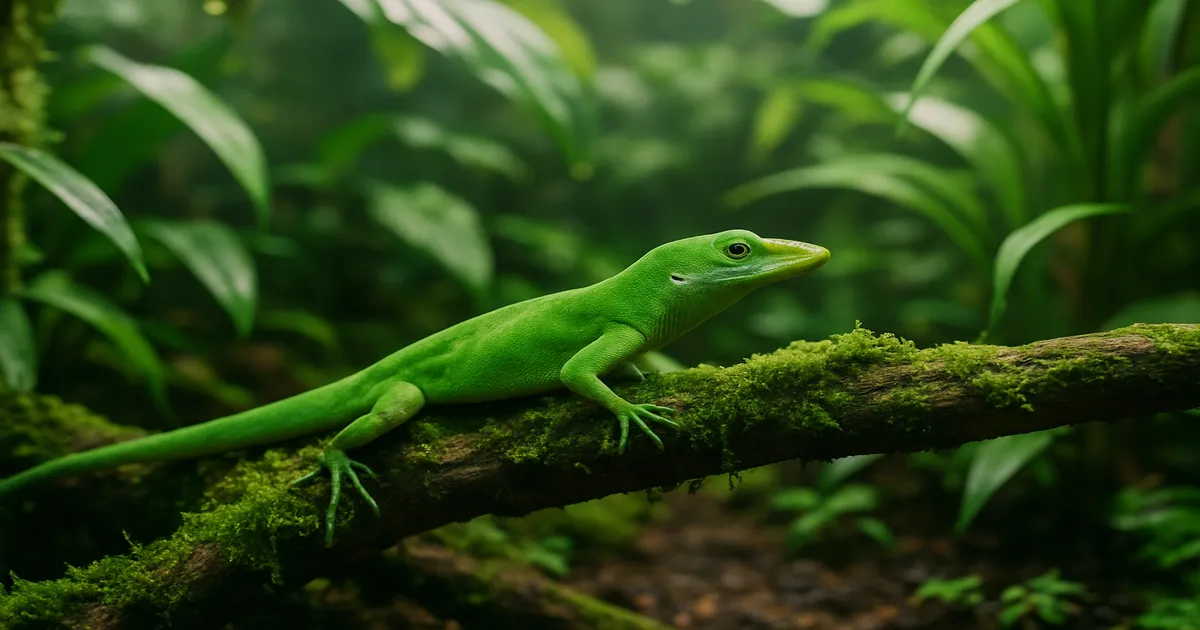
Quick Answer: Feed your green anole live insects no larger than the space between its eyes — juveniles daily, adults every other day. Dust feeders with calcium powder at most feedings, gut-load them 24–48 hours in advance, and rotate through at least 3–4 feeder species. None of this works if your temperatures are off, so make sure your basking spot hits 88–95°F (31–35°C) before you worry about anything else.
Green anoles are one of the most rewarding small lizards you can keep, but figuring out how to feed a green anole properly trips up a lot of new owners. The basics aren’t complicated — live bugs, supplements, variety. The details, though, matter more than most care guides let on, and getting them wrong is exactly how you end up with a skinny, stressed-out lizard that won’t eat.
What Do Green Anoles Eat?
Natural Diet of Anolis carolinensis
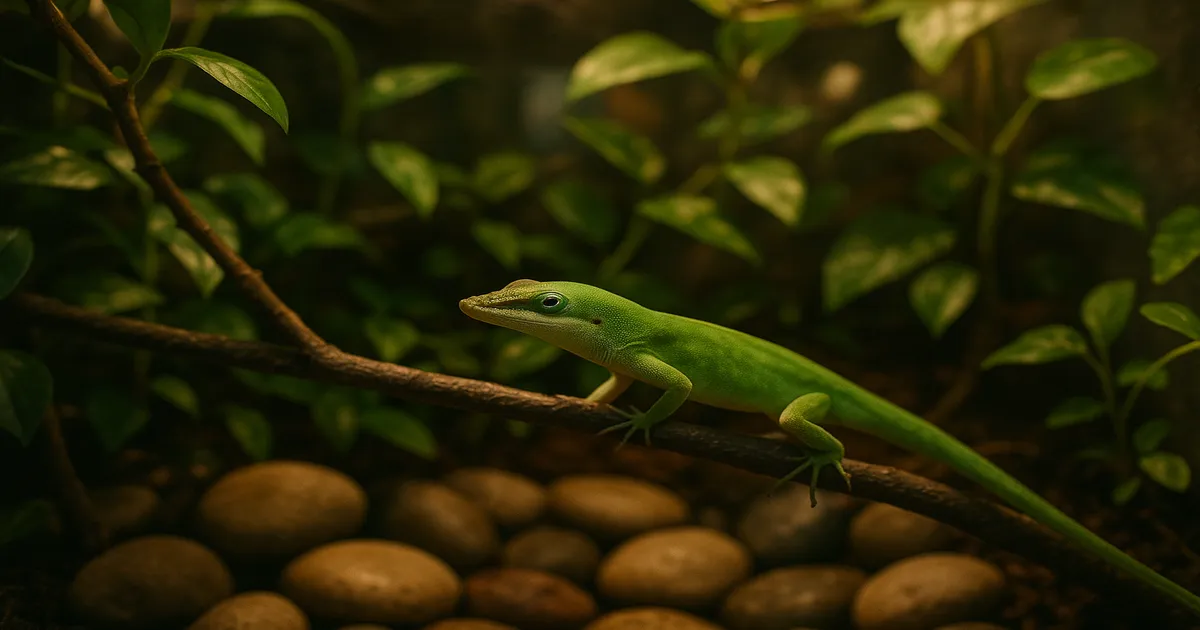
Wild green anoles are opportunistic insectivores. Gut-content studies turn up ants, beetles, moths, spiders, flies, caterpillars, and small grasshoppers — basically anything small enough to swallow that happens to be moving. They’re ambush hunters, not pursuit predators, so eyesight and quick reflexes do most of the work.
Feeding activity also tracks closely with temperature. In warm spring and summer months, anoles eat almost daily. Once fall arrives and temps drop, appetite follows — and that’s completely normal. Don’t panic and start force-feeding a healthy animal that’s just responding to seasonal cues.
In captivity, that natural prey diversity doesn’t happen on its own. You’re the one who has to replicate it deliberately, which is why rotation isn’t optional — it’s the foundation of good feeding.
One more thing worth knowing: anoles get a significant chunk of their hydration from prey items and from dew droplets on leaves. They rarely drink from standing water. That has real implications for how you manage humidity in the enclosure.
Best Feeder Insects for Green Anoles
Staple Feeders: Crickets and Dubia Roaches
Crickets are the go-to feeder for most keepers, and they’re fine as part of a rotation — but they’re not a complete diet on their own. Their calcium-to-phosphorus ratio runs around 1:9, which is genuinely bad, and they need to be gut-loaded to be worth much nutritionally.
Dubia roaches are a better staple, honestly. Superior Ca:P ratio, meatier, no noise, no smell. Anoles go after them enthusiastically. If you can source them regularly or keep a small colony, they’re worth adding to the rotation.
Essential for Juveniles: Fruit Flies and Pinhead Crickets
Young anoles physically cannot eat adult crickets. For hatchlings, you want Drosophila melanogaster — the tiny flightless fruit flies. As juveniles grow, D. hydei (the larger species) bridges the gap nicely before they’re ready for pinhead or small crickets.
I’ve seen people try to feed juvenile anoles regular-sized crickets because that’s what the pet store sold them. Don’t. The size mismatch causes real harm — choking, jaw injury, and chronic stress.
Supplemental Feeders
- Black soldier fly larvae (Calci-worms, NutriGrubs): Naturally high in calcium with an excellent Ca:P ratio. One of the best supplemental feeders available. Offer 2–3 times per week as part of your rotation.
- Waxworms: High in fat. Treat only — once or twice a month at most. Anoles love them, which is exactly why you have to be careful. An anole that discovers waxworms will sometimes refuse everything else.
- Small wild-caught insects: If you have a pesticide-free yard, small moths, aphids, and tiny grasshoppers make excellent supplemental prey. Avoid anything from areas that might have been sprayed, and gut-load for 24 hours first.
How to Size Prey Correctly
The rule is simple: no longer than the distance between the anole’s eyes, and no wider than the anole’s head. Oversized prey causes choking, jaw dislocation, and impaction. Always size-match to the individual animal in front of you — a small adult female needs smaller prey than a large male, regardless of what the care sheet says for the species in general.
Green Anole Feeding Schedule
Juveniles vs. Adults
- Juveniles (under 6 months): Feed daily. They’re growing fast and need the calories.
- Adults: Every other day, or 4–5 times per week. Daily feeding leads to obesity in adults, which puts real strain on organs over time.
Best Time of Day to Feed
Mid-morning — roughly 1–2 hours after lights come on. By then your anole has basked, warmed up, and its digestive system is ready to go. An anole that hasn’t thermoregulated yet will often ignore food entirely. People mistake that for a feeding problem when it’s really a timing problem.
How Many Insects Per Session
For adults, 3–6 appropriately sized insects per session is a reasonable starting point. Watch body condition over time — a healthy adult should have a slightly rounded midsection, not sunken flanks or a visibly prominent spine. Remove all uneaten prey within 1–2 hours. Crickets left overnight will bite a sleeping lizard that can’t defend itself, causing injuries and chronic stress.
How to Gut-Load and Supplement Feeder Insects
Gut-Loading
An insect is only as nutritious as what it’s recently eaten. Crickets kept on cardboard egg crates with no food are essentially empty calories. Gut-loading means feeding your feeders well for 24–48 hours before offering them, so that nutrition passes through to your anole.
Good gut-load foods:
- Collard greens
- Dandelion greens
- Sweet potato
- Bee pollen
- Commercial gut-load (Repashy Bug Burger)
Skip iceberg lettuce and fruit-heavy diets — high water content, minimal nutrients. Leafy greens and root vegetables are where the value is.
Supplementation Schedule
This is the part most people either skip or overdo:
- Calcium powder without D3: Dust feeders at every other feeding (roughly 50% of meals)
- Reptile multivitamin with D3: No more than twice per month
- If your UVB is functional and properly positioned: You can lean less on D3 supplementation, since your anole is synthesizing its own
One real caution: vitamin A toxicity is a thing. Don’t use a multivitamin more than twice monthly, and don’t stack multiple vitamin products thinking more is better.
The Shake-and-Dump Method
Put feeders in a small deli cup, add a small pinch of supplement powder, shake gently to coat, and introduce them to the enclosure immediately. Supplement powder starts falling off within minutes, so speed matters. A light coating is enough — you don’t want insects so coated they look white.
Husbandry That Directly Affects Feeding
Temperature
Feeding and temperature are inseparable. An anole kept below 75°F (24°C) ambient can’t properly digest food and risks gut rot and impaction. Here are the numbers:
- Warm side ambient: 80–85°F (27–29°C)
- Basking spot surface: 88–95°F (31–35°C) — measure this with an infrared temperature gun, not a stick-on thermometer
- Nighttime low: No lower than 65°F (18°C)
If your anole suddenly stops eating, check temperatures before assuming illness. It’s the right first move nine times out of ten.
UVB Lighting
UVB isn’t optional. Without it, anoles can’t synthesize vitamin D3, which means they can’t metabolize calcium properly, which leads to metabolic bone disease — one of the most common causes of death in captive anoles. Use a T5 HO 5.0 or 6% UVB bulb and replace it every 6–12 months even if it’s still producing visible light. UVB output degrades well before the bulb burns out.
Humidity and Hydration
Target 60–80% relative humidity. Mist with filtered or dechlorinated water once or twice daily — morning and early evening works well. Anoles drink droplets off leaves and enclosure walls, so misting is their primary water source. Tap water with chlorine and chloramines can irritate mucous membranes over time. It’s a small change that makes a real difference.
Enclosure Size
A chronically stressed anole in a cramped enclosure will refuse food for weeks. The absolute minimum for one adult is a 10-gallon tall, but a 20-gallon tall or an 18”×18”×24” bioactive setup (Exo Terra Glass Terrarium 18x18x24) is where these animals actually thrive. Height matters more than floor space — they’re arboreal, and they want to be up high.
Common Feeding Mistakes to Avoid
Prey that’s too large. Choking, jaw dislocation, impaction. Always use the eye-spacing rule, and when in doubt, go smaller.
Feeding only crickets. Their poor Ca:P ratio means nutritional deficiencies develop over time even with supplementation. Rotate through at least 3–4 feeder species.
Leaving crickets in the enclosure overnight. They bite. A sleeping anole can’t escape. The result is injuries, tail loss, and chronic immune suppression from ongoing stress.
Skipping gut-loading or supplementation. MBD is preventable. Empty feeders and no calcium is a slow path to a very sick animal.
Overfeeding adults. Daily feeding causes obesity and shortens lifespan. Every other day is the right rhythm.
Misting with tap water. Use filtered, dechlorinated, or RO water. Chlorine and chloramines irritate eyes and mucous membranes over time.
Pro Tips for Getting Your Green Anole to Eat
Always offer live, moving prey. Green anoles are visual hunters — dead or motionless prey gets ignored. If you’re using feeding tongs, wiggle the insect erratically to mimic natural movement.
Feed at the same time every day. Mid-morning after warm-up. It trains your anole to expect food and makes it much easier to notice when something’s off.
Recognize pre-shed refusal. Anoles routinely stop eating 3–7 days before a shed. You’ll notice cloudy eyes and dull skin. Don’t force-feed — bump humidity slightly to help the shed along and resume normal feeding once it’s complete.
Consider a bioactive setup. In a well-established bioactive enclosure, springtails and isopods give your anole something to hunt between scheduled feedings. The foraging enrichment reduces stress noticeably, and watching an anole stalk a springtail through a planted vivarium is genuinely one of the best parts of keeping these animals.
Keep a feeding log in multi-animal setups. Animal, date, what it ate, what supplement you used. A sudden refusal breaking a consistent pattern is often the first sign of illness, well before any physical symptoms appear.
Frequently Asked Questions About Feeding Green Anoles
How often should I feed my green anole?
Juveniles under 6 months should be fed daily. Adults do best on every other day or 4–5 times per week — daily feeding leads to obesity and organ stress over time. Appetite also naturally tapers in cooler winter months, which is normal.
What size crickets are safe for green anoles?
No longer than the distance between the anole’s eyes, no wider than its head. For most adults that means small to medium crickets. Hatchlings and juveniles need fruit flies and pinhead crickets — adult crickets are too large and can cause choking or jaw injury.
Can green anoles eat mealworms?
They’re not a great choice. The hard chitin shell is difficult to digest, and the nutritional profile is poor compared to other feeders. An occasional mealworm probably won’t cause harm, but black soldier fly larvae are a far better option — easier to digest and naturally high in calcium.
Why is my green anole not eating?
Start with temperatures. Check that your basking spot hits 88–95°F (31–35°C) with an infrared thermometer. If temps are correct, look for pre-shed signs — cloudy eyes, dull skin. Other common causes are stress from a too-small enclosure or too much handling. If husbandry checks out and the refusal lasts more than two weeks outside of a shed cycle, see a reptile vet.
Do green anoles need calcium and vitamin supplements?
Yes. Dust feeders with calcium powder (without D3) at roughly every other feeding. Use a reptile multivitamin with D3 no more than twice per month. Functional UVB reduces reliance on D3 supplements since the anole synthesizes its own, but calcium dusting stays important regardless. Skipping it is one of the leading causes of metabolic bone disease in captive anoles.