Quick Answer: Your veiled chameleon may well have metabolic bone disease (MBD) — one of the most common and preventable causes of death in captive chameleons. It’s caused by calcium deficiency, insufficient Vitamin D3, or inadequate UVB lighting, and shows up as soft bones, trembling limbs, and a deformed casque. Catch it early and you can reverse it with husbandry fixes. Moderate to severe cases need a reptile vet now, not next week.
Does My Veiled Chameleon Have Bone Disease? Here’s How to Tell
If you’re asking this question, something in the setup probably isn’t right — and the good news is that catching it early makes a real difference. MBD kills more captive veiled chameleons than almost anything else, and it’s almost entirely preventable once you understand what drives it.
What Is MBD in Veiled Chameleons?
MBD — metabolic bone disease — is an umbrella term. The specific condition you’re dealing with in most reptiles is nutritional secondary hyperparathyroidism (NSHP). When blood calcium drops, the parathyroid glands flood the body with PTH, which signals the bones to release their calcium stores into the bloodstream. Do that long enough and you get demineralized, rubbery, deformed bones. In severe cases it’s called fibrous osteodystrophy, and it’s exactly as bad as it sounds.
The main triggers are: not enough dietary calcium, insufficient Vitamin D3, too much phosphorus relative to calcium, and inadequate UVB exposure. Over-supplementing D3 can also cause hypervitaminosis D — a rarer problem, but worth knowing about.
How Common Is It?
Extremely common. Veiled chameleons look tough compared to other chameleon species, which leads new keepers to underestimate their needs. In Yemen and Saudi Arabia, these animals bask in UV Index levels of 6–10+ every single day. Most beginner setups don’t come close to replicating that, and the animal pays the price.
Signs and Symptoms of MBD in Veiled Chameleons
Early Warning Signs
The earliest signs look like general illness: lethargy, reduced appetite, reluctance to move. Limb trembling after climbing is a telling early indicator. Weigh your chameleon monthly on a digital kitchen scale — unexplained weight loss often shows up before any visible physical changes do.
Visible Physical Symptoms
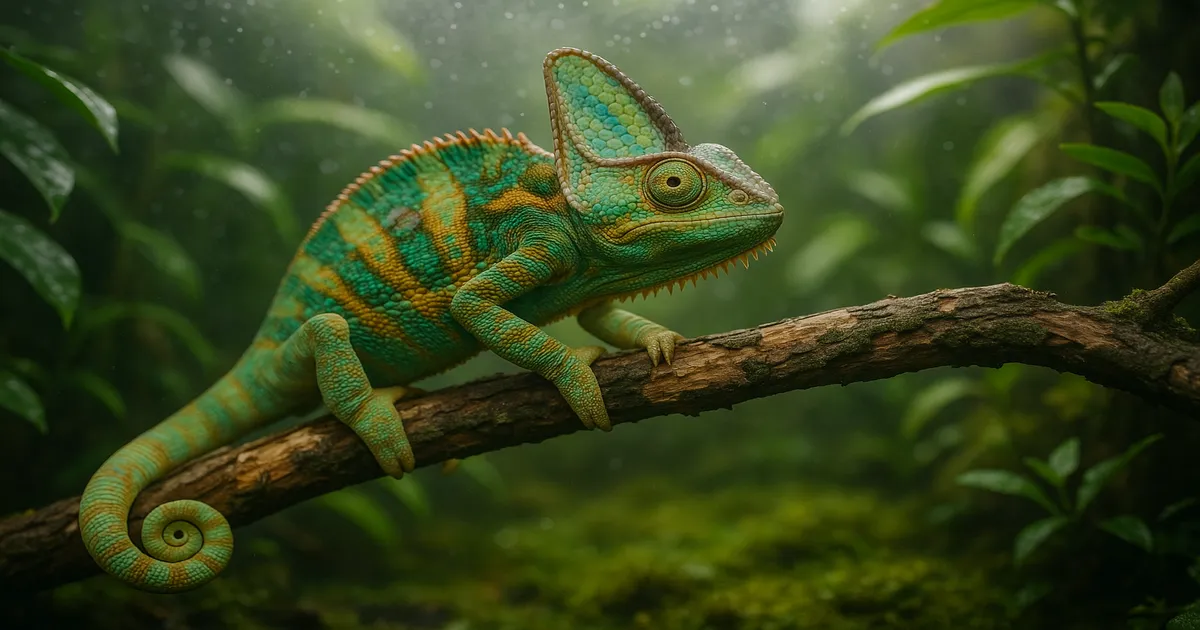
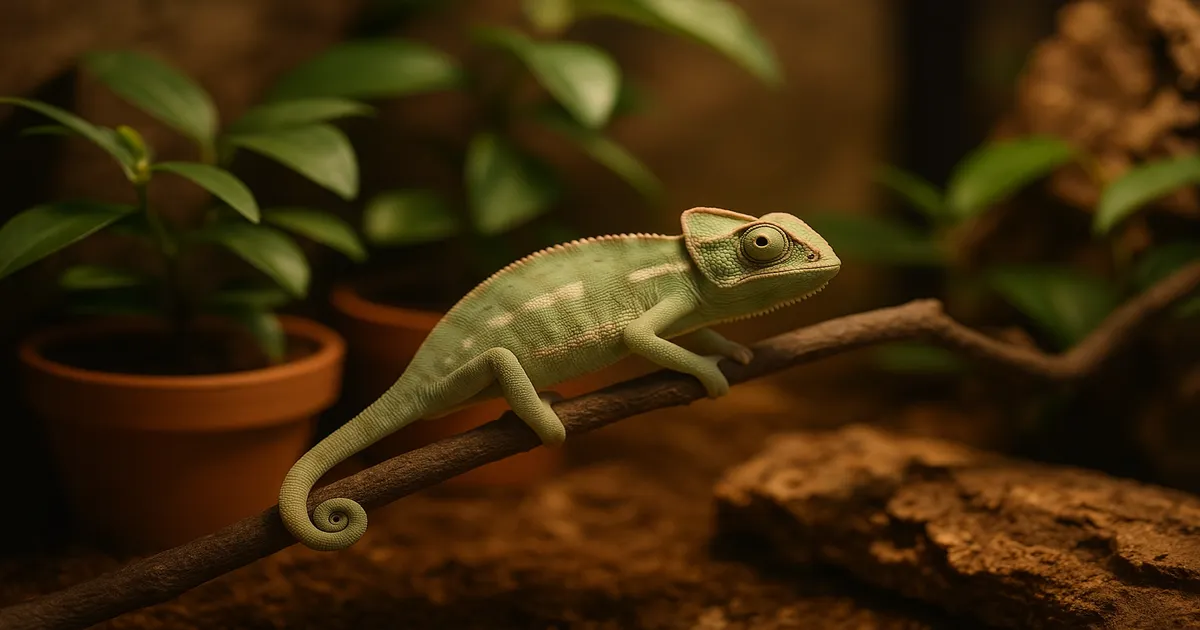
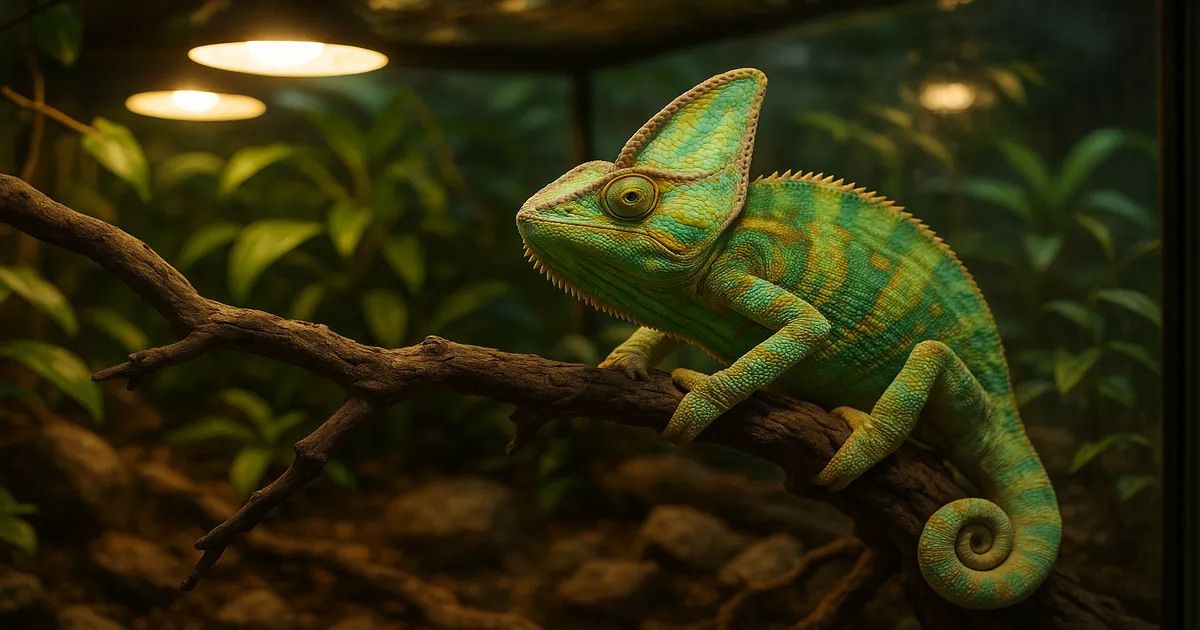
The casque is usually the first place you’ll notice something’s wrong. A healthy adult male’s casque should feel firm and sit upright. If it’s soft, leaning, or visibly deformed, that’s a red flag. From there, MBD progresses to:
- Bowed or rubbery limbs — the long bones lose rigidity
- Spinal kyphosis or scoliosis — abnormal curvature of the spine
- Swollen joints — especially knees and elbows
- Pathological fractures — bones breaking from normal movement, not trauma
Behavioral Changes
A chameleon with advancing MBD can’t grip branches properly. You’ll see slipping, falling, or — the biggest red flag of all — the animal sitting on the enclosure floor. Healthy chameleons almost never come down voluntarily. If yours is on the ground, something is wrong.
Female-Specific Risk
Female veiled chameleons are at higher risk than males because egg production — even infertile clutches — burns through calcium fast. A gravid female with MBD can develop dystocia (egg-binding), which is life-threatening. If your female is showing any MBD symptoms and you suspect she’s carrying eggs, that’s an emergency vet visit today.
What Causes Bone Disease in Veiled Chameleons?
Calcium, Phosphorus, and Vitamin D3
Calcium and phosphorus need to be in roughly a 2:1 ratio (Ca:P) for healthy bone metabolism. The problem is that most feeder insects — crickets, mealworms — have an inverted ratio, with more phosphorus than calcium. Without active supplementation and proper gut-loading, your chameleon is running a chronic calcium deficit.
Vitamin D3 is what makes calcium absorption possible. Without it, it doesn’t matter how much calcium is in the diet — the gut can’t use it. Vitamin A also plays a supporting role, and deficiencies there compound the problem.
Inadequate UVB Lighting
This is the big one. Veiled chameleons synthesize Vitamin D3 in their skin through UVB exposure, the same basic process humans use with sunlight. In the wild they’re getting UVI 6–10+ for hours a day. A coil bulb in the corner of a glass tank doesn’t cut it.
You can supplement D3 orally, and it helps, but it’s less bioavailable than photosynthesized D3 and carries a real toxicity risk if overdone. UVB lighting isn’t a backup plan — it’s the foundation of the whole setup.
Poor Gut-Loading
Buying crickets from a pet store and tossing them straight into the enclosure is one of the most common mistakes I see. Those insects have been sitting in a cup with no food — they’re nutritionally empty. Gut-loading for 24–48 hours before feeding isn’t optional if you want your feeders to actually deliver nutrition.
UVB Lighting: The Most Critical Factor in Preventing Veiled Chameleon Bone Disease
Ferguson Zone 3 and What It Means for Your Setup
Veiled chameleons are Ferguson Zone 3 species — active baskers that seek out significant UV exposure. The target UVI at the basking spot is 2.9–7.4, with a gradient down to near-zero in shaded areas. That gradient matters. The animal needs to regulate its own UV exposure by moving between zones, so don’t make the whole enclosure uniformly bright.
Choosing the Right UVB Bulb
Linear T5 HO fluorescent tubes are the gold standard. The Arcadia 6% T5 HO works well for standard setups; step up to the Arcadia 12% T5 HO for larger enclosures where the bulb sits higher. The Zoo Med Reptisun 10.0 T5 HO is widely available and performs reliably. For large enclosures, mercury vapor bulbs like the Zoo Med PowerSun 100W combine heat and UVB in one unit.
Avoid coil/compact UVB bulbs entirely. Their output is inconsistent and there’s a documented association with photokeratitis in chameleons.
Placement, Distance, and Replacement Schedule
The basking branch should sit 6–9 inches (15–23 cm) below a T5 HO 6% bulb. Closer than that with a high-output bulb risks eye damage; further away and the UVI drops below useful levels. Mount the bulb inside or directly on top of a screen enclosure — never above a glass lid, which blocks UVB entirely.
Replace T5 HO bulbs every 6–12 months. Arcadia rates theirs for 12 months; Zoo Med recommends 6. A bulb that’s still glowing can be producing zero effective UVB — mark the install date on the fixture with a permanent marker and actually stick to the schedule.
The only way to know what UVI your animal is actually receiving is to measure it. The Solarmeter 6.5 is the tool for that job. Standard aluminum window screen blocks 30–50% of UVB; fiberglass blocks even more. Glass and acrylic block it entirely.
Calcium Supplementation and Diet
Supplementation Schedule
- Plain calcium (no D3): Every feeding or every other feeding for juveniles; 2–3 times per week for adults
- Calcium with D3: Once every two weeks (if UVB is dialed in, you don’t need more)
- Multivitamin with preformed retinol: Every 2–4 weeks
My go-to products are Repashy Calcium Plus LoD as an all-in-one that simplifies the schedule considerably, Zoo Med Repti Calcium without D3 for plain dusting, and Zoo Med Herptivite as a multivitamin.
Best Feeder Insects
- Staples: Dubia roaches, crickets, black soldier fly larvae (BSFL/Phoenix worms — naturally high calcium, minimal dusting needed), hornworms
- Occasional: Silkworms, superworms for adults
- Rarely: Waxworms — high fat, poor Ca:P ratio; treat only
BSFL are genuinely underrated. Their calcium profile is naturally excellent, which gives you a useful break from constant dusting.
Gut-Loading
Feed your insects for 24–48 hours before offering them using high-calcium, low-oxalate greens: collard greens, mustard greens, dandelion greens, endive, and escarole are all solid. Add bee pollen and a commercial gut-load like Repashy Bug Burger for a complete nutritional profile.
Avoid spinach (high oxalate binds calcium), iceberg lettuce (nutritionally useless), and excess kale (goitrogenic). Don’t gut-load with random vegetable scraps and consider it done.
Getting Vitamin A Right
Chameleons are poor converters of beta-carotene to retinol. A multivitamin that lists only beta-carotene as its Vitamin A source isn’t going to cut it — you need preformed Vitamin A (retinol). That said, Vitamin A toxicity is real, so every 2–4 weeks is plenty.
How to Treat MBD in a Veiled Chameleon
When to See a Vet Immediately
If your chameleon can’t grip branches, has visible bone deformities or suspected fractures, is spending time on the enclosure floor, or is a gravid female showing any MBD symptoms — that’s a vet visit today. Moderate to severe MBD cannot be fixed at home, and waiting wastes time the animal doesn’t have.
Mild Cases: Fix the Husbandry First
For mild cases — early lethargy, slight casque softness, no visible deformities — correcting the husbandry is the primary treatment. Fix the UVB setup, adjust supplementation, and improve gut-loading simultaneously. Don’t do it one step at a time.
Veterinary Treatment
A reptile vet treating MBD will typically use injectable calcium gluconate to rapidly restore blood calcium levels, along with fluid therapy for dehydrated animals and assisted feeding if the chameleon isn’t eating. Oral supplementation alone isn’t fast enough for moderate to severe cases.
Recovery Timeline
Soft tissue improvement — better energy, improved grip — can show up within a few weeks of correct husbandry. Bone remodeling takes months. Permanent deformities, especially spinal curvature and casque deformation, may never fully resolve. The goal is to stop the progression and give the animal the best quality of life going forward.
Common Mistakes That Lead to MBD
- Using coil/compact UVB bulbs — switch to T5 HO linear tubes
- Not replacing bulbs on schedule — a glowing bulb isn’t necessarily producing UVB
- Blocking UVB with glass, acrylic, or fiberglass screen — the bulb needs a clear line of sight to the animal
- Mounting the bulb too far from the basking spot — at 18+ inches, even a T5 HO 10.0 produces negligible UVI
- Relying on oral D3 instead of UVB — supplements complement UVB; they don’t replace it
- Under-dusting calcium — once a week isn’t enough for juveniles or gravid females
- Using only beta-carotene as Vitamin A — veiled chameleons need preformed retinol
- Skipping gut-loading — unfed insects are nutritionally empty
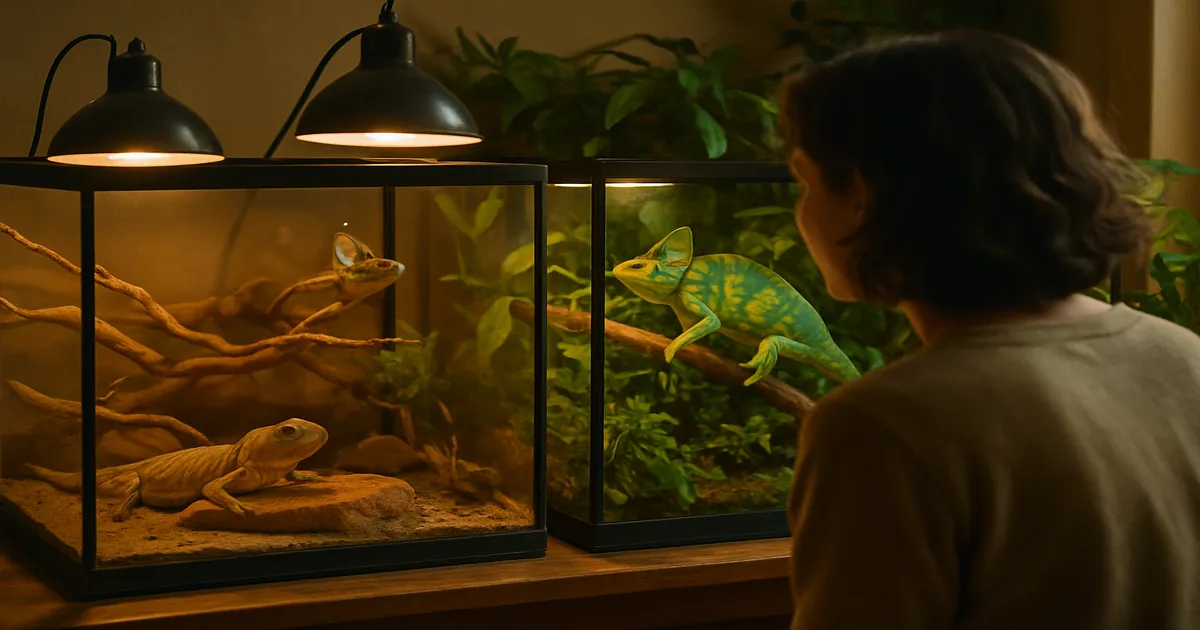
- Keeping the animal in a glass aquarium — heat builds up, airflow is poor, and the animal stresses out seeing its own reflection; screen enclosures aren’t optional for this species
Complete Setup Checklist to Prevent Bone Disease
Enclosure
- Screen cage — Zoo Med ReptiBreeze or Zen Habitats aluminum-framed screen cage
- Adult male minimum: 24×24×48 inches (61×61×122 cm)
- Adult female minimum: 18×18×36 inches (46×46×91 cm) plus a 12-inch (30 cm) deep laying bin
- No glass aquariums
Lighting and Heating
- T5 HO UVB bulb (Arcadia 6% or 12%, Zoo Med Reptisun 10.0) with a reflective fixture
- Basking branch 6–9 inches (15–23 cm) below the UVB bulb
- 12-hour photoperiod; use a timer
- Replace UVB bulb every 6–12 months
- Basking spot: 85–95°F (29–35°C)
- Cool zone: 65–72°F (18–22°C)
- Nighttime drop to 60–70°F (16–21°C)
- Ambient humidity: 50–70%, spiking to 80–100% during misting
Supplementation and Feeding
- Plain calcium (no D3): every feeding or every other feeding (juveniles); 2–3×/week (adults)
- Calcium with D3: once every two weeks
- Multivitamin with preformed retinol: every 2–4 weeks
- Gut-load feeders 24–48 hours before use
- Staple feeders: dubia roaches, crickets, BSFL, hornworms
Monitoring Tools
- Solarmeter 6.5 — verify actual UVI at the basking spot
- Digital thermometer with probe or infrared thermometer gun — confirm basking and ambient temps
- Hygrometer — monitor humidity
- Digital kitchen scale — monthly weight checks
Frequently Asked Questions
Can veiled chameleon MBD be reversed?
Mild MBD can absolutely be reversed with prompt husbandry corrections — fixing the UVB setup, improving supplementation, and better gut-loading. Bone remodeling takes months, and severe deformities like spinal curvature may be permanent. The sooner you catch it, the better the outcome.
How do I know if my veiled chameleon is getting enough UVB?
Measure it with a Solarmeter 6.5 UV Index meter . You’re targeting a UVI of 2.9–7.4 at the basking branch. Don’t assume your bulb is working based on how bright it looks — UVB output degrades invisibly long before the bulb burns out.
How often should I dust my veiled chameleon’s feeders with calcium?
Juveniles need plain calcium (no D3) at every feeding or every other feeding. Adults need it 2–3 times per week. Calcium with D3 goes on once every two weeks for both age groups, assuming your UVB lighting is properly set up.
What’s the difference between MBD and a calcium deficiency?
They’re related but not identical. Calcium deficiency is one cause of MBD, but inadequate UVB (which prevents D3 synthesis) can produce the same result even if dietary calcium looks fine on paper. That’s why fixing the lighting and the diet together matters — addressing only one often isn’t enough.
My chameleon’s casque feels soft. Is that always MBD?
Soft casque is the most common early sign of MBD in veiled chameleons, but it can also occur in very young juveniles whose bones haven’t fully hardened yet, or in animals that are severely dehydrated. If your chameleon is past the juvenile stage and the casque is soft, treat it as MBD until a vet tells you otherwise.