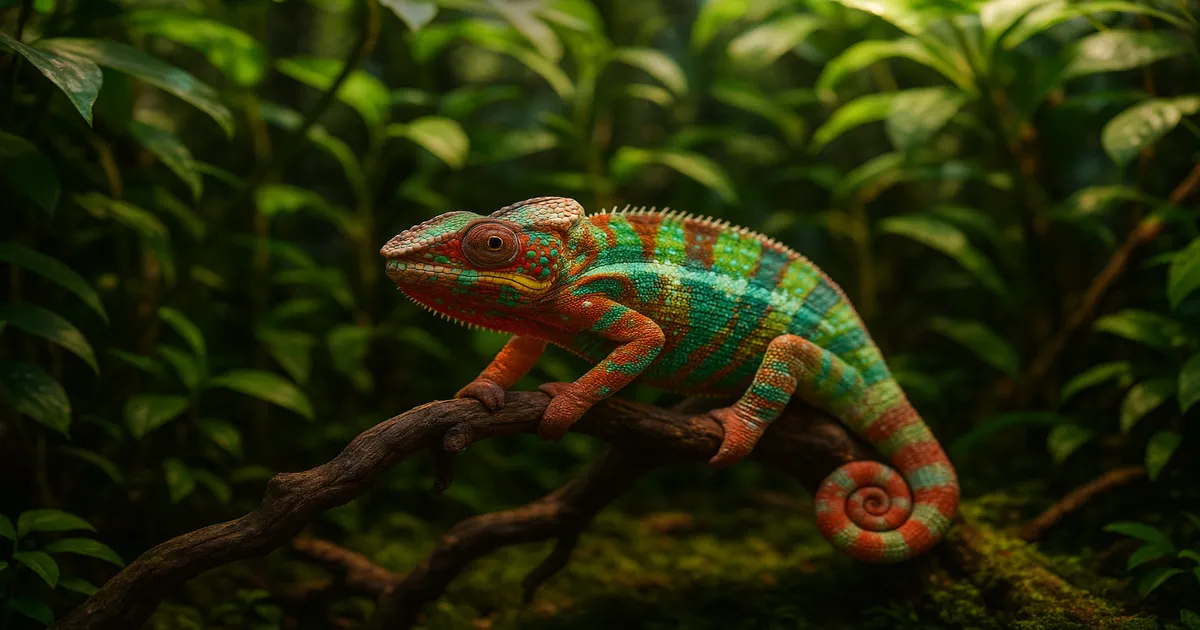
Quick Answer: A panther chameleon that stops eating is almost always reacting to something wrong in its environment — usually temperatures, UVB, hydration, or stress. Less commonly it’s illness, dietary boredom, or natural seasonal cycling. Even a week without food warrants a close look, because panthers don’t carry enough fat reserves to coast through a long fast.
If you’re searching “why is my panther chameleon not eating,” you’re probably worried — and that instinct is correct. Panther chameleons are metabolically sensitive animals, and appetite is one of the first things to go when something’s off. The good news is that most cases have a fixable cause. Let’s work through them.
Why Is My Panther Chameleon Not Eating? Common Causes at a Glance
- Incorrect temperatures — basking spot too cool or too hot, no nighttime drop
- Expired or absent UVB — bulbs lose UV output long before they burn out visually
- Dehydration — suppresses appetite faster than most keepers expect
- Stress — wrong enclosure placement, too much handling, reflections or nearby animals
- Dietary boredom — crickets-only diets lead to flat-out refusal over time
- Illness — MBD, respiratory infections, parasites, tongue injuries
- Seasonal cycling — a natural appetite reduction tied to Madagascar’s dry season
When to Act Immediately vs. When to Monitor
Monitor without panic if your chameleon is newly acquired (1–4 weeks of food refusal during acclimation is common), still drinking, still producing normal feces, and showing good color.
Get to a reptile vet if your animal has lost visible body mass, has sunken eyes or labored breathing, is producing orange or yellow urates, hasn’t eaten in more than 10 days, or aims at prey but won’t — or can’t — strike.
Temperature Problems That Kill Appetite
Panther chameleons are ectotherms. They can’t digest food, trigger immune function, or regulate behavior without the right temperatures — full stop.
The basking spot for adult males should sit between 90–100°F (32–38°C). Females and juveniles do better at 85–90°F (29–32°C). The cool side of the enclosure should stay in the 72–80°F (22–27°C) range. If ambient temperatures — not just the basking spot — creep above 95°F (35°C), you’ll see appetite suppression almost immediately. On the other end, a basking spot below 80°F (27°C) means the animal can’t reach the body temperature needed to digest prey, so it stops eating as a protective response.
The nighttime drop gets skipped constantly. Temperatures should fall to 60–70°F (16–21°C) overnight. That drop is tied to circadian rhythms that regulate feeding behavior, immune function, and rest. Keeping the enclosure at a steady 78–80°F around the clock feels “safe” — it’s actually disrupting the animal’s biology.
On measurement: throw out the dial thermometers. They’re notoriously inaccurate. Use a digital probe thermometer for ambient readings and an infrared temperature gun to check the actual surface temperature of the basking branch (Etekcity Lasergrip 774). The branch surface is what matters, not the air near the bulb.
UVB Problems: A Sneaky Reason Your Panther Chameleon Isn’t Eating
Without adequate UVB, panthers can’t synthesize vitamin D3, which leads to calcium deficiency and eventually metabolic bone disease. One of the earliest signs of MBD isn’t rubbery limbs — it’s appetite loss. By the time you see physical deformity, the problem has been building for months.
Here’s what trips up even experienced keepers: UV output degrades long before the visible light dims. A bulb that still looks bright may be putting out almost no usable UVB. Replace T5 HO bulbs every 6 months (Arcadia’s own recommendation) to 12 months maximum. I lean toward 6 months.
Also — if your enclosure has glass panels and the UVB fixture sits outside the glass, it’s doing essentially nothing. Glass filters out UVB radiation.
The two bulbs I’d recommend without hesitation are the Arcadia 6% or 12% T5 HO and the Zoo Med Reptisun 10.0 T5 HO . Mount the fixture so the basking branch sits 8–12 inches (20–30 cm) below the bulb. Run a 12-hours-on / 12-hours-off photoperiod as your year-round baseline — panthers are strictly daytime hunters, and inconsistent lighting throws off their entire behavioral schedule.
Dehydration: The Hidden Appetite Suppressor
Dehydration kills appetite faster than most people expect, and it’s easy to miss early on. Watch for sunken eyes, skin that tents slightly when gently pinched, lethargy, and — most reliably — orange or yellow urates. Healthy urates are white.
Wild panthers drink dew and rainwater off leaves. A bowl in the enclosure is useless. What works is misting 2–4 times daily, 2–5 minutes per session, using an automatic mister . Daytime humidity should hover around 40–60%, with nighttime and early morning humidity hitting 80–100%.
Use RO water or at minimum dechlorinated tap water. Mineral buildup from hard tap water irritates eyes and nasal passages, which adds stress — and that reduces appetite too.
If your chameleon is visibly dehydrated and not responding to normal misting, try the rain chamber method: place it in a warm (~80°F / 27°C), humid shower environment for 20–30 minutes — not directly under the stream, but in the ambient mist. This often triggers drinking and can jumpstart appetite in animals that are in a downward spiral. It’s not a fix, but it buys time while you address the root cause.
Stress: Why Your Panther Chameleon Won’t Eat Even When Everything Looks Fine
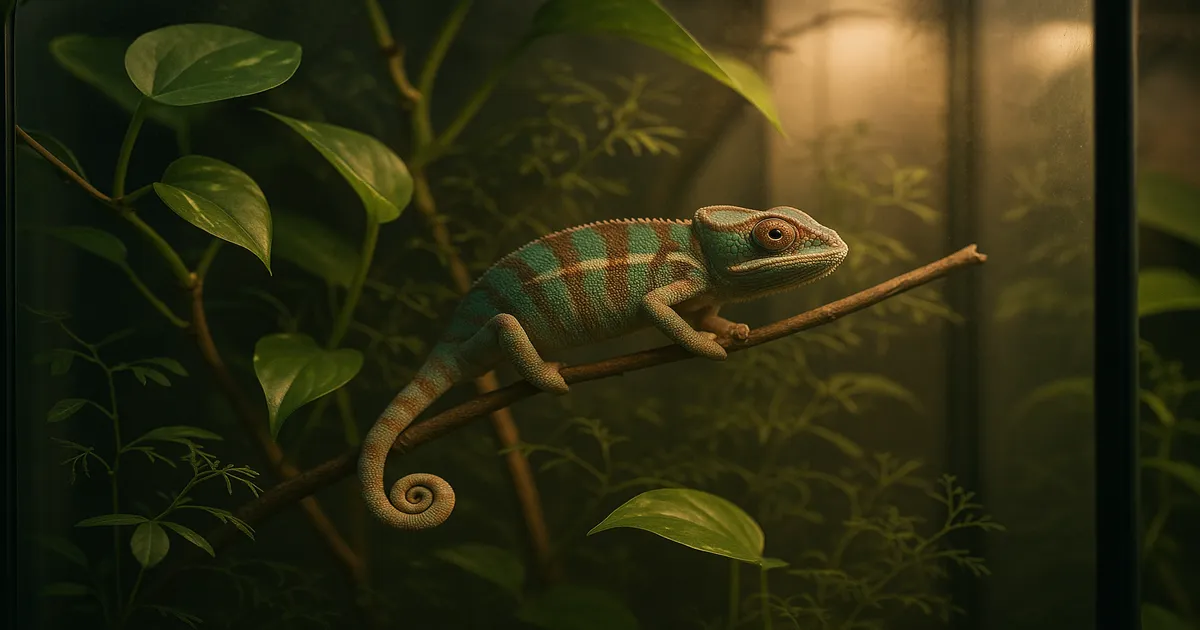
Color is your best diagnostic tool with panthers. A relaxed, feeding-ready male shows bright, vivid coloration. A stressed or unwell animal goes dark, muted, or patchy — even when warm. Learn your individual’s “happy colors” and treat any significant departure as a warning sign.
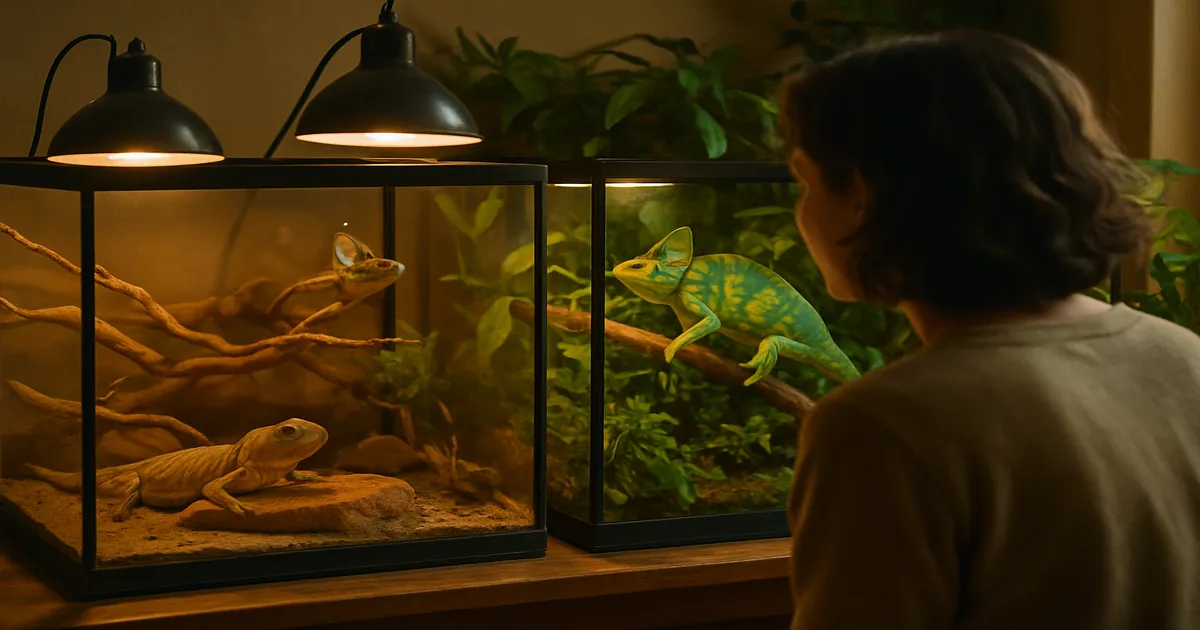
Panther chameleons feel safest when they’re elevated and have visual cover. Enclosures at floor level, in high-traffic hallways, near windows with direct sunlight, or next to other reptile enclosures all cause chronic stress and food refusal. Even seeing their own reflection in glass or PVC panels can make a chameleon behave as if there’s a rival in its territory. Dense live plant coverage — pothos, hibiscus, umbrella plants — gives the animal escape routes and visual security. A chameleon that feels exposed won’t eat.
I’ll be direct about handling: panther chameleons are display animals. Daily handling causes chronic stress. If your chameleon is refusing food and you’ve been handling it regularly, stop. Give it two full weeks of hands-off time and see what happens. One trick I’ve found genuinely useful: set up a small camera like a Wyze Cam and observe remotely. Many panthers eat perfectly well when no one is watching.
Newly acquired animals commonly refuse food for 1–4 weeks. That’s normal acclimation, not illness — provided the animal is still drinking and producing waste.
Feeding Mistakes That Cause Food Refusal
Feeding only crickets is one of the most common mistakes in chameleon keeping. Panthers will flat-out refuse a single feeder species over time, and a cricket-only diet creates nutritional gaps even with solid gut-loading. Rotate at least 3–4 feeder species weekly — dubia roaches, black soldier fly larvae, hornworms, and silkworms make a solid rotation.
Prey should never be larger than the width of the chameleon’s head. Oversized prey causes stress and refusal, and can injure smaller animals. Gut-load your feeders 24–48 hours before offering them using collard greens, dandelion greens, squash, and bee pollen. Feeding your feeders plain lettuce or dry grain is barely better than offering empty calories.
On supplementation: more is not better. Over-supplementing preformed vitamin A (retinol) causes hypervitaminosis A; too much D3 powder causes hypercalcemia. Both suppress appetite. Stick to calcium without D3 at every feeding, calcium with D3 twice a month, and a multivitamin twice a month — and that’s assuming you have proper UVB running.
Some chameleons refuse cup-fed insects and will only respond to free-roaming prey that triggers their natural ambush instinct. If your animal is being picky, try releasing 2–3 dubia roaches directly into the enclosure and walking away. The movement does the work.
Timing matters too. Feed 45–60 minutes after lights come on, once the basking spot is up to temperature. A cold chameleon won’t eat — and if it does, it may regurgitate. Juveniles should eat daily; adult males every other day to every three days.
Health Conditions That Cause Appetite Loss
MBD weakens the hyoid bone — the structure that powers the tongue strike. A chameleon that aims at prey but doesn’t strike, or repeatedly misses, is showing classic tongue dysfunction. Vitamin A deficiency causes similar issues. If you’re seeing this behavior, it’s a vet visit, not a husbandry tweak.
Chronic high humidity — above 70% all day with no drying period — promotes respiratory infections. Signs include wheezing, mucus around the mouth or nostrils, and appetite loss. Internal parasites are another common culprit, especially in wild-caught animals or those from questionable sources. A fecal float at a vet will tell you quickly whether parasites are involved.
Healthy feces are dark brown or black with white urates. Orange or yellow urates mean dehydration. No feces for 7–10 days alongside appetite loss is a reason to call a vet.
Find a vet who is an ARAV member (Association of Reptile and Amphibian Veterinarians) or who lists exotic reptiles as a specialty. A general practice vet seeing their first chameleon is not equipped to diagnose MBD, tongue injuries, or reptile respiratory infections accurately.
Practical Fixes When Your Panther Chameleon Won’t Eat
If you’ve ruled out husbandry issues and your panther is still refusing food, start with hornworms. Their bright color, active movement, and high moisture content make them almost universally effective at triggering a feeding response in reluctant eaters (Manduca hornworms from Symton Black Soldier Fly). I’ve seen animals that hadn’t eaten in two weeks go after a hornworm within minutes.
After the hornworm gets them eating again, transition into a proper rotation: dubia one session, BSFL the next, silkworms after that. Silkworms are particularly good for animals recovering from illness — soft bodies, excellent calcium-to-phosphorus ratio, easy to consume.
If your adult male goes off food in late fall or winter and everything else checks out, this may simply be seasonal cycling. You can ride it out or lean into it intentionally: reduce photoperiod to 10–11 hours, lower temperatures by about 5°F (3°C), and hold those parameters for 6–8 weeks before gradually returning to summer conditions. Many keepers report that this reset dramatically improves appetite when spring conditions are restored.
Frequently Asked Questions
How long can a panther chameleon go without eating?
Adult males can tolerate a fast of roughly 1–2 weeks better than females, who have less metabolic buffer. That said, any fast beyond 7–10 days warrants investigation — even if the animal looks otherwise fine. Don’t assume it’s just being stubborn without checking temperatures, UVB, and hydration first.
Is it normal for a panther chameleon to stop eating in winter?
A modest reduction in appetite during winter is normal and tied to Madagascar’s seasonal dry period. If your husbandry is otherwise correct and the animal is still drinking and producing normal waste, a temporary slowdown isn’t alarming. A complete refusal to eat for weeks on end still needs investigation.
Why does my panther chameleon aim at food but not strike?
This is almost always tongue dysfunction — most commonly caused by MBD weakening the hyoid bone, a tongue injury from a previous miss, or vitamin A deficiency affecting tongue muscle function. This isn’t something you can fix at home. Get a vet who can assess the tongue and run bloodwork.
How do I know if my panther chameleon is dehydrated?
The most reliable signs are sunken or “pitted” eyes, skin that tents slightly when pinched, orange or yellow urates, and lethargy. If you’re seeing any of these, increase misting frequency immediately and try the rain chamber technique while you address the root cause.
Should I force-feed my panther chameleon if it refuses to eat?
No — not without direct veterinary guidance. Force-feeding causes severe stress, risks injury to the mouth and tongue, and doesn’t address whatever caused the refusal in the first place. Fix the environment, stimulate appetite naturally with hornworms or free-roaming prey, and get a vet involved if the animal continues to decline.