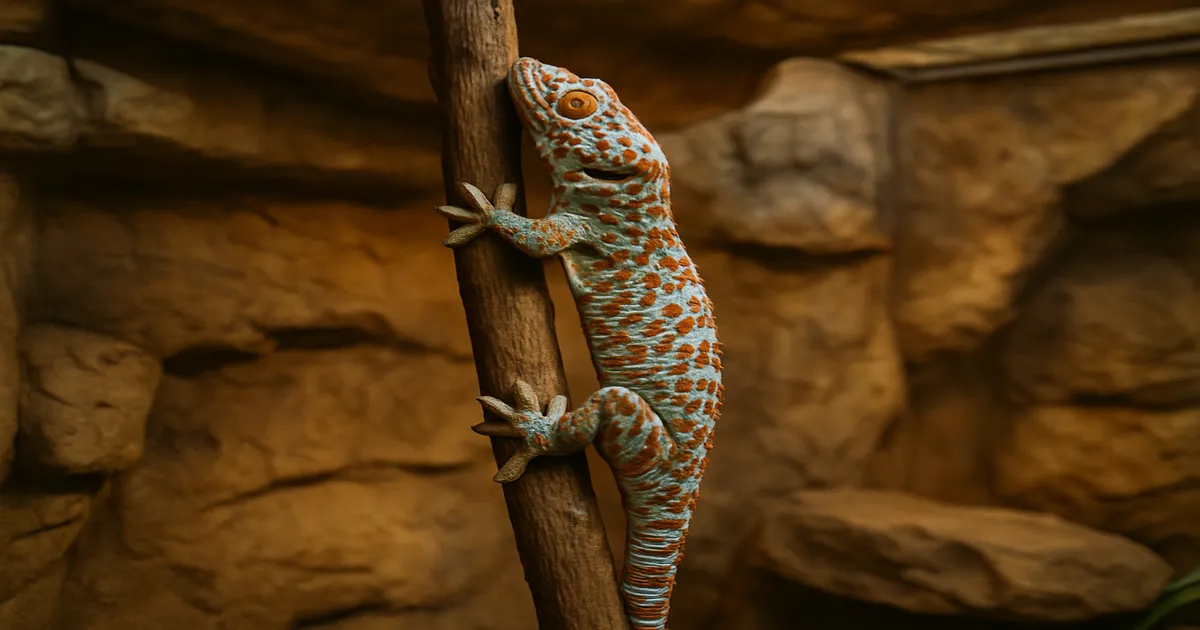
Quick Answer: Yes, you can mount heating inside a tokay gecko enclosure — and for this species, internal mounting is often the better choice. An arboreal animal that lives near the ceiling needs heat coming from above, not from a mat under the floor. Nail three things and you’re good: a thermostat, a physical guard over the heater, and verified clearance between the heat source and any surface your gecko can reach.
Tokay geckos trip up a lot of keepers, and heating is one of the biggest stumbling blocks. The question of whether you can mount heating inside of your tokay gecko’s enclosure if you mount it properly comes up constantly in forums and Facebook groups — usually after someone’s already made a mistake. Internal mounting, done right, solves problems that external heating simply can’t. This guide covers what to use, how to install it, and the mistakes that end with a vet visit.
Can You Mount Heating Inside a Tokay Gecko Enclosure?
Yes — And for Tokays, It’s Often the Right Call
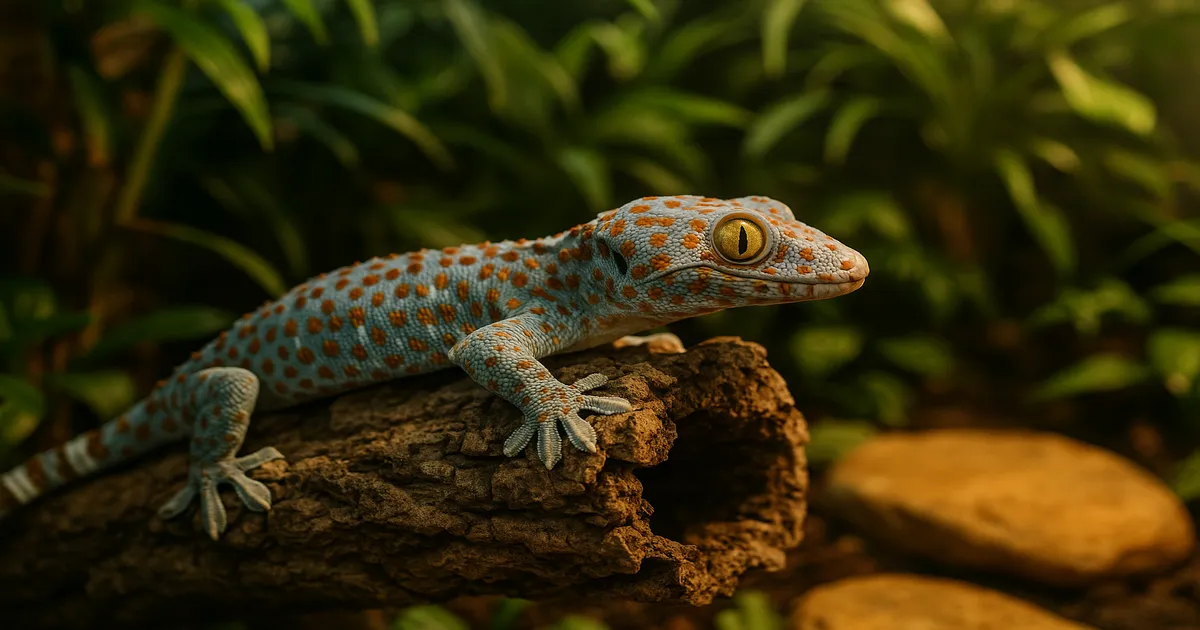
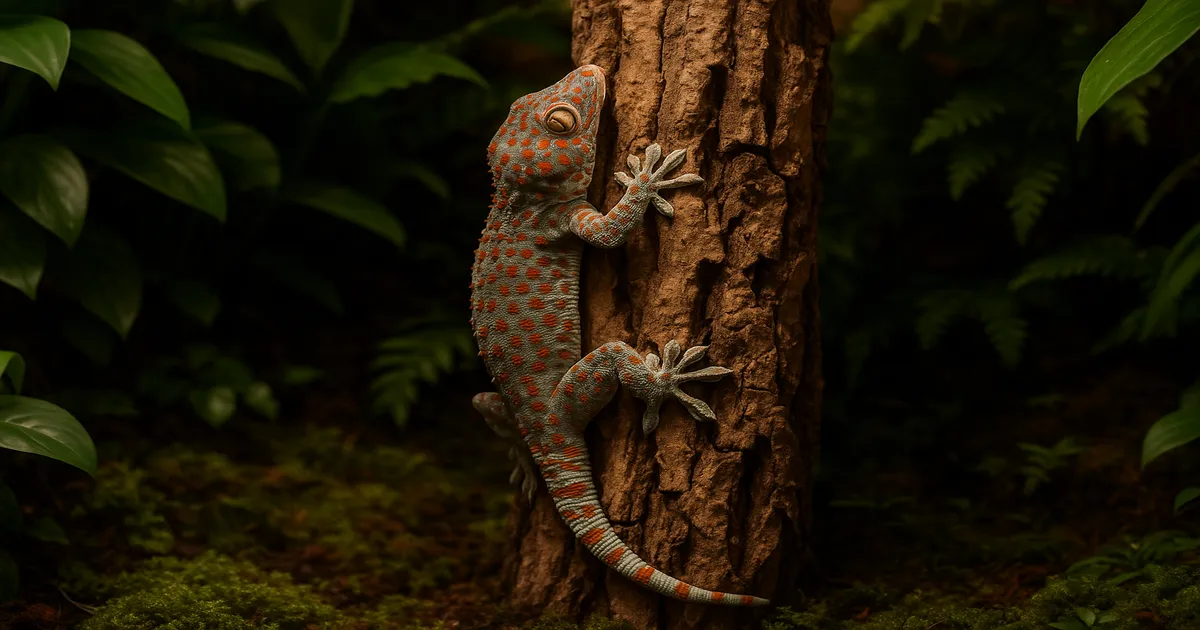
Tokays are arboreal. They spend the vast majority of their time near the top of a tall enclosure, clinging to walls, cork bark, and the ceiling itself. Heating from below — an under-tank heater, an external panel on the floor — creates a gradient that’s completely backwards for an animal living 24–36 inches off the ground.
An RHP or DHP mounted in the upper portion of the enclosure radiates heat downward, toward where your tokay actually lives. That’s not something a floor-level heat source can replicate. The tradeoff is that internal heaters need more careful setup, but the three non-negotiables are straightforward: a thermostat (always), a physical guard over the heater (always), and at least 6–8 inches of clearance between the heater surface and any perch your gecko can reach.
Why Tokay Geckos Have Unique Heating Needs
Heat Must Come From Above
Tokays (Gekko gecko) are native to Southeast Asia — humid tropical forests, rocky outcroppings, and the walls and ceilings of buildings from India to Indonesia. Their lamellae let them cling to virtually any surface, and they’ll use every inch of vertical space you give them. A heat source at floor level is functionally useless to an animal that never touches the floor.
Nocturnal Thermoregulation: No Basking Spot Required
Tokays are crepuscular to nocturnal. They don’t bask the way a bearded dragon does — they thermoregulate by moving between warmer and cooler zones, mostly after dark. What they need is a warm retreat in the upper portion of the enclosure, not a scorching hot spot. You’re not trying to hit 110°F on a basking surface. You’re creating a warm zone that hovers around 88–92°F (31–33°C) at the surface, with ambient air temps in the 82–86°F (28–30°C) range on the warm side.
Target Parameters
- Warm side ambient: 82–86°F (28–30°C)
- Cool side ambient: 75–78°F (24–26°C)
- Warm zone surface: 88–92°F (31–33°C)
- Nighttime drop: 68–74°F (20–23°C) — don’t skip this
- Daytime humidity: 60–70% RH
- Post-misting humidity: 80–100% RH
A 10–15°F difference between the warmest and coolest accessible zones isn’t optional — it’s a biological necessity. Without a gradient, your tokay can’t regulate its body temperature, and chronic thermal stress follows. Internal mounting makes achieving a proper top-to-bottom gradient far more achievable than any external approach.
Best Internal Heaters for Mounting Inside a Tokay Gecko Enclosure
Radiant Heat Panels: The Ceiling-Mount Champion
RHPs are my first recommendation for tokay enclosures. They mount to the interior ceiling, emit gentle infrared heat downward, and run at much lower surface temperatures than ceramic heat emitters. For an 18” × 18” × 36” enclosure, a 40–60W panel is the right range. They’re also the easiest to guard properly — flat panels rather than protruding bulb fixtures. An on/off thermostat works fine with RHPs.
Deep Heat Projectors: Deep Tissue Warmth With Lower Surface Risk
Arcadia’s Deep Heat Projector emits long-wave infrared (IRA) radiation that penetrates tissue more deeply than a standard CHE, more closely mimicking actual solar warmth. Surface temps run lower than a ceramic emitter, which makes them more forgiving for internal use — though a guard is still mandatory. A 50–80W DHP paired with a proportional thermostat is a genuinely excellent combination for this species.
Ceramic Heat Emitters: Effective but Highest Burn Risk
CHEs work, but they’re the riskiest option for internal mounting. The element itself can exceed 400°F (204°C), and a tokay’s lamellae will let it cling to the underside of an unguarded fixture without any hesitation. The burns that result are often fatal or permanently disfiguring. If you go with a CHE, use a deep-dome ceramic socket fixture, mount it in the upper rear corner, and surround it completely with a metal mesh guard that’s physically secured to the enclosure walls — not just resting against them. A pulse or proportional thermostat is the right pairing.
What to Skip
Heat tape isn’t appropriate for internal use in a tokay setup. It’s hard to guard properly, not designed for high humidity, and creates flat contact surfaces that are easily reached. Under-tank heaters can supplement in some setups, but as a sole heat source for a tokay, they’re nearly useless — the heat dissipates long before it reaches the top of a 36-inch enclosure.
How to Mount Internal Heating Safely
Mounting Position: Upper Rear Corner, Not Dead Center
Don’t mount your heater dead center on the ceiling. That creates a uniform heat zone with no gradient — your gecko has nowhere cooler to retreat to at the top of the enclosure. Position your RHP, DHP, or CHE fixture in the upper rear corner. This gives you a natural gradient from warm (back, top) to cool (front, bottom), and your gecko gets real thermoregulatory choices.
Installing a Physical Guard
For RHPs, make sure the panel is mounted flush enough that the gecko can’t wedge itself behind it, and that any accessible edge is covered. For CHEs and DHPs, build or buy a guard from ¼” or ½” stainless steel or powder-coated hardware cloth — avoid galvanized mesh in a high-humidity enclosure, since zinc can leach. Secure it with stainless steel screws or bolts. Tokays are strong and persistent, and a guard that’s just resting in place won’t stay there.
Thermostat and Probe Placement
Run the heater through your thermostat before anything else gets plugged in. Place the probe 6–10 inches below the ceiling, in the gecko’s primary activity zone — not on the heater surface. A probe on the heater surface reads the heater’s temperature, not the air your gecko is actually in. That single mistake will have your enclosure running far too hot or cold at animal level. (Herpstat 2)
Seal Wire Penetrations
Any hole you drill through the enclosure wall for wiring needs to be sealed with aquarium-safe silicone once the wires are routed. Humidity wicks along cables and into electrical components if you leave gaps. Most people skip this step. It causes equipment failures and potential shock hazards.
The 72-Hour Test Run
Run the full setup — heater, thermostat, misting schedule — for at least 72 hours before your tokay goes in. Use a data logger to track temps overnight and check every perch near the heater with an infrared temp gun. (Govee Temperature Humidity Sensor H5179) Fix problems before the animal is in the enclosure, not after.
Common Mistakes When Mounting Internal Heaters
Skipping the thermostat or guard. No thermostat means potential lethal overheating. No guard means burn injuries. These aren’t edge cases — they’re predictable outcomes.
Wrong probe placement. Probe on the heater surface means the thermostat shuts off before the enclosure actually warms up, or lets it run hotter than you think at animal level. The probe goes in the gecko’s activity zone.
Perches too close to the heat source. Perches look fine until you check them with an infrared temp gun and find they’re sitting at 115°F. Always verify surface temps after your full setup is running. 105°F (40°C) is the hard ceiling for any surface your tokay can contact.
Misting directly onto electrical components. Position your heater away from the direct path of your misting nozzle. If you’re using an automated mister, test where the spray actually lands before mounting anything electrical nearby. (Etekcity Lasergrip 774)
Ignoring nighttime temperature drops. A lot of keepers nail the daytime temps and forget that tokays need a drop to 68–74°F (20–23°C) at night. If your thermostat is maintaining daytime temps around the clock, you’re creating chronic low-level stress. Set a nighttime setback, or use a timer.
Underestimating tokay aggression during maintenance. Tokays bite hard, lock their jaws, and don’t care that you’re just adjusting a wire. Move your gecko to a secure holding container before you reach into the enclosure to work on internal hardware. Use a hook or target stick. This isn’t a disclaimer — it’s practical advice from people who’ve bled for skipping it.
Pro Tips for a Safe Internal Heating Setup
Use cork bark tubes for self-regulation. Position hides so one end sits closer to the warm zone and the other extends toward the cool side. Your tokay will position itself within the tube based on what temperature it needs. It’s a simple strategy that works beautifully with internal heating.
Disguise the wire guard. A bare metal guard will attract your tokay’s attention constantly. Wrap it in cork bark veneer or integrate it into your foam background. A well-disguised guard is less likely to be obsessively investigated, and it looks far better than a cage-within-a-cage aesthetic.
PVC and custom builds outperform glass. Glass enclosures like the Exo Terra work, but PVC and custom plywood builds retain heat and humidity significantly better — and they’re much easier to drill clean holes through for wire routing. If you’re setting up a permanent adult enclosure with internal heating, a custom PVC build is worth the investment. (Animal Plastics T8)
Quarantine first, complex setup second. A new tokay should spend 60–90 days in a simple quarantine setup — paper towels, a few hides, basic heating — before going into a complex enclosure with internal heating hardware. Establish baseline health, check for parasites, and get a read on the animal’s temperament before you’re reaching into a planted enclosure full of internal fixtures.
Frequently Asked Questions
Can I mount heating inside of my tokay gecko’s enclosure without burning them?
Yes, with two conditions: a physical guard completely surrounding the heater, and verified clearance of at least 6–8 inches between the heater and any surface your gecko can reach. Check every perch and climbing surface with an infrared temp gun before the gecko goes in. Nothing your tokay can contact should exceed 105°F (40°C).
Where should I place the thermostat probe for an internal heater?
At your gecko’s primary activity level — for tokays, that’s 6–10 inches below the ceiling on the warm side. Never place it directly on the heater surface; that gives you the heater’s temperature, not the ambient temperature your gecko is experiencing.
Do tokay geckos need a basking light or just a heat emitter?
They don’t need an intense basking light the way diurnal lizards do. A heat emitter providing a warm zone of 88–92°F (31–33°C) handles thermoregulation. Low-output UVB is increasingly recommended even for nocturnal species, but that’s a separate question — your tokay doesn’t need a hot spot to stand under.
Why isn’t an under-tank heater enough for a tokay gecko?
Under-tank heaters warm the floor, and tokays almost never touch the floor. In a 36-inch-tall enclosure, the heat from a UTH dissipates well before it reaches the upper zone where the gecko actually lives — creating a gradient that’s warmest at the bottom and coolest at the top. That’s exactly backwards for this species.
Can a radiant heat panel overheat a tokay enclosure?
Yes, if it’s not connected to a thermostat. Without temperature regulation, any internally mounted heater can superheat a sealed enclosure. With a properly calibrated thermostat and correct probe placement, RHPs are actually one of the gentler, more controllable internal heating options available — their surface temperatures are much lower than a CHE running at full power.