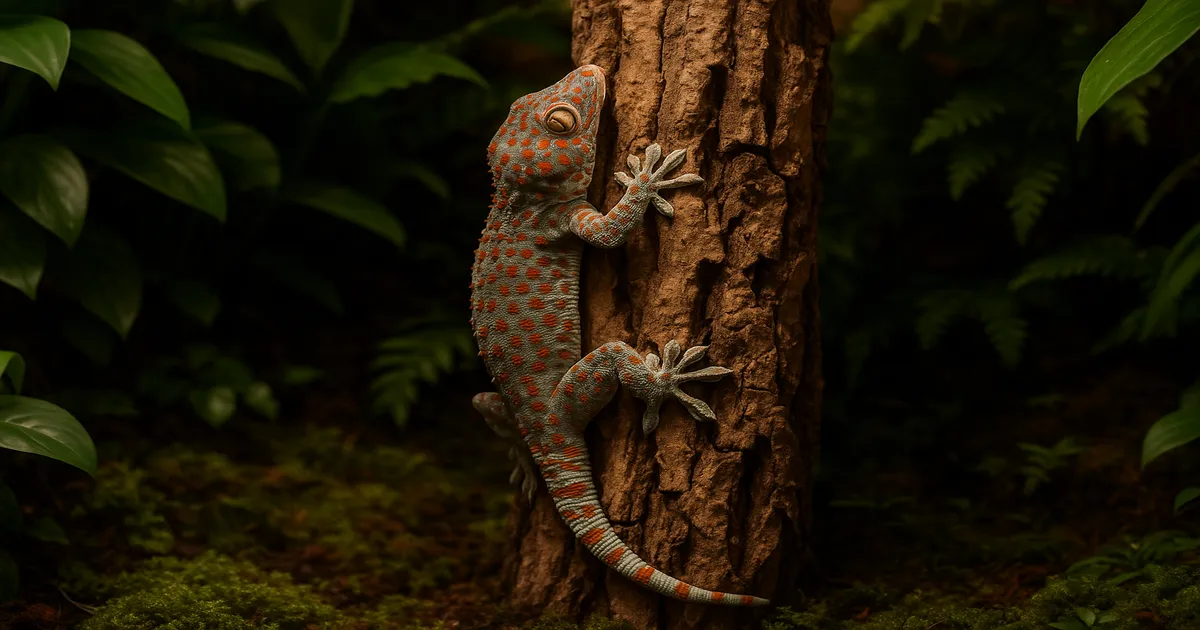
Quick Answer: Tokay geckos (Gekko gecko) are stunning, long-lived lizards that need tall, humid enclosures, a varied insect diet, and a keeper who won’t flinch at a loud call or a powerful bite. They’re best suited to experienced reptile keepers — but with the right setup and patience, they’re genuinely rewarding animals.
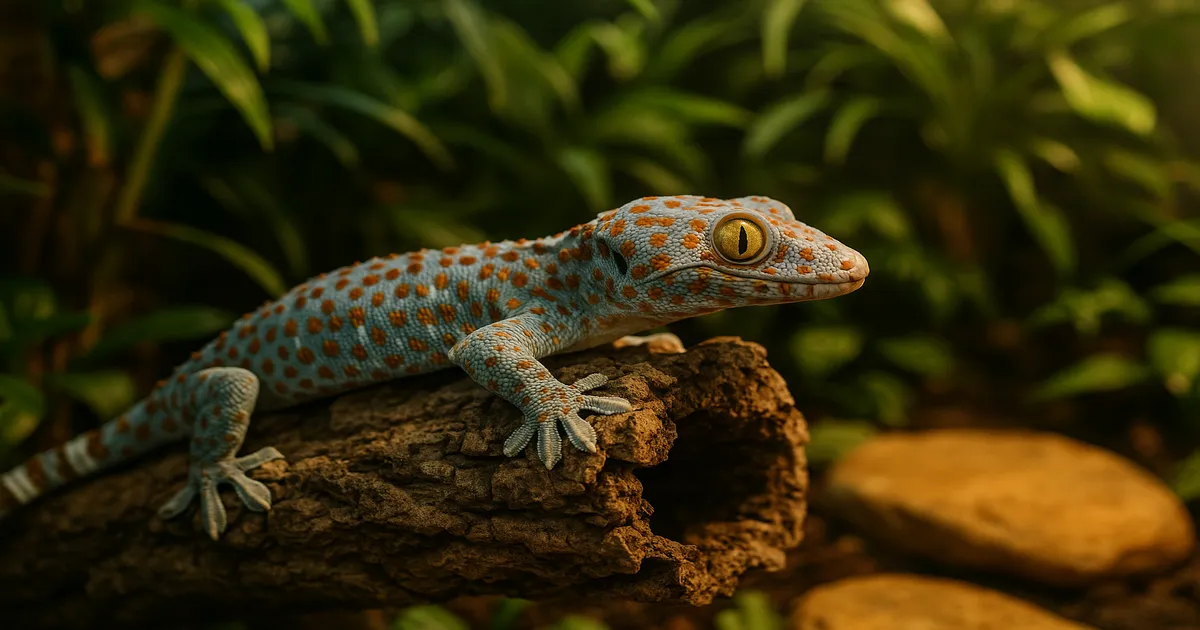
Knowing how to take care of a tokay gecko properly starts with one honest admission: these are not beginner pets. They’re among the most visually striking geckos in the hobby — vivid blue-gray with orange spots, built like a tank — but they come with a bite that draws blood and a territorial scream that’ll wake your neighbors. Get the setup right and respect the animal’s nature, though, and you’ve got a gecko that can live 15 years or more.
Tokay Gecko Care at a Glance
| Parameter | Value |
|---|---|
| Adult size | 10–14 inches (25–35 cm) |
| Lifespan | 10–15 years (up to 20+ reported) |
| Temperature range | 75–92°F (24–33°C) |
| Humidity | 60–80% |
| Feeding frequency | 2–3× per week (adults) |
| Difficulty level | Intermediate to advanced |
Is a Tokay Gecko Right for You?
If you want a handleable, low-drama gecko, get a crested gecko or a leopard gecko. Tokays are display animals first — interactive ones eventually, with real work — and some individuals never fully tame down no matter what you do. Be honest with yourself before buying:
- The bite is serious. A large adult clamps down hard and holds. This isn’t a nip — it’s a grip that can break skin and won’t let go.
- The call is genuinely loud. Males hit 80–90 decibels, roughly comparable to a lawnmower. They call most at night and ramp up during breeding season.
- Always buy captive-bred. Wild-caught imports are heavily parasitized, chronically stressed, and far more aggressive. The difference between a CB and WC tokay is night and day.
Natural History: Why It Matters for Care
Tokays are native to South and Southeast Asia — India, Nepal, Indonesia, the Philippines, Thailand, Vietnam, and beyond. They evolved in tropical monsoon climates: warm year-round, high humidity, and distinct wet and dry seasons. That’s what you’re replicating in captivity, and understanding it makes every care decision make more sense.
They’re obligate arborealists. These geckos spend virtually their entire lives on vertical surfaces — tree trunks, cliff faces, building walls, ceilings. Their lamellae (the microscopic toe-pad structures) grip glass effortlessly, which is worth keeping in mind every time you open the enclosure. They’re also crepuscular to nocturnal, hunting large invertebrates and small vertebrates — mice, smaller lizards, even small snakes — through the night.
That diet and that lifestyle explain a lot about their temperament. These are confident, aggressive animals because they’re built to be apex hunters in their niche. Males are fiercely territorial and will fight viciously with other males. Even females can be aggressive when stressed. The famous “TO-kay!” call is a territorial and breeding display — loud, repeated, and unmistakably reptilian. Captive-bred animals are significantly calmer than wild-caught ones, but even a CB tokay raised from a hatchling will go through defensive phases. Respect that. It’s not aggression for aggression’s sake.
Tokay Gecko Enclosure Setup
Size and Orientation
The absolute minimum for a single adult is 18” W × 18” D × 24” H (45 × 45 × 60 cm) — and honestly, that’s tight. I’d call 18” × 18” × 36” (45 × 45 × 90 cm) the real practical minimum for a comfortable long-term setup. For a pair, go bigger: 24” × 18” × 36” (60 × 45 × 90 cm) or a custom build.
Height is the priority. Floor space matters far less than vertical real estate for a gecko that lives on ceilings.
Front-opening glass terrariums are the best choice for most keepers — the Exo Terra tall series and Zoo Med Naturalistic Terrarium are purpose-built for this kind of setup. Screen-only enclosures work but make humidity maintenance significantly harder. Converted aquariums can work in a pinch but lack front-opening access, which makes every maintenance session more stressful for the animal.
Substrate
For a bioactive setup — which I strongly recommend — use a mix of coco fiber, organic topsoil, orchid bark, and sphagnum moss at roughly a 60/20/10/10 ratio. Add a drainage layer (LECA or clay balls under a mesh screen) and stock it with springtails and isopods. Substrate should be at least 3–4 inches (7–10 cm) deep to support plant roots and microfauna.
If you want to keep it simple, coco fiber alone works fine. Paper towels are the go-to for quarantine. Avoid sand, gravel, and reptile carpet — the first two risk impaction, and carpet harbors bacteria and snags toenails.
Decor and Plants
A well-furnished enclosure reduces stress — this isn’t just aesthetics. Tokays feel secure with tight-fitting hides on vertical surfaces. Cork bark tubes are ideal; the diameter matters more than most keepers realize. It should be just snug enough for the gecko to fit inside. Too roomy and it won’t feel like shelter.
Add bamboo tubes, branches, and vines at multiple heights. For live plants, pothos, bromeliads, snake plants, and philodendrons all tolerate the humidity and light levels well. Bromeliads are especially useful — tokays will drink from the water pooled in their cups.
Temperature, Lighting, and Humidity
Thermal Gradient
- Ambient daytime: 80–85°F (27–29°C)
- Warm end: 88–92°F (31–33°C)
- Cool end: 75–78°F (24–26°C)
- Nighttime: 72–75°F (22–24°C)
- Absolute minimum: 68°F (20°C)
- Absolute maximum: 95°F (35°C) — don’t push it; tokays overheat faster than many keepers expect
One thing worth emphasizing: the warm zone should be on a vertical surface or upper branch, not a flat basking stone on the floor. These animals thermoregulate while clinging to surfaces.
Use overhead radiant heat as your primary source — a halogen flood or incandescent bulb on a proportional thermostat (Herpstat 1). Under-tank heaters are not appropriate for arboreal species. Tokays rarely touch the substrate, and a UTH can cause thermal burns if one does rest on the floor. A thermostat isn’t optional.
If your room drops below 70°F (21°C) at night, add a ceramic heat emitter on a thermostat. Never use red or blue “night” bulbs — geckos perceive those wavelengths and they disrupt sleep cycles, causing chronic low-level stress.
UVB and Photoperiod
The evidence for UVB in nocturnal geckos has grown considerably, and at this point I think it’s worth providing. Low-output options like the Arcadia ShadeDweller Pro work well for this species. Position T5 HO bulbs 12–18 inches (30–45 cm) from the gecko’s typical resting spots.
Run 12–14 hours of light in summer and 10–12 hours in winter. This seasonal variation matters for long-term health and is important if you ever plan to breed. An automatic timer makes this effortless.
Humidity
Target 60–80% overall, with spikes to 80–90% right after misting and natural drops to 55–65% during the day as the enclosure dries out. That cycling pattern mirrors the monsoon climate these geckos evolved in — it’s not just about hitting a number, it’s about the rhythm.
Stagnant high humidity with poor ventilation is genuinely dangerous. It’s a fast path to respiratory infections and fungal growth. Airflow matters as much as moisture level.
An automatic misting system (MistKing Starter Version 4.0) set to run once or twice daily is the most reliable approach. Hand misting with a pressure sprayer works fine for smaller setups — just be consistent. Pair whatever you use with a digital hygrometer that has min/max memory so you can see how far your humidity is actually swinging. Flying blind on humidity is one of the most common mistakes I see.
Feeding Your Tokay Gecko
The core of a tokay’s diet should be gut-loaded dubia roaches and crickets, supplemented with variety: superworms, hornworms, and silkworms are all excellent. Waxworms are fine occasionally — maybe once a month — but they’re high in fat and will cause problems if they become a staple.
Adult tokays should also receive a pinky or fuzzy mouse once or twice a month. This isn’t just a treat — it’s a nutritionally appropriate food source for a gecko that eats small vertebrates in the wild.
Feeding frequency:
- Juveniles (under 6 months): Daily or every other day
- Sub-adults (6–12 months): Every other day
- Adults: 2–3 times per week
Keep prey no wider than the space between the gecko’s eyes. For adults, that means they can handle surprisingly large feeders — but err slightly smaller rather than risk regurgitation.
Supplementation:
- Calcium + D3: Every other feeding
- Multivitamin (Repashy Calcium Plus or Herptivite): Once weekly
- If providing UVB: Reduce D3 dusting to once weekly
Always use long feeding tongs. Never hand-feed a tokay. Even a tame one can misjudge and lock onto a finger — and that bite is genuinely hard to remove.
Keep a shallow, heavy water dish available at all times. Many tokays prefer to drink droplets off the glass after misting; you’ll often see them lapping water off the walls. Both methods work.
Handling and Taming a Tokay Gecko
Taming a tokay takes months, not days. Some individuals come around significantly; others stay defensive their whole lives. If you go in expecting a handleable gecko on a 30-day timeline, you’ll be disappointed and the gecko will be stressed.
The approach that actually works:
- Open the enclosure daily without reaching in. Just let the gecko observe you.
- Offer food from tongs without pressing closer than the gecko tolerates.
- Over several weeks, gradually move the tongs closer to your body.
- Eventually offer food from a gloved hand, letting the gecko choose to approach.
- Only attempt to touch or pick up the gecko once it’s consistently taking food calmly.
Never force interaction. A tokay that’s grabbed before it’s ready will bite hard, hold on, and twist — and that sets your taming progress back significantly. Patience isn’t just a virtue here; it’s the whole strategy.
Any new gecko — captive-bred or not — should go into a separate quarantine enclosure for 60–90 days minimum. Keep it simple: paper towels, a hide, a water dish, basic heat and humidity. Get a fecal test done by a reptile-experienced vet to check for pinworms, coccidia, and other parasites. Wild-caught animals almost universally carry significant parasite loads, even when they look healthy.
Common Tokay Gecko Care Mistakes
- Buying wild-caught animals. This is the single biggest mistake you can make. WC tokays are stressed, parasitized, and defensively aggressive in ways that make taming extremely difficult. Always source captive-bred from a reputable breeder.
- Too short an enclosure. Chronic stress for an arboreal animal. Height first, always.
- Poor ventilation with high humidity. Leads to respiratory infections and fungal growth fast.
- Red or blue night bulbs. Use a ceramic heat emitter instead.
- No thermal gradient. A single temperature throughout the enclosure isn’t enough — the gecko needs to thermoregulate.
- Skipping calcium supplementation. Metabolic bone disease is entirely preventable.
- Over-relying on waxworms. Fatty liver disease over time. Once a month, maximum.
- Housing two males together. They will fight, and the injuries can be severe.
- Overhandling before acclimation. Let the gecko set the pace.
- Skipping quarantine. Non-negotiable, even for captive-bred animals.
Frequently Asked Questions About Tokay Gecko Care
Are tokay geckos good pets for beginners?
No. Tokay geckos have a powerful, tenacious bite, loud vocalizations, and require consistent environmental management that’s easier for keepers with some reptile experience. They can be genuinely rewarding, but they need a keeper who understands and respects their nature from day one.
How do I take care of a tokay gecko’s basic daily needs?
Daily care involves checking temperatures and humidity, misting the enclosure (morning and evening if hand-misting), refreshing the water dish, and spot-cleaning any waste. Feeding happens 2–3 times per week for adults. Beyond that, just observe — changes in behavior or appetite are usually the first sign something’s off.
How do I tame an aggressive tokay gecko?
Use the ignore-and-reward method: open the enclosure daily without reaching in, offer food from tongs consistently, and let the gecko set the pace. Never force handling. Taming takes patience measured in months, and captive-bred animals respond significantly better than wild-caught ones.
What size enclosure does a tokay gecko need?
The practical minimum for a single adult is 18” × 18” × 36” (45 × 45 × 90 cm). Height matters more than floor space — tokays are arboreal and spend most of their time on vertical surfaces. The 18” × 18” × 24” you’ll see listed as a minimum elsewhere is workable but genuinely tight for a long-term setup.
How long do tokay geckos live in captivity?
With proper care, tokay geckos typically live 10–15 years. Well-kept individuals have reportedly exceeded 18–20 years. Captive-bred animals, consistent husbandry, and good nutrition are the biggest factors in reaching that upper end.