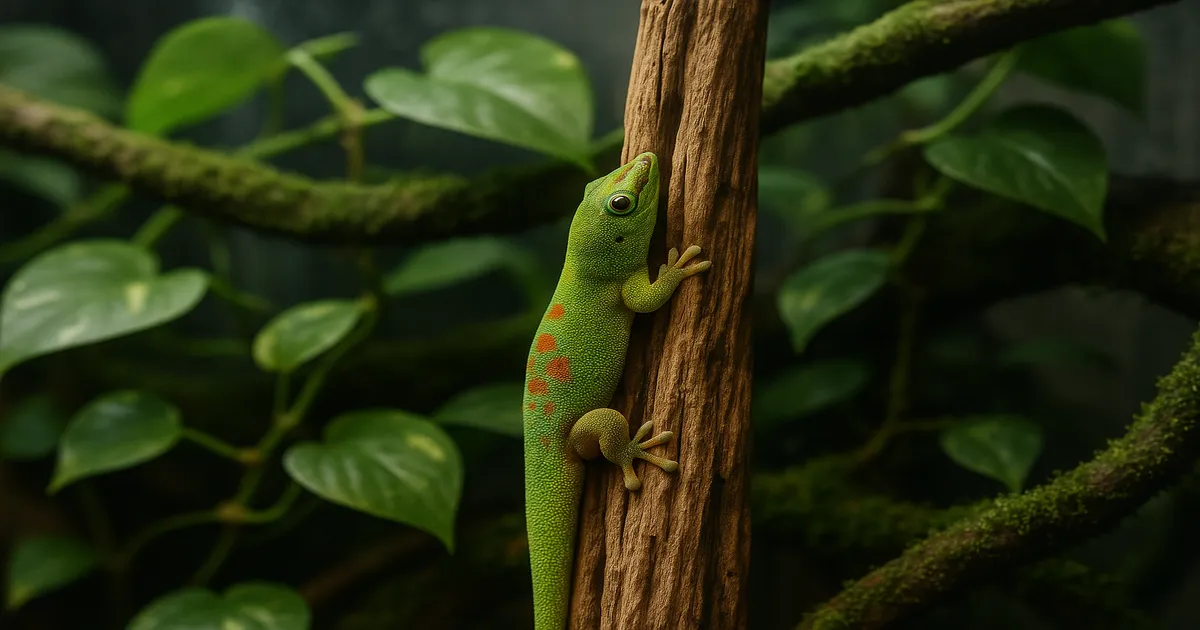
Quick Answer: Gold dust day geckos (Phelsuma laticauda) are stunning, diurnal display animals that need a vertical enclosure, proper UVB lighting, twice-daily misting, and a mixed insect-and-nectar diet. They’re not handleable pets — they’re living art. Get the setup right and they’ll thrive for 6–10 years.
If you’re researching how to care for a gold dust day gecko, you’ve probably already been stopped dead by how beautiful they are. That vivid green body dusted with gold flecking near the shoulders is genuinely hard to look away from. But Phelsuma laticauda is also a species that punishes lazy husbandry fast. Get the lighting wrong, skip misting for a couple of days, or make the rookie mistake of housing two males together, and you’ll have problems. This guide covers everything you need to do it right.
Gold Dust Day Gecko: Species Snapshot
| Feature | Detail |
|---|---|
| Scientific name | Phelsuma laticauda |
| Adult size | 4–6 inches (10–15 cm) |
| Lifespan | 6–10 years (12+ possible) |
| Activity | Strictly diurnal |
| CITES status | Appendix II |
| Experience level | Intermediate |
Is a Gold Dust Day Gecko Right for You?
These are display animals, full stop. They’re fast, they stress easily, and their skin is delicate enough that regular handling causes real harm. If you want a gecko you can take out and show friends, get a crested gecko or a leopard gecko instead — no shame in that.
What gold dust day geckos offer is something different: a naturalistic, active, behaviorally rich animal you can watch throughout the day. Set up a planted enclosure and they’ll reward you constantly. Just don’t expect them to sit on your hand.
Natural History: Why It Matters for Care
Phelsuma laticauda originates from northern Madagascar and the Comoros Islands, where it lives in warm, humid tropical environments — banana plantations, bamboo groves, coconut palms. There are also well-established feral populations in Hawaii, particularly on the Big Island and Oahu, where the climate suits them perfectly.
They’re arboreal and heliophilic, meaning they seek out vertical surfaces and bask intensely in direct sun. Not casual basking — prolonged exposure to high-UV environments. That single fact explains why UVB lighting is non-negotiable in captivity.
Males are aggressively territorial. In the wild they have enough space to establish boundaries; in a small enclosure, two males will fight until one is seriously injured or dead. Females can be combative too, though less reliably so. Their adhesive toe pads let them move effortlessly across smooth glass and leaves, and like most geckos they can drop their tail as a predator defense. It regrows, but it never looks quite the same.
Enclosure Setup for Gold Dust Day Geckos
Size and Type
The minimum for a single adult is 12” W × 12” D × 18” H (30 × 30 × 45 cm). For a pair, go with 18” W × 18” D × 24” H (45 × 45 × 60 cm) — it gives you room for proper thermal gradients and enough territory that the female isn’t constantly harassed. Front-opening glass terrariums are the right call here; they minimize disturbance during maintenance and let you observe the gecko without looming over it from above, which reads as a predator threat.
Horizontal tanks are a waste. This species lives vertically, and floor space is almost irrelevant compared to height.
Substrate
For a bioactive setup, mix organic topsoil, coconut coir, and coarse sand in roughly a 60:30:10 ratio, topped with leaf litter. Seed it with springtails and isopods and you’ve got a self-maintaining system that handles waste — including the MRP diet, which molds fast in a humid enclosure. For a simpler approach, coconut fiber alone or a coir/orchid bark mix holds humidity well and is easy to maintain. Either way, aim for at least 2–3 inches of depth.
Decor and Plants
Dense cover isn’t optional — a sparse enclosure causes chronic stress. You want cork bark tubes and rounds for climbing and egg-laying, hollow bamboo sections (used heavily as sleeping and egg-laying sites), and live plants: pothos, bromeliads, Ficus pumila, Sansevieria, and Tillandsia mounted on cork bark all work well. Bromeliads are especially useful because they hold water in their cups and double as basking sites. Pothos is practically indestructible and fills in quickly. The more covered the enclosure, the more secure your gecko will feel.
Cohabitation
Two males together is an absolute no. A single male with one or two females works, but watch the female’s condition — a male can harass a gravid female relentlessly. Provide at least two cork tubes of similar size from day one so both animals have a dedicated retreat. It dramatically reduces competition, especially when the female is carrying eggs.
Temperature and Lighting
Thermal Gradient
- Basking spot: 95–100°F (35–38°C)
- Ambient daytime: 78–85°F (26–29°C)
- Cool side: 72–78°F (22–26°C)
- Nighttime: 65–70°F (18–21°C)
The gradient matters as much as the numbers. Your gecko needs to get hot and then move somewhere cooler — that’s how thermoregulation works. An enclosure that’s uniformly warm with no cool retreat causes heat stress. A 25–40W halogen spotlight aimed at a cork or bamboo perch creates the basking zone. Use a dimmer thermostat to keep it dialed in — small enclosures can overheat surprisingly fast. (Herpstat 1) If your room drops below 68°F (20°C) at night, a low-wattage ceramic heat emitter on a separate thermostat handles supplemental heat without disrupting the dark cycle. Skip under-tank heaters entirely — an arboreal species that never touches the substrate gets nothing from them.
UVB Lighting
Gold dust day geckos are among the most UV-hungry gecko species in the hobby. A T5 HO 6% or 12% UVB bulb positioned to deliver a UVI of 2.9–7.4 at basking height is the target — that puts them in Ferguson Zone 3–4, matching their wild exposure. Replace the bulb every 6–12 months; UV output degrades long before the bulb stops producing visible light.
Invest in a Solarmeter 6.5 and actually verify what your gecko is receiving. I’ve seen setups where keepers assumed they had adequate UVB but measured below UVI 1.0 at basking height — essentially useless for a heliophilic species. Mesh screens can block 30–50% of UV output depending on the material. Don’t guess.
Photoperiod
Run 12–14 hours of light in summer, 10–11 hours in winter. That seasonal variation, combined with a slight temperature drop, significantly improves breeding success. A reliable digital timer handles this automatically.
Humidity and Hydration
Target 50–70% humidity during the day, letting it drop somewhat between mistings. After misting, brief spikes to 80–90% are fine — they actually mimic the tropical dew cycles these geckos evolved in. Consistently stagnant high humidity without airflow is the problem; that’s when you get bacterial and fungal issues.
Mist twice daily, morning and evening. This isn’t just about humidity — it’s their primary water source. Gold dust day geckos drink droplets off leaves and glass, not from standing dishes. Skip misting for a few days and you’re looking at chronic dehydration. Use filtered, dechlorinated, or RO water; tap water’s chlorine and chloramines irritate their respiratory tract and eyes over time. An automatic misting system is genuinely worth the investment — consistency matters, and it’s one less thing to forget.
The screen top on a standard Exo Terra provides enough ventilation for most setups. If you’re seeing mold or condensation that never clears, you need more airflow.
Feeding and Nutrition
Insects
Adults eat every 2–3 days; juveniles need food daily or every other day. Prey should be no wider than the gecko’s head — for most adults, that means small crickets or small dubia roaches. Fruit flies (Drosophila hydei for juveniles, D. melanogaster for hatchlings) are perfect for young animals. Waxworms are fine occasionally but they’re high-fat, so use them sparingly.
Meal Replacement Powder (MRP)
This part is non-negotiable. Commercial MRP diets like Repashy Day Gecko MRP or Pangea Fruit Mix should be offered 2–3 times per week in small bottle caps or magnetic ledge dishes. This isn’t a treat — it’s a dietary staple that reflects their nectarivorous wild diet. Rotate flavors from the start. Individual geckos can fixate on one flavor and refuse others, which limits their nutritional intake. Keeping two or three options in rotation prevents that.
Supplementation
- Calcium without D3: Dust insects at most feedings
- Calcium with D3: Every 2–4 weeks (don’t over-supplement D3 if UVB is adequate)
- Multivitamin: Every 2–4 weeks
Females actively producing eggs need more calcium and more frequent feeding — their nutritional demands go up significantly during breeding season. Weigh females monthly with a digital gram scale. A healthy adult female runs 3–5 grams. Drop below 3 grams and you need to act immediately.
Common Gold Dust Day Gecko Care Mistakes
Skipping or misusing UVB is the most damaging mistake you can make with this species. Without adequate UVB, they develop metabolic bone disease, show poor coloration, and live significantly shorter lives. They’re not crested geckos — UVB isn’t optional here.
Insufficient misting is a close second. Chronic dehydration is a leading cause of health decline, and it’s entirely preventable. If you can’t commit to twice-daily misting, get an automatic system.
Handling too often causes chronic stress, suppresses the immune system, and dramatically increases the chance of a tail drop or injury from the gecko bolting. Limit contact to necessary veterinary or maintenance situations.
Ignoring the MRP component creates nutritional deficiencies. Feeding only insects is like feeding a parrot only seeds and wondering why it’s sick. The MRP isn’t supplemental — it’s half the diet.
Cohabitation errors — two males together, a horizontal enclosure, a sparse setup — all cause chronic stress or outright injury. And if you’re keeping a breeding pair, monitor the female’s weight closely. An egg-bound female is a veterinary emergency.
Pro Tips for Gold Dust Day Gecko Keepers
Use color as a health indicator. A healthy, unstressed gold dust day gecko should be vivid, bright green with clear gold flecking. Dull, brownish, or grayish coloration is a red flag — check temperatures, UVB output, hydration, and for signs of parasites. Color is one of the best diagnostic tools you have with this species.
Leave eggs where they’re laid. Gold dust day gecko eggs are adhesive and stick firmly to the inside of cork tubes or bamboo. Trying to remove them usually damages them. If your enclosure is running at 78–82°F (26–28°C) ambient, leave them in place — they’ll hatch in 45–65 days. Remove hatchlings immediately; adults won’t tolerate them.
Separate hatchlings by size, not age. A size discrepancy of more than about 20% in body length leads to bullying and food competition. Feed juveniles daily, keep supplementation consistent, and don’t rush them into adult enclosures before they can hold their own.
Frequently Asked Questions
Do gold dust day geckos need UVB lighting?
Yes — UVB is essential, not optional. Without it they develop metabolic bone disease, poor coloration, and immune dysfunction. Use a T5 HO 6% or 12% UVB bulb and verify the UVI at basking height with a Solarmeter 6.5. Target UVI 2.9–7.4 at the basking spot.
Can you handle a gold dust day gecko?
Not really, no. They’re extremely fast, stress easily, and frequent handling often results in tail drops or injury. Limit contact to necessary veterinary or maintenance situations — for regular interaction, watch them in their enclosure. That’s genuinely where the appeal of this species lies.
How often should you mist a gold dust day gecko enclosure?
Twice daily — morning and evening. Misting is their primary water source since they drink droplets off leaves and glass rather than from standing dishes. Use filtered or dechlorinated water, and consider an automatic misting system if your schedule is inconsistent.
How long do gold dust day geckos live in captivity?
With proper care, typically 6–10 years. Some individuals reach 12 or more. Lifespan is heavily influenced by husbandry quality — UVB access, hydration, and diet are the biggest factors.
Can you keep two gold dust day geckos together?
A male-female pair or a male with two females works. Two males together is a hard no — they will fight and cause serious injury. Even in an all-female setup, monitor for aggression. When keeping a breeding pair, provide multiple retreat sites and watch the female’s weight closely.