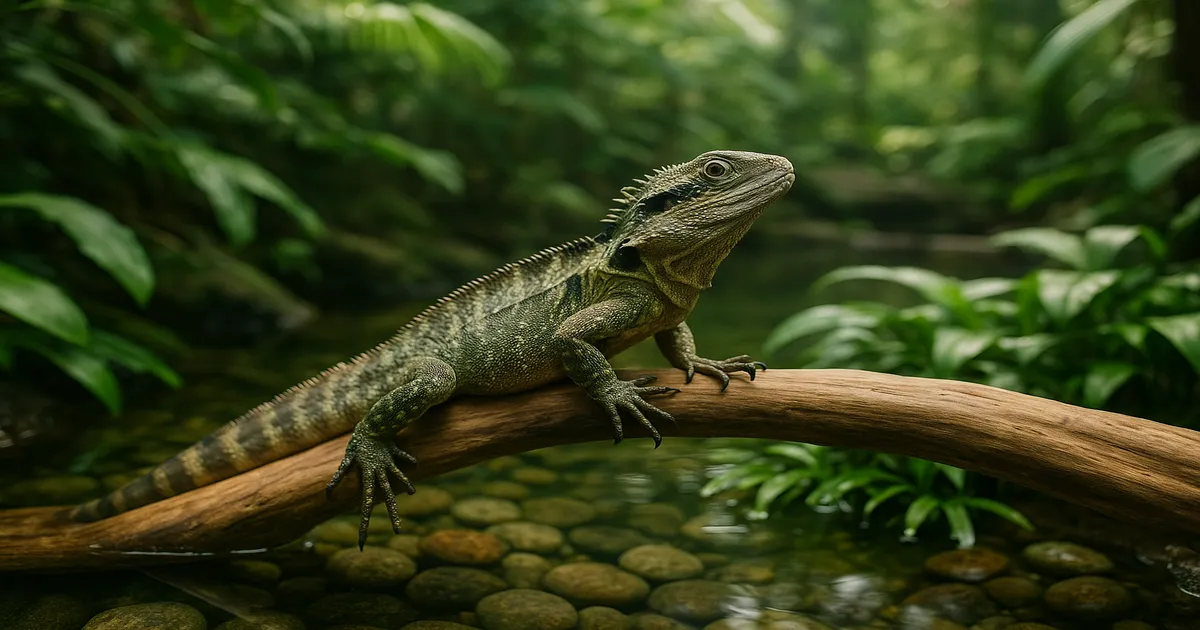
Quick Answer: Australian water dragons (Intellagama lesueurii) are large, semi-aquatic lizards that need a spacious enclosure with a real water feature, high-output UVB, a basking surface of 105–115°F (40–46°C), and an omnivorous diet of insects and leafy greens. With good care they’ll live 15–20+ years — but they’re genuinely demanding. The enclosure size and water filtration requirements alone rule them out for casual keepers. Outside Australia, all captive specimens must be captive-bred.
How to Care for Australian Water Dragons: Species Overview
The first thing worth knowing is that these aren’t beginner lizards dressed up in beginner-lizard packaging. They’re stunning, personable, and can absolutely become tame — but they grow to 3 feet, live for two decades, and need a setup most people seriously underestimate.
The scientific name is Intellagama lesueurii, and they belong to the family Agamidae — same group as bearded dragons and uromastyx. There are two subspecies you’ll encounter in the hobby.
Eastern vs. Gippsland Water Dragon
The Eastern Water Dragon (I. l. lesueurii) is by far the most common in captivity. Males develop a vivid red-orange chest flush that makes them genuinely striking animals. The Gippsland Water Dragon (I. l. howittii) comes from cooler, higher-elevation habitats in Victoria and southern New South Wales. It’s more olive-green, less flashy, and runs a few degrees cooler than most care sheets suggest.
For most keepers, you’ll be working with an Eastern. The care is nearly identical, but if you have a Gippsland, dial the cool side down 3–5°F and don’t stress if it seems less heat-hungry than expected.
Natural Habitat and What It Tells You
In the wild, water dragons live along riparian zones — rocky creek banks, river edges, and lake shores with dense overhanging vegetation. They’re almost never far from water. When threatened, they drop in and can remain submerged for up to 90 minutes. That’s not a party trick; it’s a survival strategy, and it shapes everything about how you should build their enclosure.
They’re diurnal, basking hard on sun-warmed rocks in the morning before retreating to shade or water during afternoon heat. Adult males are territorial and will chase subordinate males off prime basking spots without hesitation.
Temperament and Handling
Water dragons are among the more personable large agamids. With consistent, calm handling they can become quite relaxed — I’ve kept adults that would walk onto my hand without any fuss. That said, they’re fast and strong, and a stressed animal will bite and tail-whip without much warning. Juveniles are flightier than adults, so patience early on pays off.
One hard rule: always approach from the side, never from above. A hand descending from overhead triggers a prey-flight response every single time.
Enclosure Size and Setup
Enclosure size is the most consistently underestimated part of Australian water dragon care. I see it constantly — adults crammed into 75-gallon tanks, noses rubbed bloody from glass-surfing, owners baffled about why the animal is stressed.
Minimum Enclosure Dimensions by Age
| Life Stage | Minimum Size |
|---|---|
| Juvenile (0–6 months) | 40-gallon breeder (36” × 18” × 18”) |
| Sub-adult (6–18 months) | 4’ × 2’ × 4’ (120 × 60 × 120 cm) |
| Adult (single animal) | 6’ × 3’ × 5’ (180 × 90 × 150 cm) |
| Adult (ideal) | 8’ × 4’ × 6’ (240 × 120 × 180 cm) |
Height matters as much as floor space. These lizards climb, and a tall enclosure isn’t optional for adults.
Enclosure Material: PVC, Wood, or Glass
PVC enclosures are the best choice for adults — lightweight, moisture-resistant, easy to clean, and they hold humidity well. Zen Habitats makes solid PVC panels worth looking at.
Sealed wood works for large custom builds, but every interior surface needs waterproofing — Drylok, pond liner, or epoxy. Water dragons will destroy bare wood fast.
Glass is fine for juveniles in a 40-gallon breeder. Don’t use it for adults. Adult water dragons frequently fail to recognize glass as a barrier and will ram their snouts against it repeatedly, causing rostral abrasions that can turn into serious infections. If you’re keeping a juvenile in glass, apply frosted contact paper or opaque window film along the bottom 12 inches of the front panel — it stops glass-surfing behavior almost immediately.
Substrate and Decor
A bioactive substrate mix works beautifully: roughly 60% organic topsoil and 40% play sand at 4–6 inches (10–15 cm) deep. It holds humidity, allows some burrowing, and supports a cleanup crew of isopods and springtails. The humidity levels water dragons need are exactly what isopods thrive in — it’s a natural fit.
For plants, pothos, bromeliads, snake plants, and hibiscus all tolerate the humidity and are non-toxic. Thick climbing branches (2–4 inches in diameter for adults), cork bark hides, and a cork tile background give the animal visual security and surfaces to grip. Provide at least two hides — one warm side, one cool side.
Temperature, Lighting, and Humidity
Temperature Gradients
A lot of care sheets still recommend basking temps of 90–95°F for water dragons. That’s too low. Wild animals bask on sun-heated rocks that regularly exceed 110°F surface temperature, and insufficient basking heat impairs both digestion and immune function. It’s a bigger deal than most people realize.
- Basking surface: 105–115°F (40–46°C)
- Warm side ambient: 85–90°F (29–32°C)
- Cool side ambient: 75–80°F (24–27°C)
- Nighttime: 65–70°F (18–21°C); don’t let it drop below 60°F (15°C) for extended periods
Always verify basking temperature with an infrared temp gun pointed at the actual surface the animal sits on — not the air above it. (Etekcity Lasergrip 774) For the basking lamp, PAR38 halogen flood bulbs produce focused, intense heat that mimics natural sunlight far better than incandescent bulbs. Run it through a dimmer thermostat to keep temperatures consistent. (Herpstat 1)
UVB Lighting
Water dragons are Ferguson Zone 3–4 baskers — they seek out high UV indexes in the wild and need the same in captivity. Low-output compact coil UVB bulbs won’t cut it. You need a T5 HO 10.0 or Arcadia 12% T5 HO linear tube spanning at least 50–75% of the enclosure length.
Replace UVB bulbs every 12 months. UV output degrades well before the visible light fails, so a bulb that looks fine can be functionally useless.
Photoperiod and Humidity
Run 12–14 hours of light in summer and drop to 10–11 hours in winter. A simple digital timer handles this automatically, and the seasonal variation supports natural behavior cycles even if you’re not breeding.
Target 60–80% ambient humidity throughout most of the enclosure; the basking zone can run drier at 40–50%, which is natural. Mist the walls and plants daily — water dragons drink droplets off surfaces rather than from a still bowl.
The Water Feature
A water bowl is not a water feature. Water dragons need to fully submerge, and that requirement shapes the entire enclosure build.
For adults, you need a minimum depth of 6–8 inches (15–20 cm) and a footprint large enough for the animal to turn around in. Rubbermaid stock tanks, large tubs, or custom pond-liner pools all work. Keep water temperature at 75–80°F (24–27°C) — cold water below 70°F (21°C) is a real respiratory infection trigger. I’ve seen “mystery respiratory infections” that traced directly back to an unheated pool in a cool room. Use a submersible aquarium heater during cooler months.
Water dragons defecate in their water constantly. Without filtration, that pool becomes a bacterial and parasitic infection vector within days. A canister aquarium filter is the minimum standard — hang-on-back filters work too, but a canister handles the waste load better for larger pools. Even with filtration, do partial water changes weekly and deep-clean the pool monthly.
Always provide a textured ramp or large flat rock so the animal can exit easily. Drowning is a real risk for juveniles and weakened animals.
Feeding Australian Water Dragons
Diet Ratios and Frequency
Adults run roughly 60–70% protein and 30–40% plant matter; juveniles skew closer to 80% protein. Feed juveniles daily or every other day, adults every 2–3 days.
Good feeder insects include dubia roaches (excellent nutritional profile), black soldier fly larvae (high calcium, great for juveniles), hornworms and silkworms (good hydration feeders), and crickets as part of a rotation — not as a sole staple. Their calcium-to-phosphorus ratio is poor, and crickets-only diets are one of the most common feeding mistakes I see.
Earthworms are the underrated staple of water dragon keeping. Wild water dragons eat enormous quantities of them. Captive animals fed earthworms regularly show better growth and better hydration — earthworms are roughly 80% water — and they just seem to thrive on them.
For adults, an occasional pinky mouse or small feeder fish is fine once or twice a month. Don’t overdo it; too much animal protein over time is a gout risk, and gout is painful, progressive, and often fatal by the time it’s diagnosed.
Plant Matter
Don’t skip this part. Adults especially need leafy greens regularly. Good options: collard greens, dandelion greens and flowers, mustard greens, squash, berries, mango, papaya. Avoid spinach (oxalates bind calcium), excess kale, and iceberg lettuce (nutritionally empty).
Supplementation
- Calcium with D3: 2–3x per week for juveniles, 1–2x per week for adults
- Plain calcium (no D3): Dust on alternate feedings
- Multivitamin: Once weekly
With proper high-output UVB, the animal synthesizes its own D3, so you don’t need to hammer D3 supplementation if your lighting is dialed in. Gravid females and fast-growing juveniles need the most calcium attention.
Common Mistakes in Australian Water Dragon Care
The big four: enclosure too small, no real water feature, dirty water, and insufficient UVB. These account for the majority of health problems I see in captive water dragons. Basking temperature too low is sneaky — the animal might look fine short-term, but impaired digestion and weakened immunity show up over months, not days.
Never house two adult males together. They will fight, and even if you don’t see obvious wounds, the chronic stress alone causes real harm.
Give a new animal 2–4 weeks of minimal disturbance before you start handling. Forcing interaction on a freshly acquired, stressed water dragon creates fear responses that take far longer to undo than if you’d just waited.
Water dragons are stoic — by the time illness is obvious, it’s usually advanced. Watch for sunken eyes, lethargy, refusal to bask, and loose or discolored stools. Any new animal should be quarantined for 60–90 days and have a fecal exam done by a reptile-experienced vet before going into a permanent setup.
One practical tip worth adding: weigh your animal monthly on a digital kitchen scale and keep a log. Gradual weight loss is often the first sign something is wrong — long before behavioral changes become obvious. Catching a downward trend early gives you options you won’t have if you wait until the animal looks visibly sick.
Frequently Asked Questions
How big does an Australian water dragon enclosure need to be?
Adults need a minimum of 6’ × 3’ × 5’, with 8’ × 4’ × 6’ being the better target. Height matters just as much as floor space — these are active climbers. Juveniles can start in a 40-gallon breeder, but they grow fast and will need upgrades within their first year.
Do Australian water dragons need UVB lighting?
Yes, and specifically high-output UVB. They’re Ferguson Zone 3–4 baskers that seek out intense UV in the wild. A T5 HO 10.0 or Arcadia 12% T5 HO tube spanning most of the enclosure length is the standard. Low-output compact bulbs won’t provide adequate UV and can lead to metabolic bone disease over time.
What do Australian water dragons eat?
They’re omnivores. Adults eat a rotation of feeder insects — dubia roaches, crickets, BSFL, earthworms — making up roughly 60–70% of the diet, with leafy greens, squash, and fruit filling out the rest. Juveniles skew more heavily toward protein at around 80%. All feeders should be dusted with calcium and a multivitamin on a regular schedule.
How long do Australian water dragons live?
With good care, 15–20 years is realistic, and some individuals exceed that. They’re a longer commitment than most dogs. That lifespan is directly tied to husbandry quality — animals kept in inadequate conditions rarely come close to their potential.
Can you keep two Australian water dragons together?
Two females or a male-female pair can sometimes coexist in a large enough enclosure, but two adult males cannot be housed together — they’ll fight seriously even in a large space. If you’re keeping a pair, the enclosure needs to be significantly larger than the single-animal minimums, with multiple basking spots and hides so the animals can genuinely avoid each other.