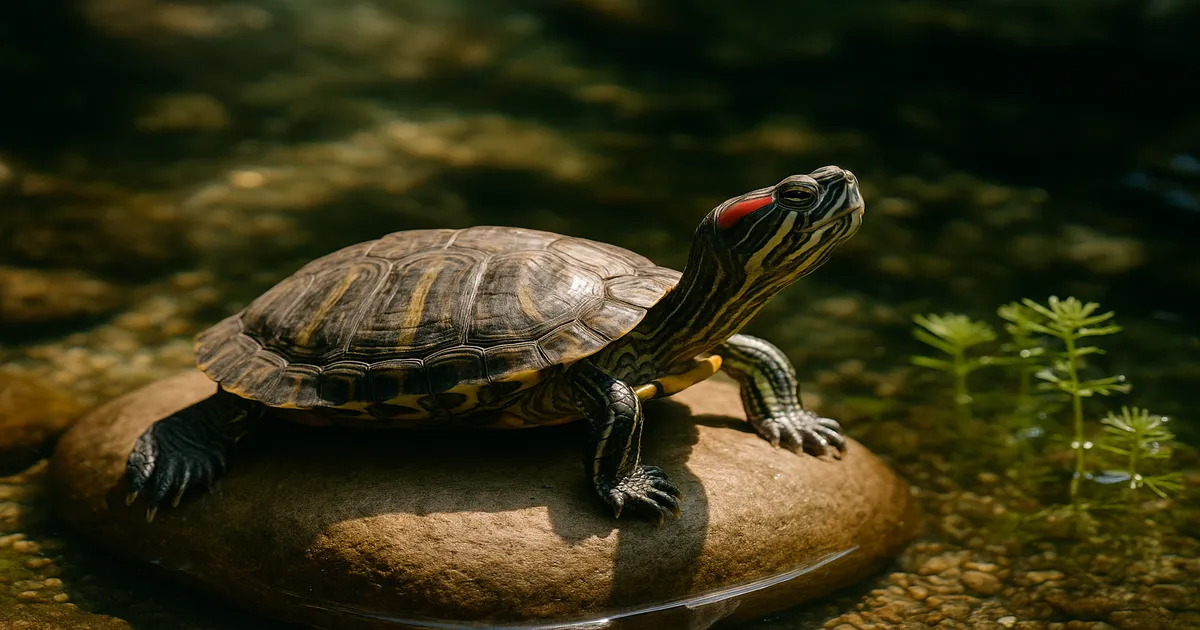
Quick Answer: Red-eared sliders need a large, well-filtered aquarium (100+ gallons for adults), a completely dry basking area at 88–95°F (31–35°C), proper UVB lighting, and a diet that shifts from protein-heavy as juveniles to mostly plant-based as adults. They live 20–40 years and grow up to 12 inches — this is a decades-long commitment that most beginners seriously underestimate.
Red-eared sliders (Trachemys scripta elegans) are one of the most commonly kept turtles in the world, and unfortunately, one of the most commonly surrendered. Learning how to care for a red-eared slider the right way — before you bring one home — is what separates keepers who thrive from the ones who end up dropping their turtle at a rescue five years in. This guide covers everything you need to set up correctly from day one.
Red-Eared Slider Care at a Glance
Species Snapshot
| Parameter | Details |
|---|---|
| Adult size | Females 10–12 in (25–30 cm); males 6–8 in (15–20 cm) |
| Lifespan | 20–40 years in captivity |
| Water temperature | 72–78°F (22–26°C) |
| Basking temperature | 88–95°F (31–35°C) |
| Minimum adult tank size | 100–150 gallons (379–568 L) |
| UVB lighting | Required — non-negotiable |
| Diet | Omnivore; shifts from protein-heavy (juvenile) to plant-heavy (adult) |
| Feeding frequency | Juveniles daily; adults every 2–3 days |
The Long-Term Commitment
Here’s what the pet store won’t tell you: that 2-inch hatchling will eventually need a tank the size of a coffee table. Adult females regularly hit 12 inches and need 120–150 gallons minimum. They’ll also be with you for 20 to 40 years — longer than most dogs, longer than some marriages.
Reptile rescues are overflowing with red-eared sliders because people bought them on impulse. If you’re genuinely ready to commit, they’re personable, interactive turtles that will recognize you and beg for food. Just go in with clear eyes about what’s ahead.
Enclosure Setup for Red-Eared Sliders
How Big Does the Tank Need to Be?
The standard rule is 10 gallons (38 L) of water per inch of shell length. A 10-inch female needs a 100-gallon minimum — and honestly, 120–150 gallons is more realistic once a basking platform eats into the footprint.
Size progression as your turtle grows:
- Hatchlings (under 2 in): 20-gallon (75 L) minimum
- Juveniles (2–4 in): 40–55 gallon (150–208 L)
- Sub-adults to adult males: 75–100 gallon (284–379 L)
- Adult females: 120–150 gallon (454–568 L) minimum
Footprint matters more than height. A tall, narrow 100-gallon gives your turtle almost no room to swim. A long, shallow 100-gallon with a 48 × 24 inch (122 × 61 cm) footprint is dramatically better. Target water depth at 1.5–2× your turtle’s shell length — enough to fully submerge and turn around comfortably.
Best Enclosure Types
Glass aquariums are the most common choice and work fine, but they’re heavy and expensive at larger sizes. A 75–125 gallon glass tank is a reasonable option for adult males.
Rubbermaid or Sterilite stock tanks are my personal favorite for adult females. A 150-gallon stock tank costs a fraction of a comparable glass aquarium, it’s easy to drill for drainage, and the turtle genuinely doesn’t care what it looks like. Custom plywood builds with pond liner work well too, but require more upfront effort.
Outdoor ponds are the gold standard for adult RES in warm climates (USDA zones 6–10). A 200+ gallon pond setup will give your turtle a quality of life that’s hard to match indoors. If you have the space and the weather, it’s worth serious consideration. For outdoor setups, predator-proofing is non-negotiable — hardware cloth over the top and smooth walls at least 12 inches (30 cm) above the waterline will stop raccoons and prevent escapes. RES are surprisingly good climbers when motivated.
Filtration and Water Quality
Why You Need Oversized Filtration
Red-eared sliders are, without question, among the messiest animals you can keep in an aquarium. They eat in the water, defecate constantly, and will overwhelm a properly-sized fish filter within days. Filtration is the single most important equipment decision you’ll make.
The rule: use a filter rated for 2–3× your actual water volume. A 100-gallon tank needs a filter rated for 200–300 gallons. No exceptions.
Canister filters are the best overall choice for indoor setups. The Fluval FX4 or FX6 are workhorses that handle turtle waste well . Eheim and SunSun are solid budget alternatives. Sump filters work excellently for large stock tanks and custom builds — more DIY to set up, but easy to service. Hang-on-back filters like the AquaClear 110 are fine as supplemental filtration for juveniles , but don’t rely on one alone for an adult. Skip undergravel and small internal filters entirely.
Cycling Your Tank
Before your turtle goes in, you need to establish the beneficial bacteria that convert ammonia to nitrite, then nitrite to nitrate. This takes 4–6 weeks. Use established filter media from another tank if you can, or a bacterial starter product to speed things up.
Water Parameters and Maintenance
- Ammonia: 0 ppm
- Nitrite: 0 ppm
- Nitrate: Under 40 ppm
- pH: 6.5–8.0
Test weekly with a liquid test kit — strips aren’t accurate enough . Do 25–30% water changes every week regardless of how clean the water looks. Always treat new water with a dechlorinator before adding it to the tank (Seachem Prime).
Heating, Lighting, and Basking Setup
Water Temperature
Keep water between 72–78°F (22–26°C). Below 60°F (15.5°C) and your turtle becomes lethargic and stops eating. Above 82°F (27.8°C) promotes bacterial growth and stresses the animal.
Use a titanium or stainless steel heater only — red-eared sliders crack glass heaters, full stop. The Finnex Titanium Heater and Cobalt Aquatics Neo-Therm are both reliable . Plan for 3–5 watts per gallon, always use a heater guard, and pair it with a separate thermostat controller for safety backup.
Basking Area
The basking surface needs to hit 88–95°F (31–35°C) — measure with an infrared temp gun, not by guessing. The platform must be completely dry and large enough for your turtle to fully exit the water and turn around. A textured ramp with good grip is essential; turtles shouldn’t have to struggle to haul out.
Commercial platforms like the Zoo Med Turtle Dock work for juveniles, but for adult females you’ll likely need a DIY build. Egg crate zip-tied to a PVC frame is the classic solution and costs almost nothing.
UVB Lighting
Without UVB, red-eared sliders can’t synthesize vitamin D3, which means they can’t metabolize calcium properly. The result is metabolic bone disease — soft, deformed shells and weakened bones. This happens within months, not years. It’s not a slow-burn problem.
Go with a T5 HO linear fluorescent or a mercury vapor bulb. I prefer T5 HO for most indoor setups. The Arcadia 6% or 12% T5 HO and Zoo Med Reptisun 5.0 or 10.0 T5 HO are both excellent choices . Position the bulb 10–12 inches (25–30 cm) above the basking surface and replace it every 6–12 months — UVB output degrades long before the bulb stops producing visible light.
Outdoor natural sunlight, unfiltered through glass, is genuinely the gold standard. Even a few supervised hours outside each week makes a noticeable difference.
Run lights 12–14 hours daily in summer, 10–12 hours in winter. Use a timer — consistency matters more than perfection.
Feeding Red-Eared Sliders
The Diet Shift Most People Get Wrong
Juvenile RES are primarily carnivorous — they need protein to fuel rapid growth. Adults shift toward herbivory. Feeding an adult turtle a juvenile’s diet leads to obesity and fatty liver disease. This is one of the most common long-term mistakes, even among experienced keepers.
- Juveniles (under 4 in): 60–70% protein, 30–40% plants
- Adults (over 4 in): 50–60% plants, 40–50% protein
What to Feed
For juveniles, quality aquatic turtle pellets should form the base — Mazuri Aquatic Turtle Diet is my top pick . Supplement with earthworms, feeder fish, crickets, and bloodworms. Offer some plant matter from the start so they don’t reject it as adults.
For adults, staple plant foods include romaine, red leaf lettuce, dandelion greens, collard greens, mustard greens, duckweed, and anacharis. Protein sources like quality pellets, earthworms, and occasional feeder fish round things out. Avoid spinach — the oxalates bind calcium and work against you. Iceberg lettuce is basically just water with a green tint; skip it.
Float a cuttlebone in the water for calcium supplementation. Turtles gnaw on it as needed, which is a much more natural delivery method than dusting alone. Dust food with calcium powder a couple of times a week for juveniles, once or twice a week for adults.
Feeding Frequency and Method
Red-eared sliders have fixed tongues and physically can’t swallow food out of water. Always feed in the tank or a separate feeding tub. A dedicated feeding container keeps the main tank cleaner and makes it easy to monitor intake.
Feed juveniles daily or every other day. Adults do fine on every 2–3 days. Offer only what they can finish in 5–10 minutes — overfeeding is one of the most common mistakes, and a fat turtle is not a healthy turtle.
Equipment Checklist
Enclosure and water:
- Appropriately sized tank or stock tank
- Canister filter rated 2–3× water volume
- Titanium or stainless steel submersible heater with guard
- Thermostat controller
- Liquid water test kit
- Dechlorinator
Lighting and heating:
- T5 HO UVB fixture and bulb (Arcadia or Zoo Med)
- Basking heat lamp (halogen flood bulb works great)
- Digital outlet timer
- Infrared temperature gun
Furniture and extras:
- Basking platform with textured ramp
- Separate feeding tub
- Quarantine tank (20–40 gallon, bare bottom)
- Nesting box for adult females — a plastic bin with 4–6 inches (10–15 cm) of moist topsoil/play sand mix
If you have a female, the nesting box isn’t optional. A gravid female that can’t find a place to lay will become egg-bound — dystocia is life-threatening and expensive to treat. Provide a nesting box once she reaches sexual maturity around age 4–5.
For substrate, bare bottom is the best choice for indoor setups. Easy to clean, no impaction risk, and you can see waste accumulating. If you want something more natural-looking, large river rocks (3+ inches / 7.5+ cm diameter) are safe. Fine gravel and sand carry impaction risk and are a pain to maintain.
Common Red-Eared Slider Care Mistakes
Undersized enclosures. Starting small and never upgrading is the number one setup failure. A cramped tank means chronic stress, stunted growth, and perpetually poor water quality.
Inadequate filtration. An undersized filter means ammonia spikes, and ammonia spikes mean shell rot, respiratory infections, and eye infections. If your water smells or looks cloudy, the filter is almost always the culprit.
Skipping UVB. A regular incandescent or LED bulb does nothing for UVB. MBD develops within months, and by the time the shell softening is obvious, significant damage has already been done.
Overfeeding and wrong diet ratios. Overfeeding causes obesity, fatty liver disease, and shell pyramiding. Make sure adult turtles are getting plenty of leafy greens — not just pellets.
Wet basking areas and glass heaters. A basking platform that stays wet is a shell rot incubator. Make sure it drains fully and dries between uses. Replace any glass heaters immediately — a cracked glass heater in water is an electrocution hazard.
Frequently Asked Questions
How big of a tank does a red-eared slider need?
Adult females need a minimum of 120–150 gallons (454–568 L). Adult males can get by with 75–100 gallons (284–379 L). Use the 10-gallons-per-inch-of-shell rule as your baseline, and always prioritize footprint over height — a long, shallow tank beats a tall, narrow one every time.
What do red-eared sliders eat?
They’re omnivores, but diet needs change with age. Juveniles need 60–70% protein (pellets, earthworms, feeder fish) and 30–40% plants. Adults should eat mostly plant matter — romaine, dandelion greens, collard greens — with protein making up around 40–50%. Quality pellets like Mazuri are a good staple, but variety is essential.
Do red-eared sliders need a UVB light?
Yes, absolutely. Without UVB, they can’t synthesize vitamin D3 or metabolize calcium properly, and metabolic bone disease follows within months. Use a T5 HO bulb from Arcadia or Zoo Med, positioned 10–12 inches (25–30 cm) above the basking area, and replace it every 6–12 months even if it still looks lit.
How long do red-eared sliders live?
With proper care, 20–40 years in captivity is realistic. This is not a short-term pet. Many end up in rescues because owners weren’t prepared for that reality — make sure you are before bringing one home.
How often should I change the water?
Do a 25–30% water change every week, even with a good filter running. Nitrates accumulate faster than most people expect with these turtles. In smaller setups or with multiple animals, you may need 50% changes every two weeks. Always treat new water with dechlorinator before adding it.