Quick Answer: To set up a Russian tortoise habitat, you need a minimum 4×4 ft open-top enclosure with 8–12 inches of topsoil/sand mix for burrowing, a basking spot of 95–105°F at shell level, a cool side of 70–75°F, a T5 HO 12% UVB tube, and ambient humidity between 30–50%. Nail those five things and you’re most of the way there.
Russian Tortoise Habitat Requirements at a Glance
| Parameter | Requirement |
|---|---|
| Enclosure (indoor) | 4×4 ft minimum; 4×8 ft preferred |
| Substrate | 8–12 inches topsoil/play sand mix |
| Basking spot | 95–105°F (35–40°C) at shell level |
| Warm side ambient | 80–90°F (27–32°C) |
| Cool side | 70–75°F (21–24°C) |
| Nighttime low | 65–70°F (18–21°C) |
| UVB | T5 HO 12%, UVI 3.0–6.0 in basking zone |
| Humidity | 30–50% ambient |
What Makes This Species Different
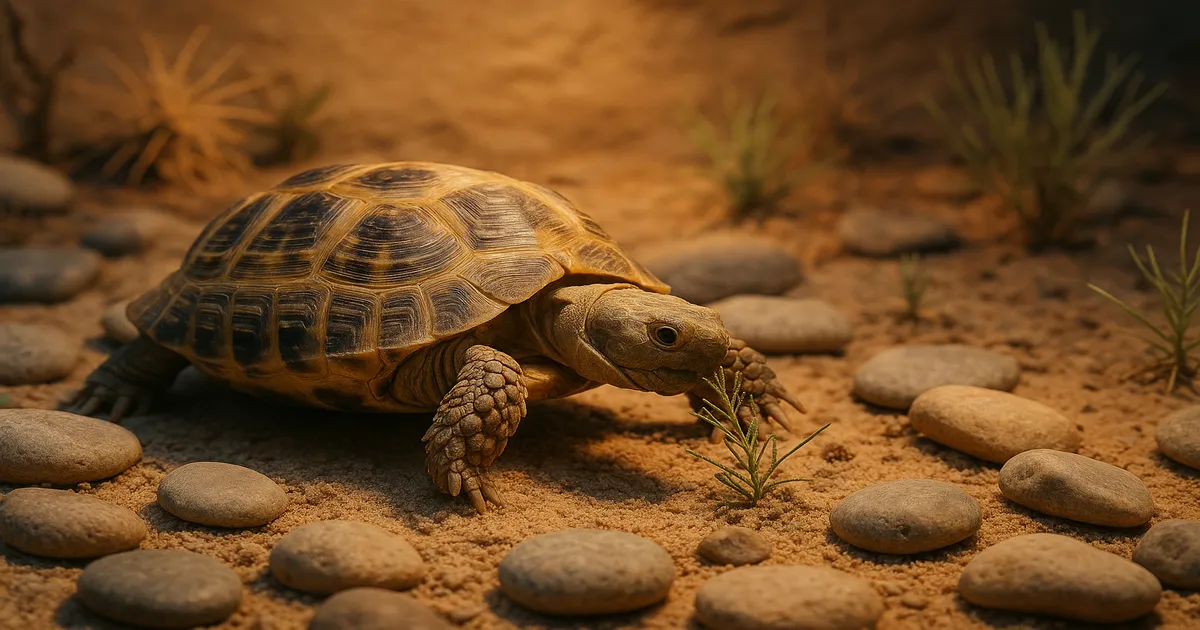
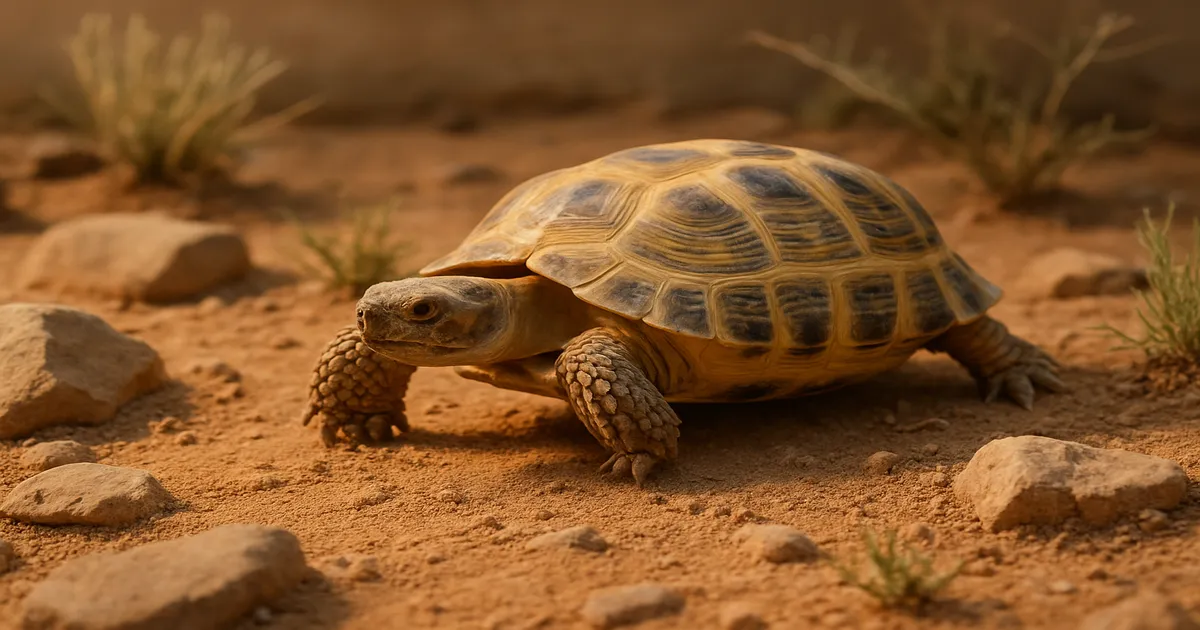
The Russian tortoise (Testudo horsfieldii) is a Central Asian burrowing specialist from the arid steppes of Afghanistan, Kazakhstan, Iran, and Uzbekistan. They top out at 6–10 inches and live 40–80+ years, which means the habitat you build now matters for a very long time. They’re bold, active, and surprisingly personable — but they’re also one of the most commonly mis-kept tortoises in the hobby because their needs look simple on paper and aren’t.
One thing worth knowing before you buy: most Russian tortoises in the pet trade are wild-caught. Captive-bred animals are healthier, better adjusted, and worth seeking out. If you’re getting a wild-caught animal, budget for a vet visit and a fecal parasite screen before it goes into a permanent setup.
How to Set Up a Russian Tortoise Habitat: Choosing the Right Enclosure
Tortoise Tables Are the Right Call for Indoor Keeping
Open-top tortoise tables are the gold standard for indoor Russian tortoise setups. Good airflow, easy access, no glass-surfing stress. You can build one from untreated plywood for under $100, or buy a pre-made version — either works as long as the floor space is there.
The minimum for one adult is 4×4 ft (16 sq ft), but 4×8 ft is genuinely where you want to be. These tortoises move more than people expect.
Stock Tanks and Custom Builds
A 150–300 gallon Rubbermaid stock tank is a solid alternative — durable, holds deep substrate well, and easy to clean. If you use a galvanized metal tank, line it with pond liner to prevent zinc leaching. Custom builds from PVC panels or melamine-coated plywood also work. Avoid pressure-treated lumber, cedar, and anything with chemical coatings.
Why Glass Aquariums Don’t Work
Glass terrariums are a bad long-term home for adult Russian tortoises. Ventilation is poor, and tortoises that can see through the walls will pace endlessly trying to get through — it doesn’t stop, and it’s genuinely stressful for the animal. Maintaining a proper thermal gradient in a glass box is also harder than it needs to be. A glass tank can work temporarily for a hatchling, but plan to upgrade before the animal reaches adult size.
Outdoor Enclosures: Best Option When Climate Allows
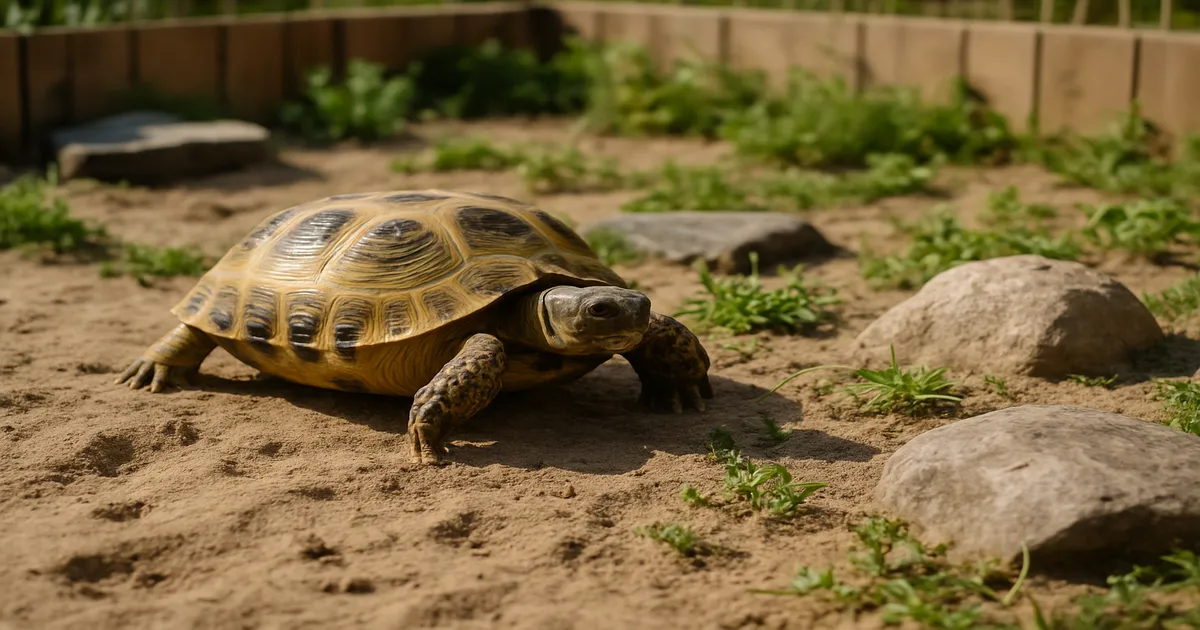
When daytime temperatures are consistently above 60°F, outdoor keeping beats everything else. Natural sunlight, real temperature fluctuation, actual soil to dig in — it checks every box. Build walls from solid wood, cinder block, or brick at least 16 inches above ground and 12 inches below ground. Russian tortoises are strong climbers and dedicated diggers, so both dimensions matter.
Cover the pen with hardware cloth to exclude raccoons, foxes, and birds of prey. Keep 30–40% of the space shaded at all times and include a weatherproof shelter with hay for overnight protection.
Best Substrate for a Russian Tortoise Habitat
The Mix That Actually Works
Sixty to seventy percent chemical-free topsoil mixed with 30–40% play sand is the right substrate for Russian tortoises. It mimics the loamy steppe soils of their native range, holds burrow shape without collapsing, and stays slightly moist at depth while drying at the surface. Read the topsoil bag — avoid anything with added fertilizers or perlite.
Good alternatives include organic coconut coir blended with topsoil and sand, or compressed coir bricks expanded with water and mixed with sand. Commercial mixes like Zoo Med Tortoise Substrate work well if good topsoil is hard to source locally.
Depth Is Not Optional
In the wild, Russian tortoises spend up to nine months underground — brumating through winter, estivating through summer heat. Burrowing is a core thermoregulatory need, not a quirk. Four to six inches is the bare minimum; 8–12 inches is what you should actually aim for. A tortoise that can’t dig will tell you about it through constant corner-digging and restless pacing.
Substrates to Avoid
- Pure sand — doesn’t hold burrow shape, dries too fast, impaction risk
- Calci-sand — impaction and toxicity risk; avoid entirely
- Cedar or pine shavings — toxic aromatic oils
- Reptile carpet — traps bacteria, causes nail and beak problems over time
- Gravel — injury risk, completely wrong texture
Temperature and Heating
The Thermal Gradient Is Non-Negotiable
Tortoises regulate body temperature by moving between warm and cool zones. That means your enclosure needs a real gradient — one hot end, one noticeably cooler end — not just a lamp somewhere in the middle.
Basking Setup
A 50–100W halogen flood bulb in a ceramic dome fixture is the best basking heat source for most setups. Halogens produce radiant heat that more closely mimics sunlight than incandescent bulbs and are cheap to replace. Position the lamp at one end of the enclosure and adjust output until you hit 95–105°F measured at shell level with an infrared temperature gun — not air temperature, shell level.
The Arcadia Deep Heat Projector is worth adding if your budget allows. It penetrates substrate and warms the tortoise’s core from below, which is closer to how solar radiation actually works in the field.
Nighttime and Supplemental Heat
If your room drops below 65°F overnight, you need supplemental heat without light. A ceramic heat emitter (CHE) on a thermostat handles this well. Always run it through a thermostat — never plug a CHE in uncontrolled.
For thermostats, Herpstat and Inkbird are both reliable. Vivarium Electronics makes excellent proportional PID thermostats if you want precise control.
Measuring Temperatures Correctly
An air thermometer on the warm side doesn’t tell you what the basking surface is doing. Use an infrared temperature gun to check the surface directly under the lamp. Use digital probe thermometers — one warm side ambient, one cool side — to track the gradient through the day.
UVB Lighting for a Russian Tortoise Habitat
UVB Is Not Optional
Without UVB, a tortoise can’t synthesize Vitamin D3, which means it can’t metabolize calcium. The result is metabolic bone disease: soft shells, skeletal deformities, and eventually death. This is the most preventable serious health problem in captive tortoises, and it’s entirely caused by inadequate lighting.
Choosing the Right Bulb and Mounting Height
Russian tortoises are Ferguson Zone 3 animals, which means they need a UVI of 3.0–6.0 in the basking zone. T5 HO tube bulbs are the right tool. The Arcadia 12% T5 HO and Zoo Med Reptisun 10.0 T5 HO are both excellent. Mount the tube 10–14 inches above the tortoise’s shell — too far away and you’re delivering negligible UV regardless of what the packaging claims.
Don’t place UVB tubes behind glass or acrylic. Both materials filter out UVB and you’ll end up with essentially nothing reaching the animal. If you want to verify actual UVI at shell level, a Solarmeter 6.5 is the tool for that.
Replace bulbs on schedule. T8 tubes every 6 months, T5 HO every 12 months. The bulb will still look lit long after the UV output has dropped to useless levels.
Photoperiod
Run lights on a timer for 12–14 hours per day in spring and summer, dropping to 10–12 hours in winter if you’re not brumating the animal. Unfiltered outdoor sunlight is better than any bulb — even 30–60 minutes outside a few times a week makes a real difference. Through a window doesn’t count; glass blocks UVB.
Hides, Decor, and Water
Hides
Every tortoise needs at least one hide on the warm side and one on the cool side. Half-log hides, cork bark rounds, or simple wooden boxes all work. The hide should be snug — if it’s too large, it won’t provide the sense of security the tortoise is looking for.
Basking Surface and Plants
Flat slate or flagstone under the basking lamp absorbs and radiates heat, extending the effective basking period. The rough texture also helps naturally wear down the beak. Make sure any rocks are stable — a tipping stone can seriously injure a tortoise.
Live plants serve as both enrichment and supplemental food. Good options: dandelion, clover, plantain (Plantago spp.), hibiscus, mulberry, and sedum. Keep out daffodil, foxglove, azalea, rhododendron, nightshade, and buttercup.
Water and Soaking
Use a wide, shallow ceramic dish no deeper than the tortoise’s chin when standing. Place it in the cool-to-mid zone where it won’t overheat. Beyond the dish, regular soaking matters: hatchlings 2–3 times per week, adults once or twice a week, in 1–2 inches of lukewarm water at 85–90°F for 15–20 minutes. Many wild-caught animals arrive chronically dehydrated — regular soaking supports kidney health and is a real part of the care routine, not an optional extra.
Keep a cuttlebone in the enclosure at all times. Tortoises will gnaw on it as needed for calcium and beak wear. Low effort, genuinely useful.
Step-by-Step Russian Tortoise Habitat Setup
Step 1 — Prepare the enclosure. Position it away from drafts, cold windows, and exterior walls. Opaque sides prevent stress pacing.
Step 2 — Add substrate. Fill with topsoil/play sand mix to 8–12 inches. Lightly moisten the bottom third; the surface should stay dry.
Step 3 — Install heating. Mount the basking halogen at one end on a thermostat or dimmer. Add a CHE or Deep Heat Projector for nighttime heat, also on a thermostat. Run the setup 24 hours before adding any animals.
Step 4 — Mount UVB lighting. Install the T5 HO tube 10–14 inches above the basking zone, running along the warm half of the enclosure. Set a timer for a 12–14 hour photoperiod.
Step 5 — Add hides and decor. One hide warm side, one cool side. Flat basking stone under the lamp. Cork bark or driftwood for visual barriers. Live plants where space allows.
Step 6 — Add water dish and cuttlebone. Water dish in the cool-to-mid zone. Cuttlebone propped against a hide or placed nearby.
Step 7 — Verify everything before introducing the tortoise. Run the full setup 24–48 hours and confirm: basking surface 95–105°F (infrared gun), warm side ambient 80–90°F, cool side 70–75°F, nighttime low 65–70°F. Adjust lamp height, wattage, or thermostat settings until everything is dialed in. Don’t rush this step.
Common Russian Tortoise Habitat Mistakes
Enclosure too small or using an aquarium. A 40-gallon tank is not an adult Russian tortoise enclosure. It’s too small, the glass causes stress pacing, and ventilation is poor. Start with at least 4×4 ft of open-top space.
Skipping or under-powering UVB. No UVB means metabolic bone disease. A bulb mounted too far away, blocked by glass, or past its replacement date is effectively the same as no UVB at all.
No real thermal gradient. A single lamp in the center creates one hot zone with no escape. Your tortoise needs to choose its temperature — if it can’t, digestion, metabolism, and immune function all suffer.
Substrate too shallow or wrong type. Two inches of sand is a stress factory. Russian tortoises need to dig. Reptile carpet is worse — it traps bacteria and causes nail and beak problems over time.
Humidity too high. These are steppe animals. Consistent humidity above 60–70% leads to respiratory infections and shell rot. Open-top enclosures with good airflow help a lot.
Skipping regular soaking. Dehydration is common, especially in wild-caught animals. Skip soaking long-term and you’re looking at kidney damage down the road.
Frequently Asked Questions
How do I set up a Russian tortoise habitat on a budget?
Build a tortoise table from untreated plywood — a basic 4×4 ft box costs under $80 in materials. Use bagged topsoil and play sand from a hardware store for substrate. A halogen work bulb in a clamp fixture handles basking heat. The one place not to cut corners is UVB — a quality T5 HO tube is worth the investment.
What size enclosure does a Russian tortoise need?
The minimum for one adult indoors is 4×4 ft (16 sq ft), but 4×8 ft is a better target. For two tortoises, add at least 50% more space. Don’t house multiple males together — they’ll fight, sometimes seriously enough to cause injury.
Can Russian tortoises live outside year-round?
Only in climates that don’t drop below freezing for extended periods without a proper hibernation setup. In USDA zones 7 and warmer, many keepers successfully overwinter Russian tortoises outdoors with an insulated shelter. In colder zones, bring them in or manage hibernation carefully. They’re more cold-tolerant than most tortoises, but “more tolerant” isn’t the same as “frost-proof.”
How often should I replace the UVB bulb?
T5 HO bulbs every 12 months, T8 bulbs every 6 months. The bulb will still appear to work after those intervals — the visible light output doesn’t drop noticeably — but UV output degrades well before the bulb burns out. Mark the replacement date on the fixture with a piece of tape when you install it.
Do Russian tortoises need to hibernate?
In the wild, yes — they brumate for months. In captivity, healthy adult animals can be successfully brumated or kept active year-round with proper lighting and temperatures. Sick, underweight, or recently acquired animals should not be brumated. If you’re new to the species, keeping them active through winter while you learn the animal is a reasonable approach.