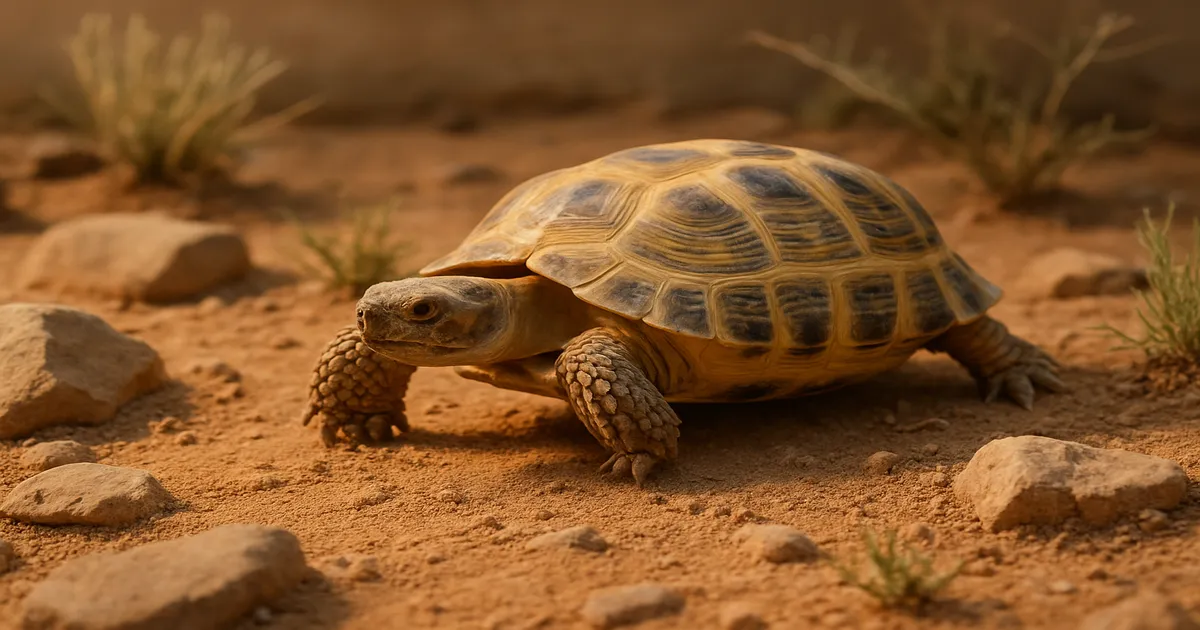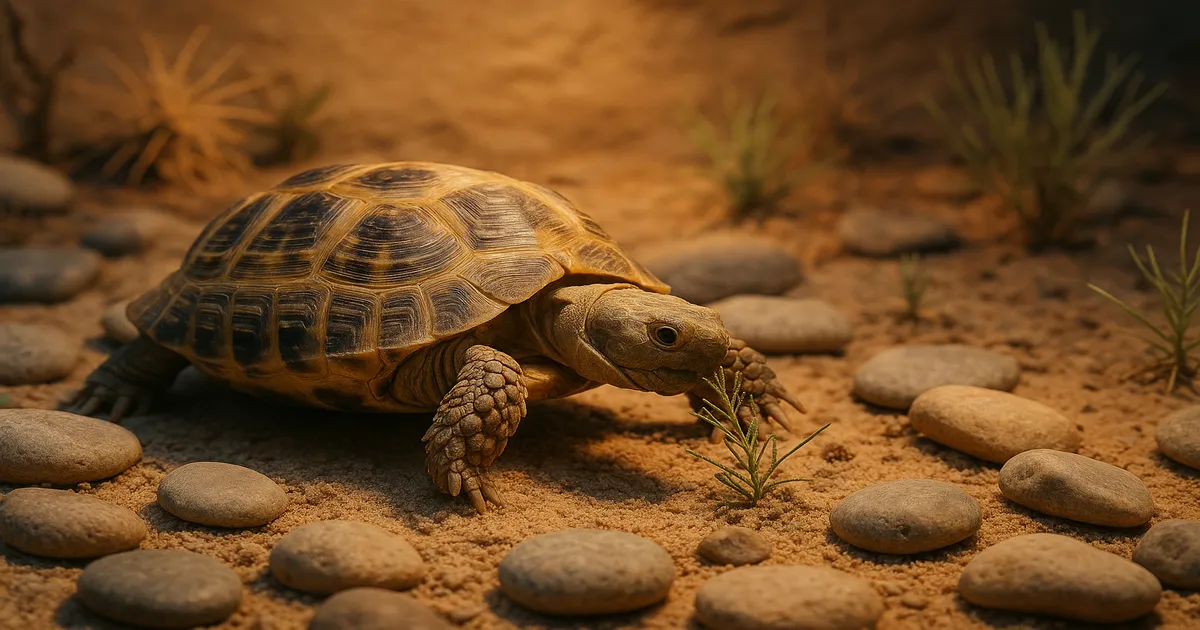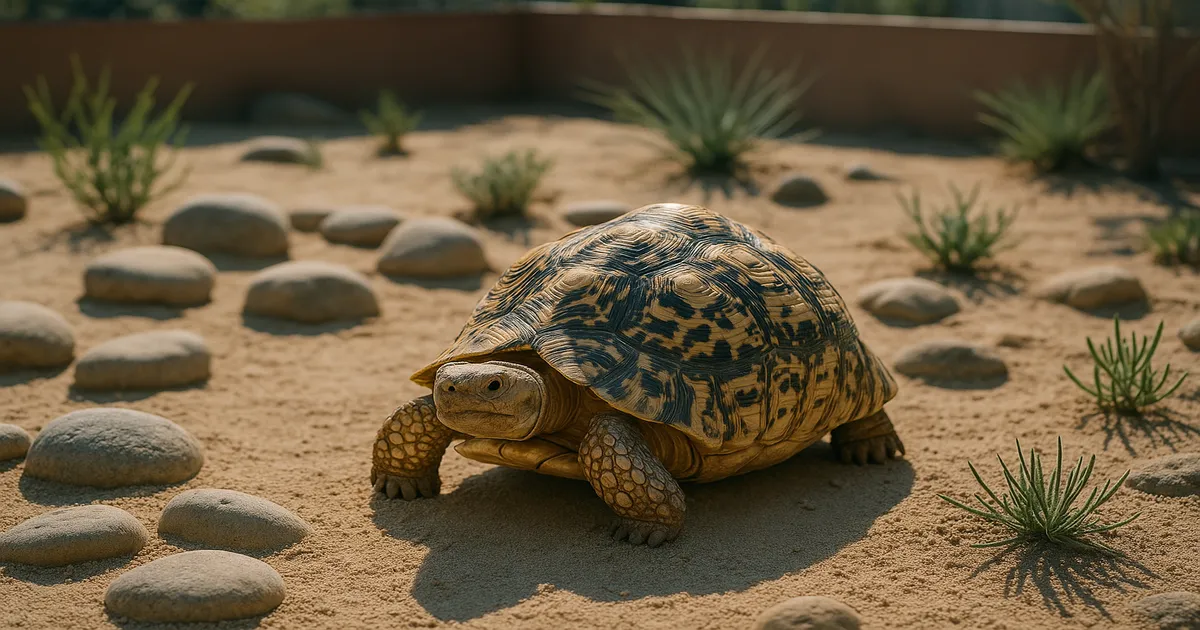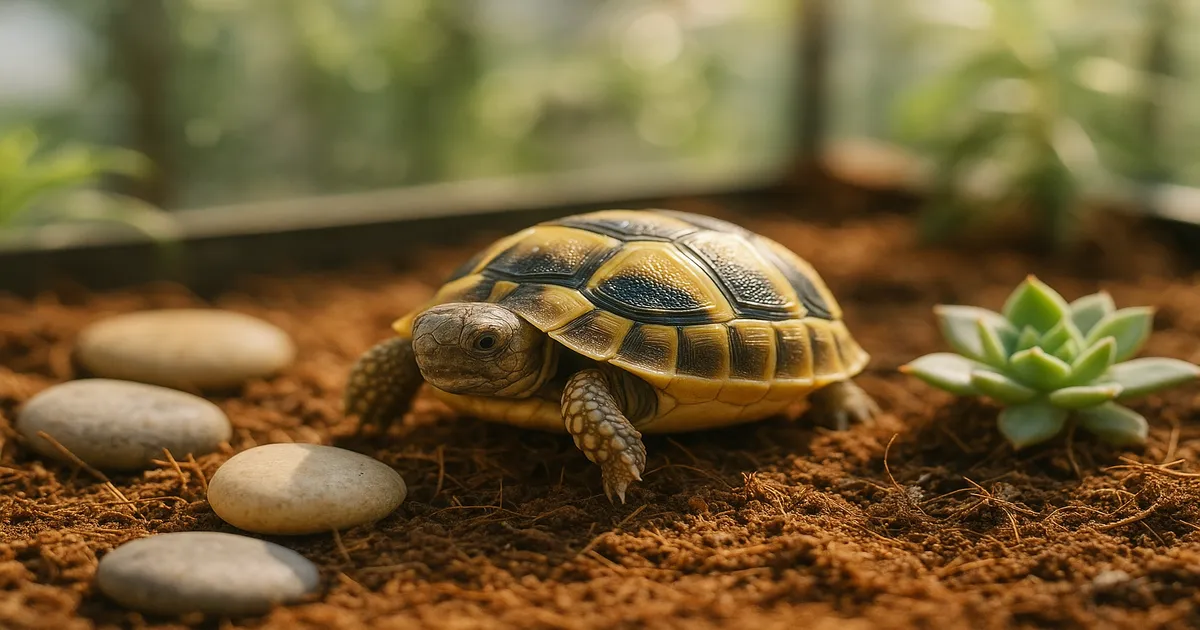
Quick Answer: One adult Russian tortoise needs a minimum of 4×4 ft (1.2×1.2 m) of floor space, but 4×8 ft (1.2×2.4 m) is the practical recommendation and 8×8 ft (2.4×2.4 m) or larger is ideal — especially outdoors. Undersized enclosures are the single biggest cause of chronic stress and poor health in captive Russian tortoises, and there is genuinely no such thing as too much space for this species.
If you’ve ever asked how much space does a Russian tortoise need, the honest answer is: more than you’re planning for. These are wide-ranging steppe animals that cover several acres a day in the wild. No matter how small and round they look sitting in a pet store, they are not built for life in a glass box.
Here’s a quick-reference table before we get into the details:
| Situation | Minimum | Recommended | Ideal |
|---|---|---|---|
| Single adult | 4×4 ft (16 sq ft) | 4×8 ft (32 sq ft) | 8×8 ft+ (64+ sq ft) |
| Pair | 6×8 ft (48 sq ft) | 8×8 ft (64 sq ft) | 10×10 ft+ |
| Group of 3–4 | 10×10 ft (100 sq ft) | 12×12 ft+ | As large as possible |
Why Space Matters So Much for Russian Tortoises
Wild Russian tortoises (Testudo horsfieldii) live across the arid steppes and semi-desert scrublands of Central Asia — Afghanistan, Kazakhstan, Uzbekistan, and the surrounding regions. They’re not sitting still out there. These animals roam multiple acres daily to forage, thermoregulate, and find mates. They also dig burrows up to 6 ft (1.8 m) deep to escape temperature extremes, which means digging is hardwired into their biology — not a quirk of captive boredom.
They’re only active for about 4–6 months of the year in the wild, brumating through brutal winters and scorching summers. That compressed active season means every day of foraging and movement counts. Their physiology is built for covering ground.
Put one in a space that’s too small and you’ll see the problem almost immediately: relentless pacing along the walls, sometimes called glass-surfing. This isn’t just annoying to watch — it’s a sign of chronic stress, and chronic stress suppresses the immune system, disrupts digestion, and causes behavioural disorders that don’t always reverse even after the enclosure is upgraded. I’ve seen tortoises kept in 40-gallon tanks for years that never fully settled down after being moved to a proper setup. Starting right matters.
Russian tortoises can live 40–80+ years with good care. The keepers who report the longest-lived, healthiest animals are almost universally the ones who prioritised space — often outdoor enclosures — from day one. Inadequate space isn’t a minor inconvenience; it’s a slow drain on the animal’s health that compounds over decades.
How Much Space Does a Russian Tortoise Need: Enclosure Sizes
Floor Space by Number of Tortoises
The 4×4 ft minimum for a single adult is genuinely the floor — the least you can do and still call it acceptable. The 4×8 ft recommendation gives you enough room to create a real temperature gradient, add meaningful decor, and watch your tortoise actually behave like a tortoise rather than a wall-bouncing machine.
For a pair, go to at least 6×8 ft (1.8×2.4 m), and I’d push hard for 8×8 ft. Male Russian tortoises can be relentless during breeding season — ramming, biting, and harassing females to the point of serious stress injury. She needs room to get away from him. For a group of three or four, 10×10 ft (3×3 m) is the starting point, not the goal.
Walls, Height, and Substrate Depth
Walls need to be at least 12–16 inches (30–40 cm) tall for adults. Russian tortoises are stronger climbers than most people expect and will use rocks or decor near the perimeter as launch pads. Keep anything climbable well away from the walls.
More importantly, walls should be solid — wood, concrete block, or brick. A tortoise that can see through its enclosure wall will pace along it endlessly, trying to move through what looks like open space. Solid walls reduce this behaviour dramatically.
Don’t overlook substrate depth. Russian tortoises need a minimum of 4–6 inches (10–15 cm), and 8–12 inches (20–30 cm) is far better. A tortoise that can’t dig is being denied one of its most fundamental behaviours. Thin substrate looks fine on the surface but causes low-grade stress day after day.
Indoor Enclosure Options
Tortoise Tables
A tortoise table — an open-top wooden box — is my top pick for indoor keeping. The open top means good airflow (Russian tortoises hate stagnant, humid air), easy access for feeding and cleaning, and a natural feel. Build one from untreated plywood or pine and seal the interior with a non-toxic waterproof sealant. Minimum dimensions: 4×4 ft for one adult, 4×8 ft if you can swing it.
Stock Tanks
100–300 gallon Rubbermaid stock tanks work surprisingly well and are often cheaper than a custom build. They’re durable, easy to clean, and deep enough for proper substrate. Drill drainage holes if you’re going heavy on the substrate. The walls are slightly translucent, so line the lower portion with cardboard or foam board if you notice pacing.
Why Glass Aquariums Don’t Work
A 40-gallon breeder (36×18 inches / 91×46 cm) gets sold constantly as a starter Russian tortoise enclosure. It isn’t one — not for an adult. Beyond the size problem, glass tanks have poor ventilation, trap humidity, and the transparent walls are practically designed to cause stress pacing. Avoid glass aquariums for any Russian tortoise over about 4 inches in shell length.
Custom Builds
If you’re in this for the long haul, a custom build is worth the effort. Design in drainage, built-in lighting mounts, a deep substrate zone in one corner, and exact dimensions to fit your space. Use exterior-grade plywood, solid walls on all sides, and a hinged or removable front panel for access.
Outdoor Enclosures: The Gold Standard
Whenever your climate allows it — consistently above 60°F (15°C) during the day — outdoor keeping is the single biggest upgrade you can make for a Russian tortoise’s quality of life. Unfiltered natural sunlight does more for their health than any UVB bulb, and the behavioural enrichment of a real outdoor environment is genuinely transformative.
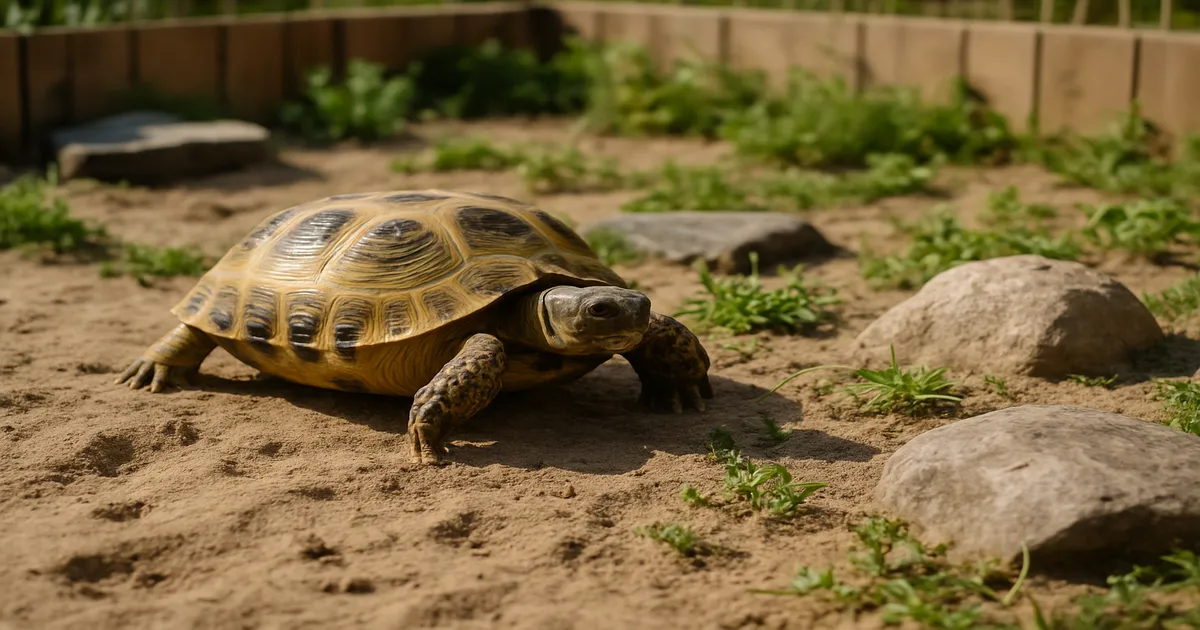
Outdoors, 4×8 ft is the minimum for one adult, but 8×8 ft or larger is where these animals really thrive. Go bigger if you have the yard space — you won’t regret it.
Escape-Proofing
This is where a lot of outdoor setups fail. Russian tortoises are powerful diggers and will find the bottom of any wall that isn’t buried deeply enough.
- Above-ground wall height: 12–16 inches (30–40 cm) minimum, solid material
- Below-ground barrier: Bury walls at least 12–18 inches (30–45 cm) deep, or use an L-shaped footer extending outward underground
- No gaps: Check corners and gate edges carefully — a determined tortoise will exploit any weakness
I’ve heard from keepers who came home to find their tortoise gone, with a neat tunnel under a wall that wasn’t buried deep enough. Twelve inches minimum, 18 to be safe.
Predator Protection and Shade
Hardware cloth over the top of the pen is non-negotiable in most areas. Raccoons, dogs, ravens, and foxes will all target a tortoise. A secure lid or roof keeps them safe.
Shade structures should cover 30–40% of the pen. Russian tortoises need to get out of direct sun, especially during peak afternoon heat. A simple wooden frame with shade cloth works fine.
Year-Round Outdoor Keeping
In USDA Hardiness Zones 7–10, Russian tortoises can live outdoors year-round with appropriate winter shelter or managed brumation. In cooler zones, they spend the warm months outside and overwinter indoors or in a controlled hibernation setup.
Environmental Setup Inside the Enclosure
Temperature Gradient
The basking spot should hit 95–105°F (35–40°C), with the warm ambient side at 80–90°F (27–32°C) and the cool side at 70–75°F (21–24°C). Nighttime drops to 60–65°F (15–18°C) are fine — Russian tortoises are cold-tolerant and don’t need supplemental nighttime heat in most homes. Place the basking lamp at one end of the enclosure, not the middle. The whole point is a gradient the tortoise can move along to regulate its own temperature. A quality thermostat keeps basking temps consistent and prevents overheating. (Herpstat 1)
UVB Lighting
Russian tortoises are Ferguson Zone 3 sun baskers — they need strong, high-quality UVB, not the weak coil bulbs sold at big-box pet stores. Use a T5 HO linear bulb rated at 10–12% UVB, spanning at least 50% of the enclosure length. Mount it 10–14 inches (25–35 cm) above the tortoise’s back and replace it every 6–12 months even if it’s still producing visible light — UV output degrades long before the bulb burns out.
Humidity and Substrate
Ambient humidity should stay in the 30–50% range. Russian tortoises are genuinely arid-adapted, and chronic humidity above 70% sets them up for respiratory infections and shell rot. The hide and burrow area can run slightly higher — 50–60% — mimicking the microclimate of a natural burrow.
The best substrate is 70% organic topsoil (no fertilisers or additives) mixed with 30% play sand. It holds its shape for burrowing, retains some deep moisture, and closely matches the loamy steppe soils of their native range. Water the substrate deeply once a week and let the surface dry out between waterings. The tortoise will dig down to the moist layer when it needs hydration — exactly how they self-regulate in the wild. Keeping the entire substrate wet is one of the most common mistakes keepers make.
Hides and Visual Barriers
Provide at least two hides per tortoise — one on the warm side, one on the cool side. (Exo Terra Large Reptile Cave) They should be snug enough to feel secure but large enough for the tortoise to turn around inside.
Beyond hides, use rocks, cork bark, and plants to break up sightlines so the tortoise can’t see from one end of the enclosure to the other. This single change reduces pacing dramatically and makes even a modestly sized enclosure feel more stimulating. Mound substrate 10–12 inches (25–30 cm) deep in one corner and partially bury a hide in it — most Russian tortoises will claim this as their sleeping burrow within a few days.
Common Mistakes to Avoid
Housing adults in aquariums. The 40-gallon breeder is the most common offender. Pet stores sell it, old care sheets recommend it, and it’s wrong. An adult Russian tortoise in a 40-gallon tank is like keeping a dog in a bathroom — technically alive, but not living well.
Transparent walls. Glass walls are a welfare issue, not just an aesthetic preference. Solid walls fix stress pacing almost immediately.
Shallow substrate. One or two inches is not enough. It prevents burrowing, forces the tortoise to sleep exposed, and denies one of its most fundamental behavioural needs.
Unburied outdoor pen walls. Twelve inches minimum, 18 to be safe. Don’t skip this.
No temperature gradient. A basking spot under 90°F (32°C) means your tortoise can’t properly digest food or mount an immune response. Heat source in the middle of the enclosure means there’s nowhere cooler to go. Both are common, and both matter more than most keepers realise.
Frequently Asked Questions
What is the minimum enclosure size for a Russian tortoise?
The absolute minimum for one adult is 4×4 ft (1.2×1.2 m), or 16 square feet. That’s a true floor — 4×8 ft (32 sq ft) is the practical recommendation, and anything larger is better. Undersized enclosures are the leading cause of chronic stress and health problems in captive Russian tortoises.
Can a Russian tortoise live in a 40-gallon tank?
No — not comfortably, and not long-term. A 40-gallon breeder measures roughly 36×18 inches (91×46 cm), well below the minimum floor space for an adult. Beyond the size issue, glass tanks have poor ventilation and transparent walls that cause stress pacing. A 40-gallon might work briefly for a very young hatchling, but it’s not appropriate for an adult at any stage.
How deep should the substrate be?
At least 4–6 inches (10–15 cm), with 8–12 inches (20–30 cm) preferred. Russian tortoises are instinctive diggers and need to burrow to express natural behaviour, self-regulate temperature, and reduce stress. Thin substrate is one of the most overlooked welfare issues in Russian tortoise keeping.
How much space does a pair of Russian tortoises need?
A pair needs a minimum of 6×8 ft (1.8×2.4 m), with 8×8 ft (2.4×2.4 m) strongly recommended. Male Russian tortoises can be aggressively persistent during breeding season, and the female needs enough space to avoid him. Multiple hides and visual barriers are essential when housing a pair.
Can Russian tortoises be kept outdoors year-round?
In USDA Hardiness Zones 7–10, yes — with appropriate winter shelter or managed brumation. Russian tortoises are cold-tolerant and naturally brumate through harsh winters in the wild, so year-round outdoor keeping is well within their biology in mild climates. In colder zones, they live outside through the warm months and overwinter indoors or in a controlled hibernation setup.