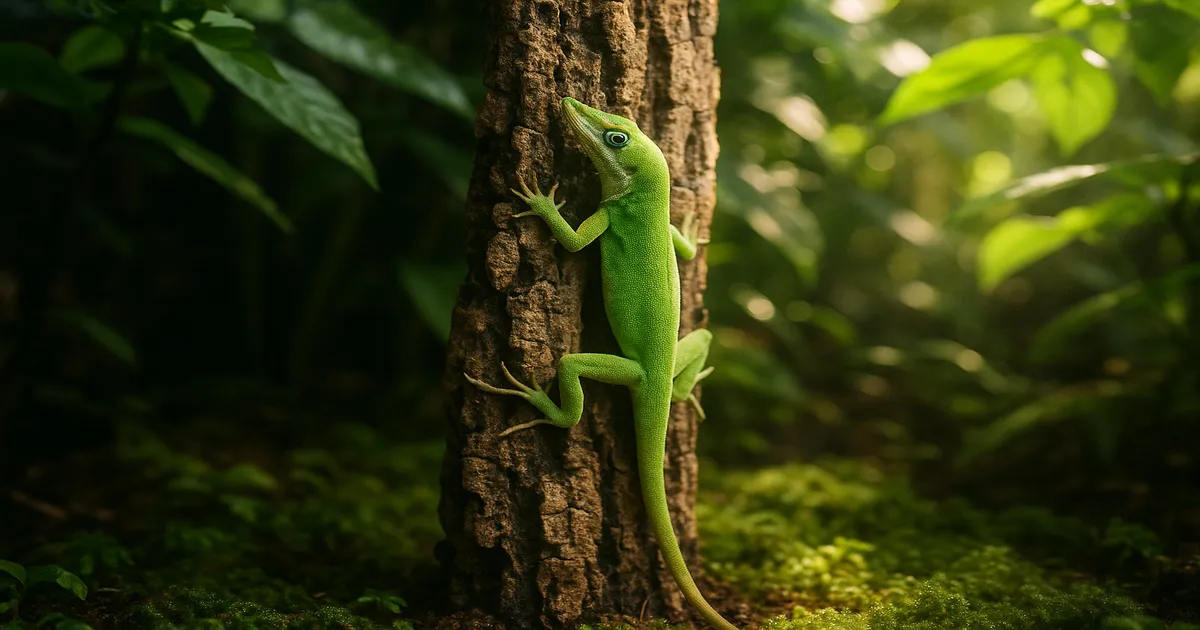
Quick Answer: Helping a green anole shed comes down to three things: humidity at 70–80% during the active shed, rough surfaces like cork bark for rubbing, and a damp sphagnum moss hide the anole can retreat to on its own schedule. Anoles shed in patches over several days — not in one piece like a snake — so don’t panic if it looks messy. Get the husbandry right and you’ll rarely need to intervene at all.
Green anoles are tougher than their reputation suggests, but shedding problems — dysecdysis, technically — are one of the most common issues keepers run into. Almost every case traces back to a fixable husbandry gap. If you’re searching for how to help a green anole shed, the good news is that the fix is almost never complicated. It’s usually humidity, surfaces, or both.
Understanding Green Anole Shedding
What Is Ecdysis and Why Does It Happen?
Ecdysis is the shedding of the outermost skin layer — the stratum corneum — as the animal grows and replaces old tissue. It’s a normal, healthy process that continues throughout an anole’s entire life. The skin doesn’t just fall off on its own; the anole actively works it loose by rubbing against rough surfaces, which is exactly why enclosure setup matters so much.
Unlike snakes, green anoles don’t shed in one clean piece. Skin comes off in irregular patches over several days, which looks alarming if you’ve never seen it before. It’s completely normal.
How Often Do Green Anoles Shed?
- Juveniles: Every 3–4 weeks — they’re growing fast
- Adults: Every 4–8 weeks, depending on nutrition, season, and overall health
An adult shedding more frequently than that is worth a second look at diet and temperatures. A juvenile shedding less often than every four weeks is a sign something’s off.
Recognizing the Pre-Shed Phase
Three to seven days before the shed starts, the anole’s skin takes on a dull, grayish, washed-out look. The vivid green fades and the pattern loses its crispness. Eyes may appear slightly cloudy.
Catching this early is genuinely useful — it gives you time to boost humidity before the shed begins rather than scrambling after problems develop. Keepers who notice the dull phase early almost never deal with retained shed.
Humidity: The Most Critical Factor for a Healthy Shed
Ideal Humidity Levels During Shedding
Low humidity is the single most common cause of problem sheds in captive anoles. Everything else is secondary.
- Baseline daytime humidity: 50–60%
- During active shed: 70–80%, maintained until the shed is complete
The Wet/Dry Cycle — Why Constant High Humidity Backfires
Here’s where a lot of well-meaning keepers go wrong. They see “needs high humidity” and crank it to 80% and leave it there. That’s actually a problem — constant high humidity with no dry period promotes respiratory infections, bacterial growth, and mold in the substrate.
The right approach is a wet/dry cycle: mist once in the morning and once in the late afternoon, let humidity spike to 70–80%, then allow it to drop back toward baseline before the next session. This mirrors the natural dew and afternoon rain patterns of the anole’s native southeastern US and Caribbean habitat. During an active shed, mist a little more generously — but still let things dry out between sessions.
Measuring Humidity Accurately
Ditch the analog gauge that came with your starter kit. They’re notoriously inaccurate — I’ve seen them read 20% off from actual conditions. A digital hygrometer is non-negotiable.
Also: use distilled or reverse-osmosis water in your mister. Tap water leaves mineral deposits on glass and decor, and chlorine and chloramines can irritate your anole’s mucous membranes over time.
Enclosure Setup That Supports Easy Shedding
Best Enclosure Types for Humidity Retention
Your enclosure choice has a huge impact on hitting those humidity targets.
- Front-opening glass terrariums: Best option for most keepers. Better humidity retention, purpose-built for tropical species, and easier to access without stressing the animal. A minimum of 18×18×24 inches for one adult male is the floor, not the goal.
- Screen-top glass tanks: Workable, but you’ll lose humidity fast and need to mist more often. Partially covering the screen top with plastic wrap or a glass panel helps significantly.
- Screen enclosures: Not recommended in most of the US. Unless you live somewhere with naturally high ambient humidity year-round, you’ll fight a losing battle.
Substrate That Maintains Ambient Humidity
The substrate is doing passive humidity work around the clock.
- Coconut fiber (coco coir): Reliable, affordable, retains moisture well. Use 2–3 inches depth.
- Bioactive mix (coco fiber + organic topsoil + sand, roughly 60:30:10): Excellent for planted setups; maintains humidity passively once established.
- Sphagnum moss top layer: Adding moss over your substrate creates a humidity reservoir right where the anole spends time near ground level.
Avoid paper towels and reptile carpet. Both are humidity black holes and offer nothing for shedding.
Rough Surfaces for Natural Rubbing Behavior
This part gets overlooked constantly. Anoles need texture to shed. A bare enclosure with smooth plastic plants gives them nothing to work shed against, so the process stalls even when humidity is fine.
What actually works:
- Cork bark rounds and flats — the rough, furrowed texture is ideal for rubbing
- Manzanita branches and grapevine wood — multiple diameters let the anole choose the right fit
- Dried magnolia or oak leaf litter on the substrate — natural rubbing surfaces at ground level that most care guides never mention
If your decor is all smooth plastic, that’s worth changing.
The Humid Hide: Single Most Effective Shedding Tool
If I had to pick one thing that makes the biggest difference in shedding outcomes, it’s a damp sphagnum moss hide. Simple, cheap, and it works every time.
Make one from a small deli cup or Tupperware container with a hole cut in the side, packed with moist (not soaking wet) sphagnum moss. Place it on the cool side of the enclosure. Your anole will find it during pre-shed and spend hours inside — they’re self-regulating their microenvironment. Re-wet or replace the moss every 3–5 days.
Temperature and Lighting
Basking and Ambient Temperature Targets
Low temperatures slow metabolism, and a sluggish metabolism means incomplete sheds. Anoles need to thermoregulate actively to drive the physiological processes behind ecdysis.
- Basking spot: 88–95°F (31–35°C)
- Warm side ambient: 80–85°F (27–29°C)
- Cool side ambient: 72–76°F (22–24°C)
- Nighttime minimum: 65°F (18°C), ideally 68–72°F (20–22°C)
UVB Lighting and Skin Health
UVB isn’t optional for green anoles. It drives vitamin D3 synthesis and calcium metabolism, both of which directly affect skin condition and shed quality. Anoles kept without proper UVB will eventually show poor skin health, and their sheds will reflect it.
Use a T5 HO 5.0 or 6% bulb — the Arcadia 6% and Zoo Med Reptisun 5.0 T5 HO are the two I’d recommend. Position it 8–12 inches from the basking area and replace it every 12 months regardless of whether it still produces visible light. UV output degrades well before the bulb burns out.
Mimic natural seasonal photoperiods too: 12–14 hours of light in summer, 10–11 hours in winter. It supports normal hormonal rhythms, which influence shedding frequency and quality.
How to Help a Green Anole Through a Shed: Step by Step
Step 1 — Spot the pre-shed phase early. Watch for dull, grayish skin and reduced color vibrancy 3–7 days before the shed begins. Once you’ve seen it a few times, you’ll recognize it immediately.
Step 2 — Boost humidity proactively. As soon as you notice the dull phase, increase misting to push humidity toward 70–80%. Don’t wait for the shed to start. Getting ahead of it is the whole game.
Step 3 — Activate the humid hide. Make sure the sphagnum moss is freshly moistened and the entrance is accessible. The anole will do the rest.
Step 4 — Leave the animal alone. Do not handle your anole while it’s actively shedding. Even accidentally catching a piece of loose skin can tear underlying tissue, causing scarring or opening the door to infection. Just watch.
Step 5 — Check for retained shed once it’s done. Under good lighting, inspect the toes (look for constricting rings), the tail tip (retained shed here can cut off circulation), and the eyes (look for a dull or double-layered appearance). If everything looks clear, you’re done.
Dealing With Retained Shed
Safe Soaking Technique for Stuck Shed
- Fill a small deli cup with about ¼ inch of lukewarm water — 85–88°F (29–31°C).
- Add a damp paper towel or piece of moss for the anole to grip. They’re much calmer with something to hold onto.
- Soak for 5–10 minutes maximum.
- Use a damp cotton swab to gently press and roll the retained shed — never pull. It should slide off with minimal effort if it’s adequately hydrated.
Never try to remove dry retained shed without soaking first. It’s bonded to living tissue and you will cause damage.
Retained Eye Caps: See a Vet
Retained spectacles (eye caps) are the most dangerous retained shed and the easiest to miss. Under good lighting, a retained cap gives the eye a slightly dull or double-layered look compared to the other eye.
Don’t attempt to remove eye caps yourself unless you have significant hands-on experience. The risk of damaging the eye is real. If your anole has retained eye caps after two consecutive sheds, see a reptile-experienced vet. Preventing it in the first place is almost entirely about humidity — if it keeps happening, something in your setup needs to change.
A shedding aid spray can be misted lightly onto stuck areas during or after a soak as a short-term assist. It’s a useful safety net, not a substitute for fixing the underlying husbandry.
Common Mistakes That Cause Shedding Problems
Humidity too low or too high. Too low causes retained shed; too high causes respiratory infections. The wet/dry cycle solves both.
No rough surfaces. Smooth plastic decor is one of the most overlooked causes of shedding failure. The shed initiates but can’t progress without something to rub against.
Handling during an active shed. Even a brief accidental touch can tear tissue. Leave the animal alone.
Expired UVB and poor nutrition. Old bulbs and calcium/vitamin D3 deficiency both degrade skin quality. Replace UVB bulbs annually and dust feeders with calcium + D3 powder 2–3 times per week. (Repashy Supercal LoD)
Housing two males together. Chronic territorial stress suppresses immune function and disrupts normal behavior — including shedding. It also makes pre-shed dullness nearly impossible to detect against a chronically stressed brown coloration. One male per enclosure, full stop.
Frequently Asked Questions
How long does it take a green anole to shed?
Most green anoles complete a shed over 2–5 days, though it can stretch to a week if humidity is suboptimal. Unlike snakes, the shed comes off in patches rather than one piece, so you’ll see it happening gradually across different areas of the body.
Why is my green anole not shedding completely?
Incomplete shedding is almost always a humidity problem. Check your hygrometer — if you’re using an analog gauge, replace it with a digital one, since analog gauges are often significantly inaccurate. Also confirm the enclosure has rough surfaces to rub against and that a damp sphagnum moss hide is available.
Should I peel the shed skin off my green anole?
No — don’t peel shed skin off a dry anole. If retained shed is present, soak the animal in ¼ inch of lukewarm water (85–88°F) for 5–10 minutes first, then use a damp cotton swab to gently press and roll the loosened skin away. Pulling dry shed tears living tissue and can cause permanent scarring or infection.
How do I know if my green anole has retained eye caps?
Look carefully under good lighting. A retained eye cap gives the affected eye a slightly dull, hazy, or double-layered appearance compared to the other eye. It’s subtle and easy to miss. If you suspect retained spectacles after two consecutive sheds, consult a reptile vet rather than attempting removal yourself.
What humidity do green anoles need to shed properly?
Aim for 70–80% during an active shed, with a baseline of 50–60% during normal periods. Mist morning and late afternoon, letting humidity drop between sessions to prevent respiratory issues. A damp sphagnum moss hide gives your anole a high-humidity microclimate to use on its own terms — it’s the single most effective tool for preventing shedding problems.