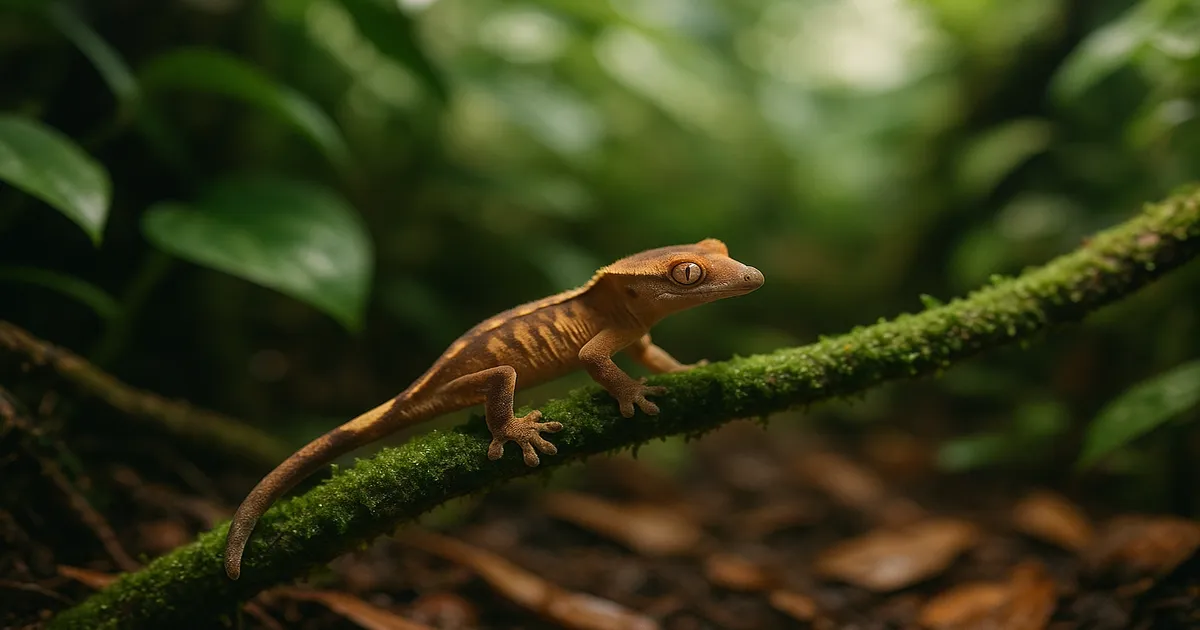
Quick Answer: Caring for newly hatched crested geckos starts with getting three things right: a small enclosure (a 6-quart tub or an 8”×8”×12” terrarium), temperatures between 72–78°F (22–26°C), and a wet-dry humidity cycle that peaks at 80–90% after misting. Feed Crested Gecko Diet (CGD) every other day, and don’t stress if your hatchling ignores food for the first 5–10 days — they’re still absorbing yolk reserves and have zero interest in your carefully mixed CGD. These animals weigh 1.5–3 grams at birth and can live 15–20 years. Getting the basics right early genuinely matters.
Understanding Your Newly Hatched Crested Gecko
Species Background and Natural Habitat
Crested geckos (Correlophus ciliatus) come from the cool, humid montane rainforests of New Caledonia, a French island territory in the South Pacific. Wild temperatures there rarely crack 80°F (27°C) and drop into the low 60s°F (~16°C) at night — which explains a lot about why these animals are so sensitive to heat. They were believed extinct until 1994, when a survey team caught in a tropical storm stumbled across a thriving population. Nearly every crested gecko in captivity today descends from that original discovery stock, and the species remains IUCN Vulnerable in the wild.
What to Expect in the First Two Weeks
Hatchlings emerge weighing 1.5–3 grams with a total length of about 3–4 inches (7.5–10 cm). Genuinely tiny. They’re fully independent from birth, which sounds impressive until you’re staring at something smaller than your thumb and trying to figure out if it’s okay.
Most won’t eat for the first 5–10 days because they’re still absorbing residual yolk from the egg. Their first shed usually happens somewhere between days 7 and 14, and they’ll eat the skin almost immediately after — that’s normal, not alarming. Don’t try to intervene.
Tail Autotomy: Take This Seriously
Crested geckos can voluntarily drop their tails as a stress response, and unlike many lizards, they do not grow them back. Ever. Hatchlings are at the highest risk: they’re easily stressed, their tails are proportionally large relative to their body, and their handling tolerance is essentially zero for the first few weeks. Treat tail loss prevention as a hard rule, not a suggestion.
Enclosure Setup for Crested Gecko Hatchlings
Why Smaller Is Actually Better
A 1.5-gram gecko in a large terrarium is worse off than one in a snug tub. Food is harder to find, humidity swings more dramatically, and all that open space is stressful rather than enriching. A small enclosure isn’t cruel — it’s appropriate.
Best Enclosure Options
Two setups dominate for hatchlings:
- Sterilite or Rubbermaid 6-quart tub — drill cross-ventilation holes in the sides and lid, and you’ve got what most serious breeders use. Cheap, easy to clean, holds humidity well. Not pretty, but it works.
- Exo Terra Nano (8”×8”×12” / 20×20×30 cm) — front-opening glass with dual doors. Better if you want to actually see your animal without sacrificing appropriate sizing.
The tub is the practical choice. The Exo Terra Nano is the display choice. Both work.
Enclosure Progression as Your Gecko Grows
Don’t rush upgrades. Follow this and you’ll be fine:
- Hatchling to ~5g: 6-quart tub or 8”×8”×12” enclosure
- 5–15g: 12”×12”×18” (30×30×45 cm) terrarium
- 15g and above: Minimum 18”×18”×24” (45×45×60 cm) front-opening terrarium
Always go vertical. Crested geckos are arboreal — they use height constantly.
Should You House Hatchlings Together?
Don’t. Hatchlings kept together will nip each other’s tails, compete for food, and stress each other in ways that are hard to detect until something’s already wrong. If you’re short on enclosures and absolutely must cohouse, they need to be within 1 gram of each other in weight, and you need to watch them closely. Separate at the first sign of tension.
Temperature and Humidity: Getting the Environment Right for Newly Hatched Crested Geckos
Ideal Temperature Range
The sweet spot is 72–78°F (22–26°C) during the day, dropping to 65–72°F (18–22°C) at night. That nighttime drop is actually beneficial — it mirrors New Caledonia’s natural rhythm. The hard ceiling is 82°F (28°C). Sustained temps above 85°F (29°C) can kill hatchlings, and because they’re so small, they have almost no thermal buffer. Direct sunlight through a window can hit lethal temperatures in minutes, even on a mild day.
Heating: What to Use and What to Skip
Many keepers in temperate homes — anywhere maintained at 68–76°F (20–24°C) — need no supplemental heat at all. That’s genuinely the safest setup. If you do need heat, a radiant heat panel mounted inside the top of the enclosure warms the air gently without creating hot spots. Whatever you use, run it through a thermostat (Inkbird ITC-306) — no exceptions.
Under-tank heaters are a poor fit. Crested geckos don’t thermoregulate from below, and a belly burn on a 2-gram hatchling is a serious problem.
The Wet-Dry Humidity Cycle
The goal isn’t constant high humidity — it’s a cycle. Mist until the walls are wet and humidity spikes to 80–90%, then let it partially dry back to 50–60% before the next misting. That dry-out period prevents bacterial and fungal growth. Keeping it perpetually damp is one of the most common mistakes new keepers make, and it leads to respiratory infections faster than almost anything else.
Mist once or twice daily — evening is ideal since it mimics natural dew patterns. Wet the walls and decor, not the gecko directly. Hatchlings drink by lapping droplets off the glass and leaves, so visible water droplets matter.
Skip the analog thermometers and hygrometers — they’re inaccurate enough to cause real problems. Use a digital combo unit with the probe positioned at mid-level where your gecko actually spends time.
Feeding Newly Hatched Crested Geckos
Crested Gecko Diet (CGD)
CGD is the nutritional foundation, and two brands have earned their reputation: Repashy and Pangea . Mix to a thin, pourable consistency — roughly 2 parts water to 1 part powder. If it sits in a lump, it’s too thick and hatchlings will struggle to lap it up. Offer every other day and remove it after 24–36 hours. Uneaten CGD molds fast, and mold in a small hatchling enclosure is a genuine health risk.
Live Insects as a Supplement
Once your hatchling is eating consistently, offer live insects once or twice a week. For hatchlings, that means 1/4-inch (6mm) crickets or small dubia roach nymphs — nothing larger than the space between the gecko’s eyes. Gut-load feeders for 24–48 hours before offering them. Feeding a poorly nourished insect to a 2-gram gecko is a wasted opportunity nutritionally.
Supplementation
CGD already contains calcium and vitamins, so supplementation is mainly about the insects:
- Calcium without D3 — dust insects lightly at every insect feeding
- Calcium with D3 — every 2–4 insect feedings (more often if you’re not providing UVB)
- Multivitamin (e.g., Repashy Supervite) — once every two weeks
For water, a bottle cap or very shallow dish — no deeper than 1/4 inch (6mm) — changed daily. A 1.5-gram gecko can drown in a surprisingly small amount of water. Don’t skip this.
Lighting, Substrate, and Decor
UVB: Is It Necessary?
The science has shifted on this. Crested geckos were historically kept without UVB and did fine on supplemented CGD, but recent research increasingly supports providing low-level UVB (Ferguson Zone 1–2, targeting 0.5–1.5 UVI at the gecko’s level). The Arcadia ShadeDweller and Zoo Med T5 HO 5.0 are both solid choices, positioned 12–18 inches (30–45 cm) from where the gecko rests. If you skip UVB, increase your calcium with D3 frequency slightly.
Set a 12–14 hour photoperiod in summer, 10–12 hours in winter, on a timer. Skip the red and blue “night” bulbs — crested geckos can perceive those wavelengths, and they disrupt natural behavior.
Substrate
Paper towels. That’s my recommendation for any hatchling under 5–10 grams. You can see every dropping, spot parasites, monitor hydration, and swap it out in 30 seconds. Zero impaction risk. Not glamorous, but it’s the right call at this stage.
Coco coir (Zoo Med Eco Earth, Exo Terra Plantation Soil) is a reasonable step up once you’re comfortable monitoring the animal. Bioactive setups are great — but save them for juveniles over 10 grams.
Avoid entirely: calcium sand, reptile carpet, gravel, cedar, pine, or any loose substrate with particles larger than the gecko’s head.
Hides, Cork Bark, and Plants
Two hides minimum — one on the brighter side, one on the darker side. For hatchlings, the hide should fit snugly. A hide that’s too large doesn’t provide the security they need. Cork bark tubes and flats are ideal: naturally antimicrobial, they hold up well in humid conditions, and they look good. Add some non-toxic plants — pothos, bromeliads, and peperomia all work well — for cover and climbing structure.
Common Mistakes When Caring for Newly Hatched Crested Geckos
Enclosure and environment:
- Enclosure too large — the single most common beginner mistake
- Constant high humidity — the dry phase matters as much as the misting
- No thermostat on heating equipment
- Direct sunlight on the enclosure, even through a window
- Red or blue night bulbs
Feeding:
- Panicking over the first week of fasting — it’s normal
- CGD mixed too thick — it should pour, not sit in a lump
- Prey items larger than eye-width
- Leaving uneaten CGD in the enclosure past 36 hours
Handling:
- Handling before two weeks, or before the gecko is eating consistently
- Grabbing from above — this triggers a hard-wired predator response
- Not letting the gecko walk onto your hand voluntarily
Weekly Care Routine and Health Monitoring
Daily, Weekly, and Monthly Tasks
Daily:
- Mist once or twice (evening misting is essential)
- Check temperature and humidity
- Refresh the water dish
- Offer CGD every other day; remove uneaten food within 24–36 hours
Weekly:
- Weigh on a 0.1g precision digital scale
- Spot-clean substrate
- Inspect for retained shed around toes and eyes
- Check for mites on the gecko and enclosure walls
Monthly:
- Full disinfection with F10SC or Zoo Med Wipe Out
- Assess whether an enclosure upgrade is due
Why Weekly Weigh-Ins Matter
At 1.5 grams, losing 0.3 grams is a 20% body weight loss. That’s a medical situation, not a minor fluctuation. A 0.1g precision scale is non-negotiable. Log the numbers weekly — slow, steady gain is what you’re looking for.
Healthy Signs vs. Warning Signs
Healthy hatchling:
- Clear, bright eyes
- Clean vent with no swelling or staining
- Fat, rounded tail base
- Active and alert at dusk
- Consistent week-over-week weight gain
Contact a reptile vet if you see:
- Weight loss over two or more consecutive weeks
- Retained shed around toes or eyes
- Labored or wheezy breathing
- Mucus around the mouth or nostrils
- Lethargy during normally active hours
- Tiny moving specks on the gecko or enclosure walls (mites)
Frequently Asked Questions About Caring for Newly Hatched Crested Geckos
Why is my newly hatched crested gecko not eating?
Almost certainly because they don’t need to yet. Hatchlings absorb residual yolk for the first 5–10 days after hatching, so refusing food during this window is completely normal. Keep offering CGD every other day, maintain appropriate temperatures and humidity, and give them time. If a hatchling is still consistently refusing food past the two-week mark, that’s worth looking into.
How often should I mist a crested gecko hatchling enclosure?
Once or twice daily — many keepers do a light misting in the morning and a heavier one in the evening. The goal is a wet-dry cycle: humidity spikes to 80–90% after misting, then settles back to 50–60% before the next misting. Constant high humidity is actually harmful, so the dry-out period matters just as much as the misting itself.
What size enclosure does a crested gecko hatchling need?
A 6-quart plastic tub or a terrarium no larger than 8”×8”×12” (20×20×30 cm) is ideal for hatchlings under 5 grams. Bigger is not better at this stage — a large enclosure makes food harder to find, humidity harder to maintain, and leaves the gecko feeling exposed and stressed.
When can I start handling a newly hatched crested gecko?
Wait a minimum of two weeks, and honestly, waiting until the gecko is eating consistently is smarter. Early handling causes stress, and a stressed hatchling risks dropping its tail permanently. When you do start, keep sessions to a few minutes at most and always let the gecko walk onto your hand rather than grabbing it.
Do crested gecko hatchlings need UVB lighting?
They can thrive without it if you’re supplementing calcium with D3 appropriately, but current research supports providing low-level UVB (Ferguson Zone 1–2). It’s not strictly required, but it’s increasingly considered best practice — especially as more keepers move toward naturalistic setups.