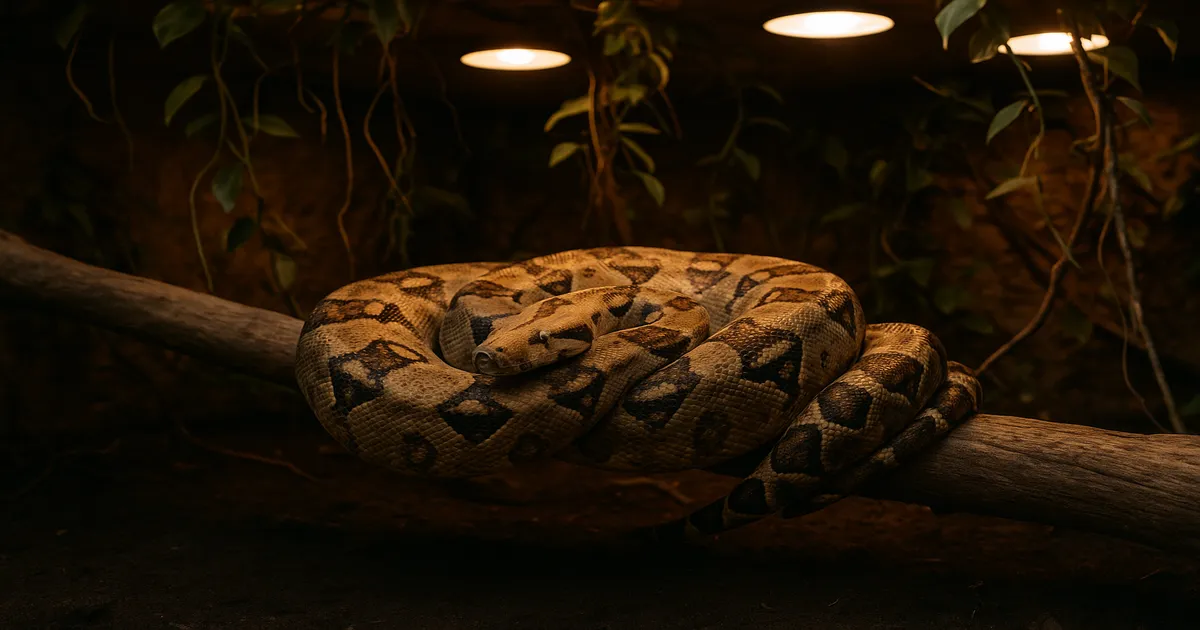
Quick Answer: Boa constrictors need spacious enclosures, a thermal gradient of 75–92°F, and steady 60–70% humidity. Adults eat pre-killed rats every 14–21 days and live 20–30 years — this is a decades-long commitment, not an impulse buy. Get a captive-bred B. c. imperator from a reputable breeder and you’ll have one of the most rewarding snakes in the hobby.
Learning how to care for boa constrictors properly is one of those things where getting the fundamentals right from day one makes everything else easier. Boas are genuinely forgiving compared to a lot of species, but “forgiving” doesn’t mean “anything goes.” A boa kept in a cramped enclosure with inconsistent temperatures and no real hides will slowly deteriorate — and because these snakes are stoic, you often won’t notice until there’s a real problem. Get the setup right first, and everything else falls into place.
Boa Constrictor Care at a Glance
- Species: Boa constrictor imperator is the most common and beginner-friendly; true red-tails (B. c. constrictor) get larger and need more humidity
- Adult size: Females 6–9 ft (1.8–2.7 m), males 5–7 ft (1.5–2.1 m)
- Lifespan: 20–30+ years
- Temperature gradient: 75–92°F (24–33°C)
- Humidity: 60–70% baseline
- Feeding: Pre-killed rats every 14–21 days for adults
- Legal status: CITES Appendix II — check your state and local laws before buying; Florida, New York, and several other states have restrictions
Is a Boa Constrictor Right for You?
Boas aren’t hard to keep, but they’re not small. A female B. c. imperator will eventually need an enclosure the size of a large piece of furniture, and she’ll live long enough to outlast a dog, a cat, and possibly a marriage. If you’re ready for that, great. If you’re on the fence, start with a ball python and revisit boas in a year. If you do go forward, buy captive-bred from a reputable breeder — it makes every part of this easier.
Species Background: What You’re Actually Getting
Subspecies Commonly Kept in Captivity
B. c. imperator — the Colombian or Central American boa — is what you’ll find at most reptile expos and from most breeders, and it’s the right choice for most keepers. The true red-tail (B. c. constrictor) from South America is larger, more humidity-demanding, and a genuine step up in complexity. Hog Island boas (B. c. sabogae) are smaller, prefer lower humidity (50–65%), and are popular for keepers with limited space. There are also hundreds of color morphs across all these lines — albino, hypo, motley, sunglow — making boas one of the most visually diverse snakes in the hobby.
Size, Lifespan, and Long-Term Commitment
This is the part people underestimate most. A female B. c. imperator won’t hit full size until she’s 4–5 years old, and she’ll keep you company for 20+ years after that. Plan for the adult animal from day one — both in terms of enclosure budget and lifestyle. Boas are viviparous (live-bearing), which is unusual among large constrictors; a gravid female can deliver 10–60+ live young after roughly 100–120 days of gestation.
Temperament
Captive-bred boas are genuinely docile when handled consistently. I’ve worked with animals calm enough to drape over a shoulder without a second thought. Wild-caught boas are a different story — stressed, heavily parasitized, and often food-refusing for months. Don’t buy wild-caught. It’s not worth it for you or the animal.
How to Care for Boa Constrictors: Enclosure Setup
Enclosure Size by Age and Sex
| Life Stage | Minimum Enclosure Size |
|---|---|
| Juvenile (under 3 ft) | 36” × 18” × 18” (91 × 46 × 46 cm) |
| Sub-adult (3–5 ft) | 48” × 24” × 24” (122 × 61 × 61 cm) |
| Adult female (6–9 ft) | 6’ × 3’ × 2’ (183 × 91 × 61 cm) |
| Adult male (5–7 ft) | 5’ × 2’ × 2’ (152 × 61 × 61 cm) |
Floor space matters more than height for adults, though juveniles will use climbing structure if you provide it.
Best Enclosure Types
PVC enclosures are the gold standard for adults. They hold heat and humidity better than anything else, they’re easy to clean, and front-opening doors mean you’re not reaching over a large snake from above — which stresses the animal. Animal Plastics, Boaphile Plastics, and Zen Habitats all make solid options.
Glass terrariums work fine for juveniles but fight you on humidity and heat retention as the snake grows. Rack systems are popular with breeders and work well for juveniles and sub-adults — functional over aesthetic. For most display keepers, PVC or sealed wood is the right call.
Substrate
Good choices: Cypress mulch holds humidity well and is easy to spot-clean. Coconut fiber (like Zoo Med Eco Earth) is excellent for humidity retention and works best mixed with cypress. Bioactive soil mixes are great for advanced keepers who want a self-sustaining setup. Paper towels are fine for quarantine.
Avoid completely: Cedar and pine (toxic aromatic oils), reptile carpet (bacteria trap, causes snout abrasions), and sand (impaction risk, poor hygiene). Keep substrate depth at 3–4 inches minimum so the snake can partially burrow.
Hides and Decor
Every boa needs two hides — one on the warm side, one on the cool side. The hide must be snug. A hide that’s too large provides no security; the snake should feel the walls on its body. Cork bark rounds are my personal favorite — they look great, hold humidity, and last for years. Add a branch or two for juveniles (at least as thick as the snake’s body — they’ll actually use it) and a heavy ceramic water bowl large enough for the snake to soak in. Boas soak regularly, especially before a shed.
Temperature and Humidity
Getting the Gradient Right
- Basking surface: 88–92°F (31–33°C)
- Warm ambient: 82–86°F (28–30°C)
- Cool side: 75–80°F (24–27°C)
- Nighttime minimum: 72°F (22°C); aim for 74–76°F (23–24°C)
The cool side is just as important as the warm side. Without a proper gradient, the snake can’t thermoregulate — it can’t choose to cool down after digesting or warm up when it’s fighting something off. Temperatures below 70°F suppress immune function and cause regurgitation. Don’t let it get there.
Heating Equipment
Radiant heat panels are the best primary heat source for adult boas in PVC or wood enclosures — they warm ambient air and surfaces evenly without a single intense hot spot. Size the panel to cover roughly one-third of the enclosure ceiling. For overnight temperature maintenance, a thermostat-controlled ceramic heat emitter handles the job cleanly.
Every heat source must run through a thermostat. No exceptions — unregulated heat sources kill snakes. The Inkbird ITC-306A is a solid budget option; Herpstat and Vivarium Electronics are the premium picks if you want more precision and peace of mind.
Humidity
B. c. imperator does well at 60–70% baseline; bump it to 70–80% during shed. True red-tails want 65–75%; Hog Island boas are comfortable at 50–65%. Chronic humidity above 80% with poor ventilation causes scale rot and bacterial dermatitis. Chronic humidity below 50% causes incomplete sheds and dehydration.
Cypress mulch, a large water bowl, and a well-sealed enclosure handle humidity for most keepers without extra effort. In dry climates, a light misting on one side of the enclosure a few times a week does the job. Monitor with a digital hygrometer — Govee and Inkbird Bluetooth models let you check remotely, which is genuinely useful.
Use a digital probe thermometer on each side of the enclosure (dial thermometers are inaccurate — skip them) and an infrared temperature gun for checking actual surface temps.
Feeding Your Boa Constrictor
What and How Much
Pre-killed or frozen/thawed rats. That’s the answer. Live prey can and does injure snakes — bite wounds, eye damage, even death. There’s no benefit to live feeding that outweighs the risk. Prey size should roughly match the widest point of the snake’s body; a small lump after feeding is normal.
Feeding frequency:
- Hatchlings (under 12 in): Every 5–7 days
- Juveniles (1–3 years): Every 7–10 days
- Sub-adults: Every 10–14 days
- Adults: Every 14–21 days
Adults fed every 7 days will become obese. It’s one of the most common ways keepers shorten a boa’s life.
Warming Frozen-Thawed Prey
Thaw in the refrigerator overnight, then warm in a ziplock bag submerged in hot water until the prey reaches 100–105°F (38–41°C). Check with your infrared gun. Never use a microwave — it creates hot spots and destroys the scent cues that trigger the boa’s heat-sensing labial pits. A properly warmed prey item is dramatically more appealing than one that’s just room temperature.
Picky Feeders and Obesity
For boas switching from mice to rats, scenting works well — rub the rat against a mouse or put it briefly in a bag with mouse bedding. Feeding in the enclosure is fine for boas and less stressful than moving them to a separate container. If a boa still refuses, braining the prey item (a small incision exposing brain tissue) is a last resort that works when nothing else does.
On the flip side: a healthy boa in cross-section looks like a slightly rounded triangle. If it looks like a circle, it’s overweight. Obesity leads to fatty liver disease, reproductive failure, and a significantly shortened lifespan. Feed on schedule, use appropriate prey sizes, and resist the urge to feed more because the snake “seems hungry.”
Handling and Behavior
How to Handle a Boa Safely
Support the whole body — don’t grip or restrain the head unless there’s a specific reason. Move slowly. Let the snake move through your hands rather than holding it fixed. For larger adults, having a second person around is sensible, not because boas are dangerous, but because a 20-pound snake that decides to anchor itself to something is genuinely hard to manage solo.
Reading Body Language
An S-curve posture with a flattened, triangular head means the snake is defensive. Tail rattling — yes, boas do this — is another stress signal. A relaxed boa moves with slow, exploratory movement and a loosely coiled body. Learn the difference early.
For juveniles, 2–3 short handling sessions per week builds tameness quickly. Adults maintain their disposition with 1–2 sessions per week. Don’t handle within 48–72 hours of feeding (regurgitation risk), during pre-shed (wait until the shed is complete), or when the snake is in a defensive posture.
How to Care for Boa Constrictors: Common Mistakes
The single most common mistake is buying a juvenile and housing it in something that’ll be too small in two years. Plan for the adult from day one. The second most common is overfeeding — it’s one of the leading causes of premature death in captive boas, and it happens because keepers confuse a feeding response with actual hunger.
Other frequent errors: hides that are too large (chronic stress, food refusal), no cool side (the snake can’t thermoregulate), and ignoring humidity until the snake has a stuck shed or a respiratory infection.
Any new snake goes into quarantine for 90 days minimum — in a separate room, not just a separate enclosure. Get a fecal parasite test done by a reptile vet during that window. Find that vet before you need one. Emergency-searching for an exotic vet at 10pm on a Sunday is not a situation you want to be in.
Signs of illness to watch for:
- Respiratory infection: Head elevated or tilted, wheezing, mucus around the mouth or nostrils
- Mites: Tiny moving dots on the snake or in the water bowl
- Dysecdysis: Incomplete shed, retained eye caps — almost always a humidity problem
- Scale rot: Discolored, soft, or blistered scales — usually from chronic high humidity with poor ventilation
Frequently Asked Questions
How big do boa constrictors get in captivity?
Female B. c. imperator typically reach 6–9 feet and 20–30 lbs; males stay smaller at 5–7 feet. True red-tails (B. c. constrictor) run larger, sometimes reaching 10–12 feet. Full adult size is usually reached by 4–5 years of age.
How often should you feed a boa constrictor?
Adults eat every 14–21 days. Juveniles eat more frequently — every 5–7 days for hatchlings, tapering to every 10–14 days as sub-adults. Overfeeding is a bigger problem than underfeeding in captive boas.
Do boa constrictors need UVB lighting?
It’s not strictly required for survival, but keeper experience and emerging research both suggest UVB improves immune function, feeding response, and general vitality. If you want to provide it, a 5.0 or 6% T5 HO bulb on a 12/12 cycle is appropriate — just make sure the snake has shaded areas to retreat from the light.
Are boa constrictors good for beginners?
B. c. imperator is one of the better large snake options for a first-time keeper — docile when captive-bred, adaptable, and not particularly fussy about food. The challenge isn’t temperament or husbandry complexity; it’s size and lifespan. Make sure you’re ready for a 7-foot snake that’ll be with you for 25 years before you commit.
How do I know if my boa constrictor is healthy?
A healthy boa has clear eyes (outside of shed), smooth scales with no blistering or discoloration, a body condition that looks like a rounded triangle in cross-section, regular feeding, and normal sheds. Any wheezing, mucus, lethargy outside of normal resting behavior, or significant weight loss warrants a vet visit.