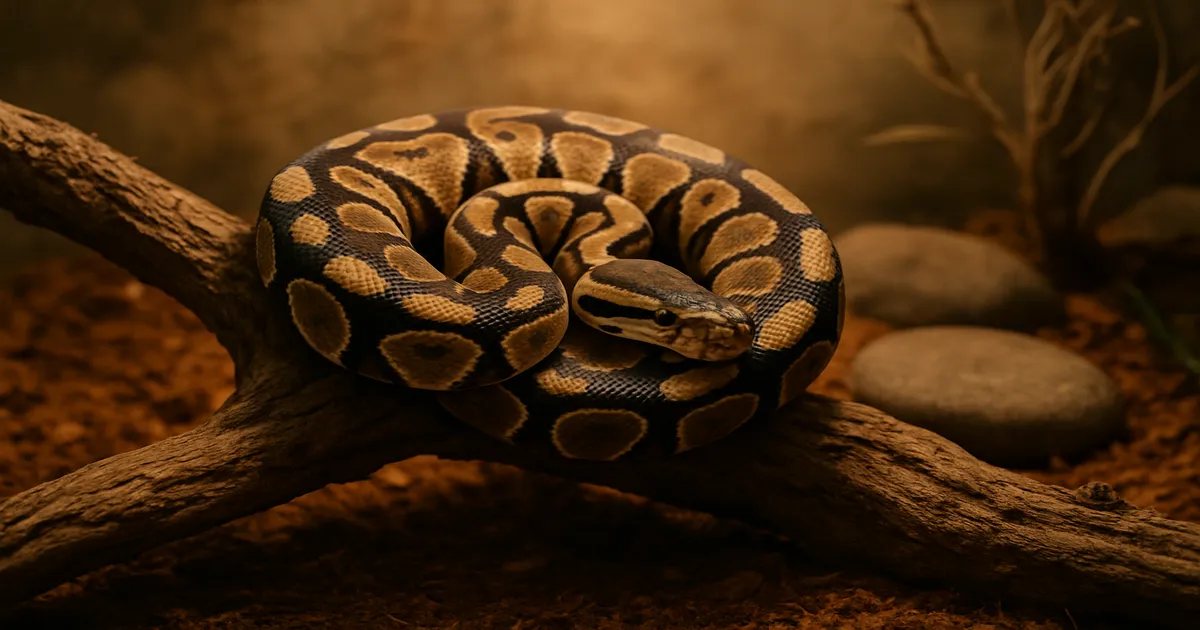
Quick Answer: Ball pythons are docile, manageable snakes that can live 20–30 years in captivity. They need a warm hide floor of 88–92°F (31–33°C), ambient cool-side temps of 76–80°F (24–27°C), humidity of 60–80%, two snug hides, and frozen/thawed prey — plus a thermostat on every heat source, no exceptions.
Knowing how to care for a ball python properly is what separates a thriving snake from a chronically stressed one. Ball pythons are calm, compact, and come in hundreds of color and pattern mutations — which is a big part of why they’re one of the most popular pet snakes on the planet. But they have specific needs that a lot of beginner guides gloss over. This one doesn’t. From enclosure setup to feeding tricks that actually work, here’s everything you need to get it right.
Ball Python Care at a Glance
Key Stats: Size, Lifespan, and Temperament
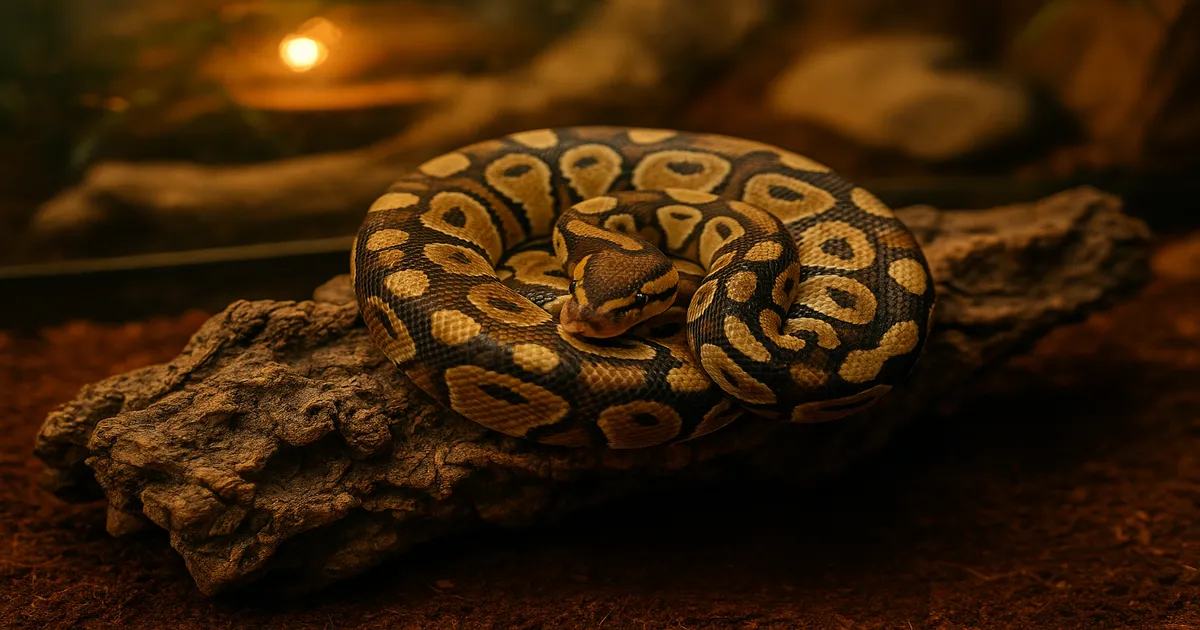
Females typically reach 3.5–5 feet and are noticeably heavier-bodied than males, which usually top out around 2.5–3.5 feet. Both sexes are slow-moving and tolerate handling well once they’ve settled in. The name “ball python” comes from their defensive habit of coiling into a tight ball with the head tucked in the center — that’s a stress response, not a relaxed posture.
Lifespan is where people get surprised: 20–30 years is completely normal, and some individuals push past 40. This is a decades-long commitment.
Core Care Requirements
| Parameter | Target Range |
|---|---|
| Warm hide floor temp | 88–92°F (31–33°C) |
| Warm side ambient | 80–85°F (27–29°C) |
| Cool side ambient | 76–80°F (24–27°C) |
| Nighttime drop | 72–75°F (22–24°C) |
| Humidity | 60–80% RH |
| Adult female enclosure | 4×2×2 ft (120×60×60 cm) minimum |
| Feeding frequency (adult) | Every 10–14 days |
| Hides | Two minimum (warm and cool side) |
Natural History and Why It Matters for How to Care for a Ball Python
Native Range and Wild Habitat
Python regius — “regius” meaning royal, a nod to the African royalty who supposedly wore them as jewelry — comes from the grasslands and open forests of West and Central Africa: Ghana, Togo, Nigeria, Senegal, and surrounding countries. During the day they’re underground in mammal burrows and termite mounds where temperatures are stable and humidity is high. They emerge at dusk to hunt.
That natural history isn’t trivia. It’s the blueprint for everything in their husbandry.
What the Burrowing Lifestyle Means for Your Setup
Ball pythons evolved in thermally buffered burrows, so they’re not built for wild temperature swings. Belly heat matters far more than overhead radiant heat — they thermoregulate through contact with warm substrate, not by basking under a lamp. That’s why the warm hide floor temperature is the number that actually matters, not the air temperature above it.
High humidity, snug enclosed spaces, and stable temperatures aren’t nice-to-haves. They’re what this animal’s physiology expects.
Captive-Bred vs. Wild-Caught
Always buy captive-bred. Wild-caught ball pythons arrive heavily parasitized, chronically stressed, and frequently refuse food for months — sometimes permanently. The captive-bred morph market is enormous, with hundreds of recognized mutations available from reputable breeders, so there’s no good reason to go wild-caught.
One caveat on morphs: spider, champagne, and woma morphs carry a neurological condition called wobble syndrome that affects balance and coordination. Research morph genetics before you fall in love with a color pattern.
Enclosure Setup: Size, Type, and Modifications
Choosing the Right Enclosure
Four main options, and they’re not equal:
- PVC enclosures (Vision, ProBox, Reptile Systems) — the best all-around choice for adults. Excellent heat and humidity retention, durable, easy to clean, and front-opening.
- Melamine/wood enclosures — solid if properly sealed against moisture.
- Tub/rack systems — the breeder standard. Efficient, cheap, and great for maintaining conditions. Not the most display-friendly, but ball pythons genuinely don’t care.
- Glass terrariums — functional with modification, but they fight you on heat and humidity retention.
Avoid wire-sided cages and anything with excessive ventilation. They’re humidity and heat sieves.
Sizing by Age
Bigger isn’t always better, especially with young snakes. A hatchling in a massive enclosure feels exposed and stressed, which leads directly to feeding refusal.
- Hatchlings (0–6 months): 12×24 inch (30×60 cm) tub equivalent
- Juveniles (6–18 months): 18×36 inch (45×90 cm) tub equivalent
- Adult females: 4×2×2 ft (120×60×60 cm) minimum
- Adult males: 3×2×2 ft (90×60×60 cm) is usually sufficient
A useful rule of thumb: the snake should be able to stretch to about 2/3–3/4 of the enclosure’s length. Below that, you’re undersizing.
Making a Glass Tank Work
If you’re starting with a glass tank, cover 75–80% of the screen top with aluminum foil or a cut-to-fit acrylic panel. An uncovered screen top in a typical home will drop humidity to 30–40%, which is far too low. Even with the cover you’ll work harder than you would in a PVC enclosure, but it’s doable.
Temperature and Heating
The Thermal Gradient
The warm hide floor temperature — 88–92°F (31–33°C) — is the single most important number in ball python care. Measure it with a temperature gun or a probe thermometer placed directly on the surface of the hide floor, not the air above it. The full gradient: warm side ambient 80–85°F (27–29°C), cool side 76–80°F (24–27°C), nighttime drop to 72–75°F (22–24°C). Don’t let it stay below 70°F (21°C) for any sustained period — that suppresses the immune system and invites respiratory infections.
Heating Equipment
- Under-tank heaters (UTH): Ultratherm and Flexwatt heat tape are the go-to options. Size to cover roughly 1/3 of the floor on the warm side. Always run these through a thermostat — without one, a UTH can hit 120°F (49°C) and cause serious burns.
- Radiant heat panels (RHP): Great for PVC and wood enclosures, mounted overhead. Reptile Basics makes reliable ones.
- Deep heat projectors (DHP): Arcadia and Habistat make these. They penetrate deeper into tissue than surface heat, which more closely mimics what a warm burrow floor does. I’ve been genuinely impressed with how well they work as a primary heat source.
- Ceramic heat emitters (CHE): Useful for supplemental ambient heat, especially in winter.
Thermostats — Not Optional
Dimming (proportional) thermostats are the gold standard — they modulate power output smoothly rather than cycling on and off. Herpstat, Inkbird ITC-306T, and Vivarium Electronics all make solid options. On/off thermostats work but cause temperature fluctuations. Rheostats — those simple dimmer switches — are not thermostats and shouldn’t be used for temperature control.
UVB and Lighting
The old “ball pythons don’t need UVB” advice is outdated. Low-level UVB is now recommended: an Arcadia Forest 6% tube mounted 12–18 inches (30–45 cm) above the enclosure supports immune function and circadian rhythm regulation. Ball pythons are shade-dwellers, so keep intensity low and always provide shaded areas where they can retreat from UV exposure. Run 12 hours on / 12 hours off in summer, dropping to 10/14 in winter.
Humidity, Substrate, and Hides
Hitting the Right Humidity
Target 60–80% relative humidity, bumping toward the higher end during shed cycles. Misting alone won’t maintain it — it spikes humidity briefly and then it drops. Deep substrate and an appropriate enclosure type are what actually hold humidity steady. Use a digital hygrometer probe at substrate level inside a hide for the most accurate reading.
Best Substrates
- Coconut fiber (Zoo Med Eco Earth, Exo Terra Plantation Soil) — excellent humidity retention, soft for burrowing
- Cypress mulch — naturally antimicrobial and holds humidity well; avoid cedar and pine, which have toxic aromatic oils
- Bioactive mixes — 60% coco coir, 30% organic topsoil, 10% sand; the base for a live-plant setup with isopods and springtails as a cleanup crew
- Organic topsoil blended with coco coir — cheap and effective
Aim for 3–6 inches of depth. Shallow substrate can’t hold humidity and prevents the burrowing behavior that makes ball pythons feel secure.
Hides
Two hides minimum — one warm side, one cool side. The hide should be snug: the snake’s body should touch the walls on both sides. A hide that’s too large provides no sense of security, and inadequate hides are the single most common cause of feeding refusal in otherwise healthy ball pythons.
Pack the warm-side hide with damp sphagnum moss. This creates a microhabitat at 90%+ humidity that the snake can choose to use, and it virtually eliminates shed problems. It’s one of the simplest upgrades you can make.
Cork bark rounds, Exo Terra caves, and 3D-printed hides all work well. For tub setups, an upside-down plastic container with an entry hole cut out is perfectly functional.
Water and Decor
The water bowl should be large enough for the snake to soak its entire body — they do this regularly, especially pre-shed. Place it on the cool side and change the water at least twice a week. Cork bark flats, live plants (pothos, snake plants, philodendrons), and branches add environmental complexity that ball pythons actually use.
Feeding Your Ball Python
Prey Size and Frequency
Match prey width to the widest point of the snake’s body. A slight lump after feeding is correct — that’s the right size.
- Hatchlings: Frozen/thawed pinkies or fuzzies, every 5–7 days
- Juveniles: Every 7–10 days, transitioning through adult mice to small rats
- Adults: Every 10–14 days on appropriately sized rats
Transition adults from mice to rats if you haven’t already. Rats are more nutritionally efficient and you’ll feed less often with better results.
Frozen/Thawed Prey
Frozen/thawed is the right call, full stop. Live prey can and does injure snakes — a cornered rat can bite through a snake’s skull, and that’s not hyperbole. Thaw in the refrigerator overnight, then warm in a bag submerged in hot water until the prey reaches 100–105°F (38–41°C). Verify with a thermometer. Cold prey gets refused far more often than people realize.
Dealing with Feeding Refusal
Ball pythons are infamous for going off food, especially in winter. A healthy adult can fast for 3–6 months without health consequences if body condition is good. Before assuming illness, check your husbandry — hide floor temp, humidity, hide sizing — because that’s almost always the culprit.
If husbandry is solid and the snake still isn’t eating, try these in order:
- Leave it alone. Place prey after dark, close the enclosure, and don’t check for an hour. Observation stress is real.
- Feed after lights out. They’re crepuscular hunters. Timing matters.
- Scent the prey. If they take mice but not rats, rub the rat with a mouse or use used mouse bedding to transfer scent.
- The paper bag method. Place the snake and prey in a brown paper bag in a warm, dark spot. The enclosed space triggers feeding response in stubborn snakes.
- Braining. Make a small incision in the skull to expose brain matter. Last resort — but the scent is highly stimulating.
Wait 48 hours after feeding before handling. Premature handling causes regurgitation, which is genuinely hard on the snake’s digestive system.
Handling and Common Mistakes
The First Four Weeks
Give a new snake a minimum of two weeks — ideally four — completely hands-off. Let it settle, eat a couple of meals, and get comfortable before you start regular handling. Skipping this is one of the most common reasons new keepers end up with a snake that won’t eat.
Safe Handling
Always approach from the side, never from above — an overhead approach mimics a predator and will put the snake on the defensive. Scoop from below, support the body, and let the snake move through your hands rather than gripping it. Avoid handling during shed, from when the eyes go blue until 3–5 days after the shed is complete.
Reading Body Language
A snake coiled into a tight ball is stressed, not content. A relaxed ball python moves with purpose, explores its enclosure, and tongue-flicks regularly. Once you know what relaxed looks like, the difference is obvious.
Top Mistakes to Avoid
- No thermostat on heaters — UTHs can hit 120°F+ and cause burns or fires
- Measuring air temperature instead of hide floor temperature
- Leaving glass tank screen tops uncovered — humidity crashes to 30–40%
- Enclosure too large for hatchlings — they stop eating
- Hides that are too large, too few, or both
- Handling right after feeding — causes regurgitation
- Panicking over seasonal fasting — check husbandry first
- Hot rocks — thermal burns; throw them away
- Routine live feeding — unnecessary and dangerous
- Buying wild-caught or neurologically compromised morphs
Frequently Asked Questions About Ball Python Care
How often should I feed my ball python?
Hatchlings eat every 5–7 days, juveniles every 7–10 days, and adults every 10–14 days. Prey should match the widest point of the snake’s body. Adults do best on rats — better nutrition, less frequent feeding than mice.
What temperature and humidity does a ball python need?
The warm hide floor should sit at 88–92°F (31–33°C) — that’s the most critical measurement. Cool side should be 76–80°F (24–27°C), and humidity should stay between 60–80% RH. Use a digital probe thermometer and a temperature gun to verify; analog dial thermometers aren’t accurate enough to trust.
Why is my ball python not eating?
Seasonal fasting is normal — healthy adults can go 3–6 months without eating. First, verify your warm hide floor is hitting 88–92°F (31–33°C), hides are snug and present on both sides, and humidity is in range. If husbandry checks out and the snake is maintaining body weight, patience is usually the right move. Significant weight loss warrants a vet visit.
How big does a ball python enclosure need to be?
Adult females need a minimum of 4×2×2 ft (120×60×60 cm); adult males can do well in 3×2×2 ft (90×60×60 cm). Floor space matters more than height for this terrestrial species. Don’t oversize for hatchlings — a 12×24 inch (30×60 cm) tub is appropriate and reduces the stress that causes feeding refusal.
Do ball pythons need UVB lighting?
Yes, current guidance recommends it. An Arcadia Forest 6% tube mounted 12–18 inches (30–45 cm) above the enclosure supports immune function, vitamin D3 synthesis, and circadian rhythm regulation. Keep intensity low and always provide shaded retreat areas — ball pythons are shade-dwellers, not baskers.