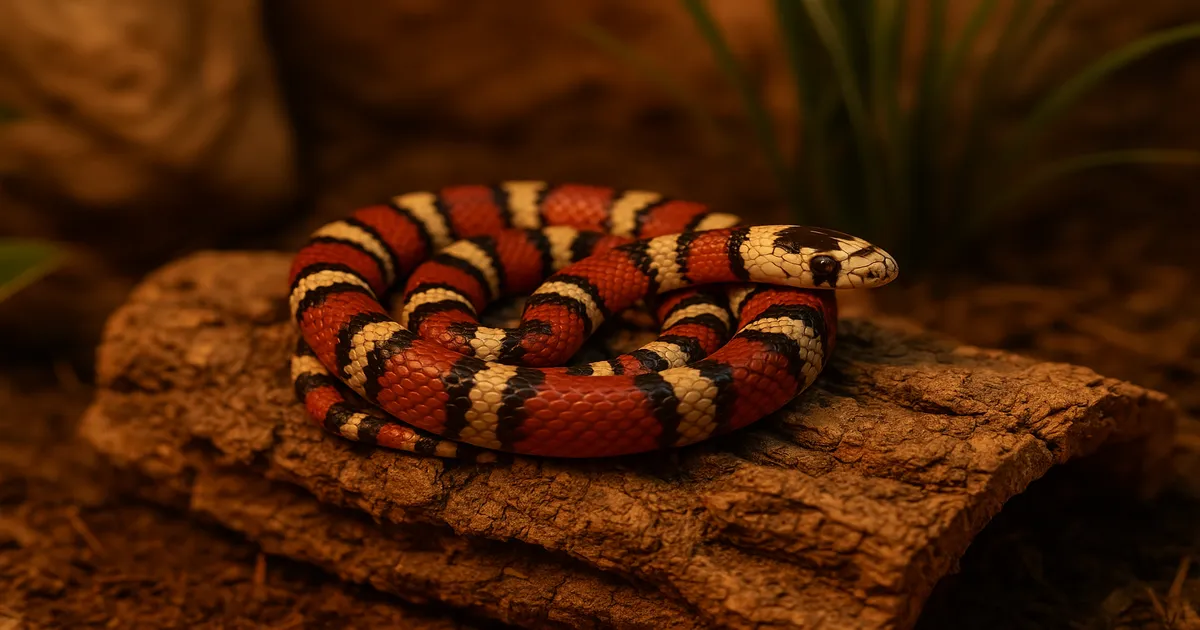
Quick Answer: Baby milk snakes need a snug 10-gallon enclosure with a warm hide of 85–88°F (29–31°C), a cool side around 72–76°F (22–24°C), and 40–60% humidity. Feed them a pinky mouse every 5–7 days and give them at least two hides — three if you count the humid hide, which you should. With proper care, these snakes can live 15–22 years.
Learning how to care for a baby milk snake is one of the more rewarding things you can do as a new keeper. These little snakes are gorgeous, stay manageable in size, and become genuinely handleable animals once they settle in. But hatchlings aren’t just small adults. They have specific needs around enclosure size, feeding, and handling that can make or break their first few months in captivity — and getting those details right early pays off for the next two decades.
Baby Milk Snake Care at a Glance
Key Care Stats for Hatchlings
| Parameter | Range |
|---|---|
| Enclosure size | 10-gallon (38L) or equivalent tub |
| Warm hide temp | 85–88°F (29–31°C) |
| Cool side temp | 72–76°F (22–24°C) |
| Humidity | 40–60% baseline |
| Feeding | Pinky mouse every 5–7 days |
| Hides | Minimum 2 (warm + cool) + 1 humid hide |
| Lifespan | 15–22 years |
What Makes Baby Milk Snakes Different from Adults
Hatchlings come out of the egg at 7–12 inches and may weigh as little as 5 grams. They’re fast, defensive, and easily stressed by oversized spaces or too much handling. Their prey needs to be tiny, their enclosure needs to feel snug and secure, and they need time to settle before you start interacting with them much. Respect those first few months and you’ll end up with a confident, easy-to-handle adult.
Understanding Baby Milk Snakes: Species Background
Natural History and Wild Behavior
Milk snakes belong to the genus Lampropeltis — Greek for “shiny shield” — which also includes kingsnakes. Their range is enormous, stretching from southeastern Canada through the United States, Central America, and into South America. The name comes from a folk myth that they’d sneak into barns to drink cow’s milk. What they were actually doing was hunting the rodents those barns attracted, which makes a lot more sense.
In the wild, milk snakes are crepuscular to nocturnal and strongly fossorial — they spend most of their time underground or tucked under rocks and logs. That behavior directly shapes how you should set up their enclosure. They need hides, they need depth in their substrate, and they don’t need bright overhead lighting.
Popular Subspecies and Their Adult Sizes
The subspecies you’re working with matters, because a Pueblan hatchling and a Honduran hatchling look similar but grow up very differently:
- Pueblan milk snake (L. campbelli): 24–36 inches as adults — a great beginner subspecies
- Eastern milk snake (L. triangulum): 24–36 inches — similar to the Pueblan in temperament and size
- Sinaloan milk snake (L. sinaloae): 36–48 inches — striking red, black, and white banding; tends to be feistier as a hatchling
- Honduran milk snake (L. hondurensis): 48–60 inches — the big one; needs more space and slightly higher humidity than the others
Coral Snake Mimicry
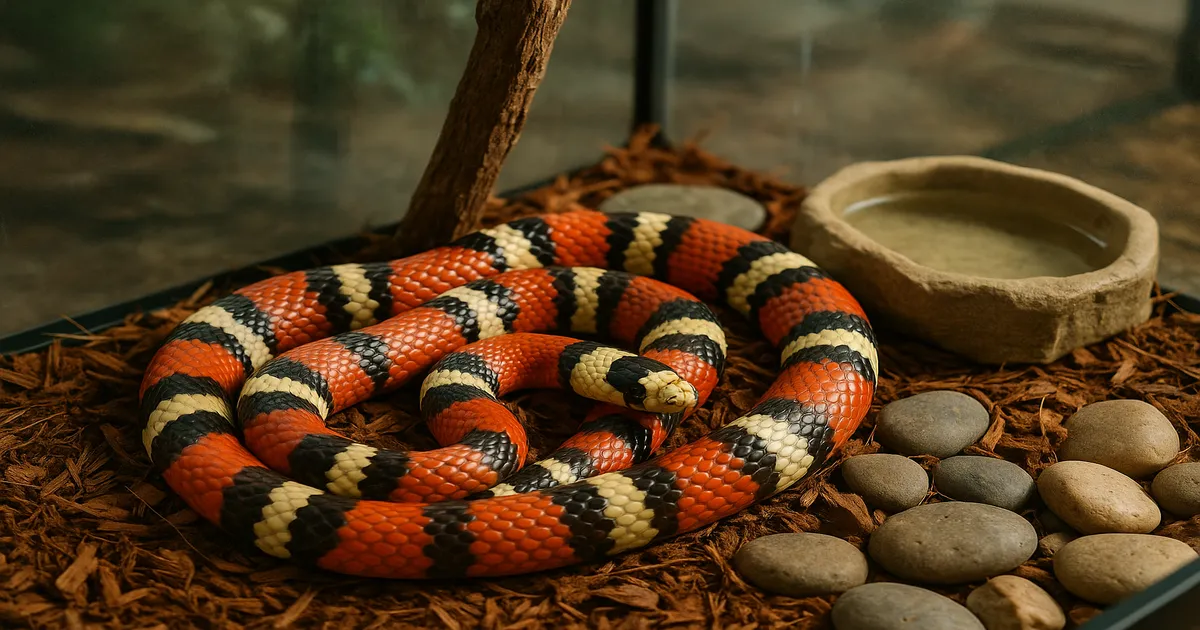
Many milk snakes display red, black, and yellow or white banding that mimics venomous coral snakes — a textbook example of Batesian mimicry. In North America, the old rhyme still holds: “Red touches yellow, kill a fellow; red touches black, friend of Jack.” Milk snakes have red touching black. It’s not foolproof outside the US, but it’s a useful quick reference.
A Note on Taxonomy
You’ll see milk snakes listed under Lampropeltis triangulum in older literature, with subspecies like L. t. hondurensis or L. t. campbelli. More recent revisions have elevated many of those subspecies to full species status, so you’ll now see L. hondurensis and L. campbelli as standalone names. Both conventions are still in common use — don’t be confused if care guides and breeder listings use them interchangeably.
Setting Up the Right Enclosure for a Baby Milk Snake
Enclosure Size: Start Small
Start with a 10-gallon (38L) tank or a plastic tub around 15” × 11” (38 × 28 cm). I know it’s tempting to buy a bigger enclosure so you don’t have to upgrade as soon, but this is one of the most common mistakes people make with hatchlings. A baby milk snake in a 40-gallon feels exposed and stressed — and a stressed hatchling stops eating.
The general rule: the enclosure’s length plus width should equal at least the snake’s body length. For babies, snug beats spacious every time.
Enclosure Types: Glass, Tub, or PVC
All three work. The right choice depends on your budget and how serious you are about the hobby:
- Glass terrariums (Exo Terra, Zoo Med): Good visibility, and front-opening doors are strongly preferred over top-opening — reaching in from above triggers a defensive response in hatchlings. Downside: they don’t hold humidity as well as the other options.
- Plastic tubs (Sterilite, IRIS): My go-to for hatchlings. Cheap, easy to clean, hold humidity well, and snakes are perfectly comfortable in them. Drill or melt small ventilation holes in the lid and upper sides.
- PVC enclosures (Vision, Animal Plastics, Zen Habitats): The premium long-term option. Excellent insulation, front-opening, and built to last decades. Worth the investment if you’re planning to keep milk snakes seriously.
Escape-Proofing
Milk snakes are legendary escape artists. They’ll find every gap, test every lid, and squeeze through spaces that seem physically impossible. If you’re using a glass tank with a screen lid, use binder clips on all four sides — don’t trust the built-in clips alone. Plastic tubs need secure latches or a weight on top. Check your setup regularly.
Upgrading as Your Snake Grows
- Hatchling to ~18 inches: 10-gallon (38L) or equivalent tub
- 18–30 inches: 20-gallon long (75L), approximately 30” × 12” (76 × 30 cm)
- Adult (most subspecies): 40-gallon (150L) breeder, 36” × 18” (91 × 46 cm)
- Large Hondurans: 4’ × 2’ × 2’ (120 × 60 × 60 cm) PVC or equivalent
Temperature, Humidity, and Lighting
Getting the Thermal Gradient Right
Milk snakes thermoregulate by moving between warmer and cooler areas, so you need a real gradient from one end of the enclosure to the other:
- Warm hide: 85–88°F (29–31°C)
- Warm side ambient: 80–85°F (27–29°C)
- Cool side ambient: 72–76°F (22–24°C)
- Nighttime drop: 68–72°F (20–22°C) — fine, and actually mimics natural conditions
- Never below: 65°F (18°C) for extended periods
- Never above: 90°F (32°C) on the warm side — overheating can kill hatchlings quickly
Always measure substrate-level temperature with a digital probe thermometer or an infrared temp gun. (Etekcity Lasergrip 774 infrared thermometer) Stick-on dial thermometers measure air temperature and are notoriously inaccurate. Don’t rely on them.
Heating Equipment
An under-tank heater (UTH) placed under one-third of the enclosure on the warm side is the standard heat source for most setups. The non-negotiable part: it must be connected to a thermostat. An unregulated UTH can reach 120°F (49°C) or higher through the substrate and will thermally burn your snake. An Inkbird ITC-306T is an affordable, reliable on/off thermostat that works well for most setups. If you want more precise control, a proportional thermostat like the Herpstat 1 is worth the extra cost.
For rooms that run cool, a ceramic heat emitter (CHE) mounted in a deep dome fixture can supplement the UTH. No light, no problem — just make sure it’s also on a thermostat.
Humidity
Most milk snakes do well at 40–60% relative humidity. During a shed cycle, bump that up to 60–70% by lightly misting one side or adding damp sphagnum moss to the humid hide.
Subspecies-specific notes:
- Honduran: Comfortable at 50–65%
- Sinaloan and Pueblan: Keep toward the lower end, 40–55% — chronic high humidity causes respiratory infections and scale rot in these forms
The Humid Hide
A humid hide is a small enclosed container packed with damp sphagnum moss, placed on the warm side or middle of the enclosure. Even if your ambient humidity is dialed in, this gives the snake the ability to regulate its own microclimate — which matters most during shed cycles. I’ve seen keepers skip this and then wonder why their snake has retained eye caps. Don’t skip it.
Lighting
Milk snakes don’t strictly require UVB, and generations of them have been kept successfully without it. That said, modern keepers and reptile vets are increasingly recommending low-level UVB — a 6% T5 HO tube like the Arcadia Forest Canopy — for long-term health and improved activity. I think it’s worth adding if you can, especially for a snake you’re planning to keep for two decades.
Regardless, maintain a 12-hour light/12-hour dark cycle on a timer. Avoid bright, intense overhead lighting — this is a nocturnal species and constant bright light is stressful.
Substrate, Hides, and Decor
Best Substrates for Baby Milk Snakes
- Aspen shavings: The gold standard. Holds burrow tunnels well, easy to spot-clean, and milk snakes love to tunnel through it. Aim for 3–4 inches (7–10 cm) depth.
- Cypress mulch: Better moisture retention — great for Hondurans or other higher-humidity subspecies. Looks good in naturalistic setups too.
- Coconut fiber (coco coir): Works well mixed with cypress; slightly messier than aspen but holds humidity nicely.
- Bioactive mix (topsoil + play sand + coco coir, roughly 60:20:20): A solid option for experienced keepers who want a naturalistic setup with live plants and a cleanup crew.
Avoid: cedar or pine shavings (toxic aromatic oils), sand alone (impaction risk), and reptile carpet (harbors bacteria, causes scale abrasions, and is a nightmare to clean).
Hides
Two hides is the minimum — one on the warm end, one on the cool end. The hide should be snug enough that the snake feels contact on all sides; a hide that’s too large doesn’t provide the security response the snake is looking for. Cork bark flats, half-logs, and commercial plastic hides like the Exo Terra Snake Cave all work well.
Your third hide is the humid hide — a small enclosed container packed with damp sphagnum moss. This is where your snake will go before and during a shed, and it makes a real difference in shed quality.
Enrichment
Milk snakes are more arboreal than people expect — they’ll use cork tubes and grapevine wood if you provide them. Live pothos (Epipremnum aureum) is a great addition to naturalistic setups: non-toxic, hardy, and provides extra cover. For a water dish, use a heavy ceramic bowl that won’t tip easily. For hatchlings, keep the water depth under 1 inch (2.5 cm) — they can drown.
How to Care for a Baby Milk Snake: Feeding
What and How Much
Match prey width to the widest point of the snake’s body — for most hatchlings, that means a standard pinky mouse. Very small hatchlings might need a pinky cut in half, which sounds unpleasant but is perfectly normal practice. One pinky every 5–7 days is the right rhythm.
Frozen/Thawed Only
Feed frozen/thawed prey. Live mice bite, scratch, and stress snakes — and a hatchling milk snake is not equipped to deal with a panicked mouse. Thaw prey in warm water until it reaches around 98–100°F (37–38°C) at the surface before offering. That warmth triggers the feeding response.
Feeding Schedule by Age
- Hatchlings: Every 5–7 days
- Juveniles (up to ~24 inches): Every 7 days
- Adults: Every 7–10 days
Dealing with Feeding Refusals
Many hatchlings won’t eat until after their first shed, which happens 7–14 days post-hatch. Don’t panic — this is normal. If attempts still fail after that, try these in order:
- Warm the prey to ~100°F (38°C) before offering
- Scent the pinky by rubbing it on a lizard shed or briefly on a live anole — milk snakes are natural lizard predators and this often flips the switch immediately
- The paper bag trick: Place the snake and a warmed pinky together in a small paper bag, fold the top closed, and leave it in a dark, quiet spot for 30–60 minutes. The enclosed space and prey scent together work surprisingly often.
A healthy hatchling can go 4–8 weeks without eating and be completely fine. Track weight weekly with a kitchen scale — as long as the snake isn’t losing significant weight, patience is usually the right move.
Handling, Health, and Daily Care
How to Handle a Baby Milk Snake
Always approach from the side, not from above. From above looks like a predator attack, and you’ll get a defensive response — musking, striking, or both. Support the body as much as possible rather than letting the snake dangle.
Building Trust
Limit handling to 5–10 minutes, 2–3 times per week until the snake is eating consistently and has had several successful sheds. Over-handling a hatchling before it’s established is one of the fastest ways to create a chronic feeding refuser. Once the snake is settled — eating reliably, moving confidently, not constantly trying to escape your hands — you can increase session length gradually.
Don’t handle for 48 hours after feeding. Handling too soon after a meal causes regurgitation, which is stressful for the snake and sets feeding back by at least 10–14 days.
Recognizing a Healthy Shed vs. Dysecdysis
Pre-shed signs: eyes turn blue or opaque (“in the blue”), skin looks dull and slightly faded. At this point, top up the humid hide with fresh damp sphagnum moss and leave the snake alone as much as possible. A healthy shed comes off in one piece.
Dysecdysis — incomplete or retained shed — is usually caused by low humidity or dehydration. Retained eye caps and retained shed on the tail tip are the most common problems. A 15–20 minute soak in lukewarm water (around 80°F / 27°C) usually resolves mild cases. If an eye cap is retained after soaking, see a reptile vet — don’t try to remove it yourself.
Signs of Illness
- Wheezing, mucus around the mouth or nose, or open-mouth breathing (respiratory infection)
- Mites — tiny moving dots on the snake or in the water dish
- Unusual lethargy beyond normal post-feeding rest
- Persistent feeding refusal combined with weight loss over several weeks
- Retained shed that doesn’t resolve with soaking
Any of these warrants a call to a reptile-experienced vet.
Quarantine Protocol
Any new snake should be quarantined for a minimum of 90 days in a separate room with completely separate equipment. New animals can carry parasites, bacteria, and viruses without showing obvious symptoms, and you don’t want to find that out after they’ve been sharing airspace with your existing collection.
Frequently Asked Questions About Baby Milk Snake Care
How often should I feed a baby milk snake? Every 5–7 days. Offer a pinky mouse sized to match the widest part of the snake’s body. Feed frozen/thawed only — never live prey.
My baby milk snake won’t eat. What do I do? First, check whether the snake has had its first shed — most hatchlings won’t eat until after that, which happens 7–14 days post-hatch. If it has shed and still refuses, try warming the prey to 100°F (38°C), scenting it with lizard shed, or using the paper bag method described above. A healthy hatchling can go 4–8 weeks without eating without it being a medical emergency.
Can I handle my baby milk snake right away? Give it at least 7–10 days to settle in before any handling, and wait until it’s eating consistently before making handling a regular routine. Start with short sessions — 5 minutes or so — and build from there.
How do I know if my baby milk snake is healthy? A healthy hatchling is alert, flicks its tongue regularly, has clear eyes (except when in shed), and sheds in one clean piece. It should be eating on schedule and maintaining or gaining weight. If you’re not sure, a baseline vet check with a reptile-experienced vet is always a good idea for a new animal.
Do baby milk snakes need UVB lighting? Strictly speaking, no — milk snakes have been kept successfully without UVB for decades. But there’s growing evidence that low-level UVB (a 6% T5 HO tube) supports long-term health and more natural activity patterns. If you’re setting up a new enclosure anyway, it’s worth including.