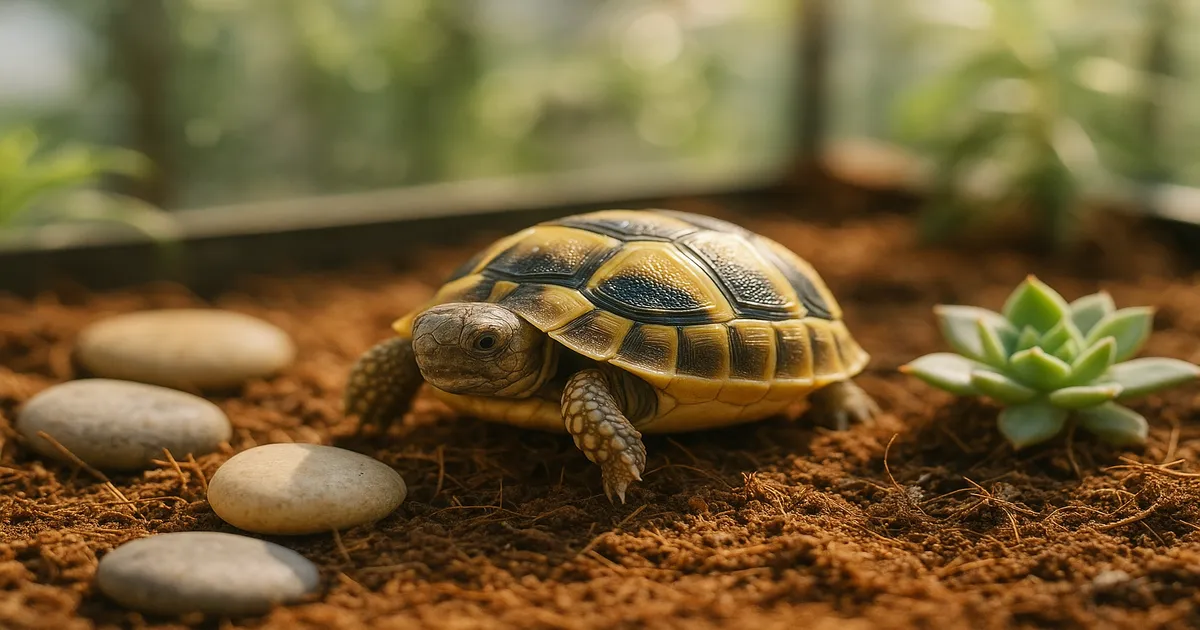
Quick Answer: Baby Greek tortoises need a minimum 2×2 ft enclosure, a basking spot of 95–105°F (35–40°C), a T5 HO UVB tube delivering UVI 3–5 in the basking zone, a 50/50 topsoil-and-play-sand substrate at least 3–4 inches deep, and a rotating diet of dark leafy weeds dusted with calcium several times a week. Hatchlings are far more fragile than adults — their shells are still ossifying, they dehydrate fast, and poor husbandry in the first year causes damage that can’t be undone. Get the basics right from day one. With a lifespan of 50–100+ years, this tortoise will almost certainly outlive you.
How to Care for a Baby Greek Tortoise: The Essentials
Key Care Parameters at a Glance
| Parameter | Target |
|---|---|
| Enclosure (hatchling) | 2×2 ft (60×60 cm) minimum |
| Basking spot | 95–105°F (35–40°C) |
| Warm ambient | 85–90°F (29–32°C) |
| Cool side | 70–75°F (21–24°C) |
| Nighttime minimum | 65°F (18°C) |
| Daytime humidity | 40–60% |
| Hide humidity | 60–70% |
| UVB (UVI in basking zone) | 3.0–5.0 |
| Substrate depth | 3–4 inches (7–10 cm) |
| Feeding frequency | Daily |
Why Hatchlings Are Less Forgiving Than Adults
Caring for a baby Greek tortoise isn’t just a scaled-down version of adult care — it’s genuinely harder. Their shells aren’t fully ossified for the first several months, which means physical stress, poor nutrition, and low humidity can all leave permanent structural damage. Adults can bounce back from a few weeks of suboptimal conditions. Hatchlings often can’t.
Metabolic bone disease, pyramiding, and chronic dehydration can all take hold within the first year, and none of those conditions are reversible once established. That’s not meant to scare you off — it’s just the reality of working with a species this small and this sensitive.
Species Background: What You’re Actually Dealing With
Testudo graeca Is a Species Complex, Not a Single Animal
“Greek tortoise” is an umbrella term covering a surprisingly diverse group. Testudo graeca has numerous recognised subspecies, and the ones you’re most likely to encounter in the pet trade are T. g. graeca (North African), T. g. ibera (Turkish), T. g. terrestris (Middle Eastern), and T. g. nabeulensis (Tunisian).
This matters for care. T. g. nabeulensis stays small — 5–6 inches (13–15 cm) — and prefers drier conditions. T. g. ibera can reach 8–10 inches (20–25 cm) and handles a wider humidity range. Most animals sold simply as “Greek tortoises” are actually T. g. ibera, so if your seller can’t tell you the subspecies, assume ibera and set up accordingly.
One quick way to tell Greek tortoises from Hermann’s tortoises: look for the small conical spur on each thigh. Hermann’s don’t have it.
What Their Natural Habitat Tells Us About Care
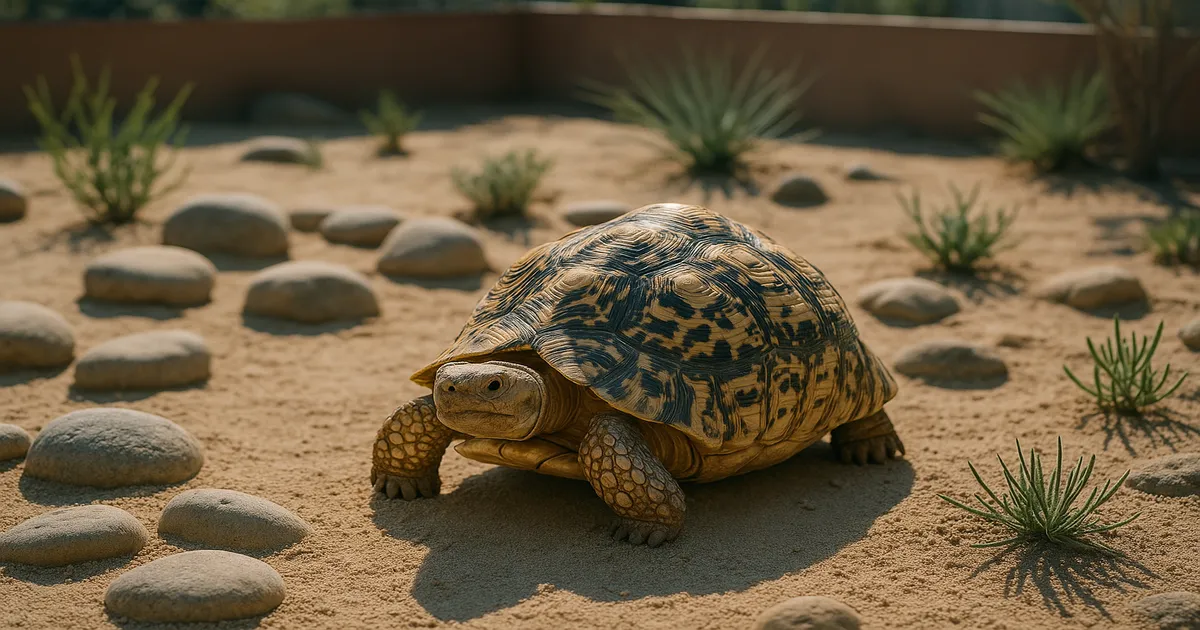
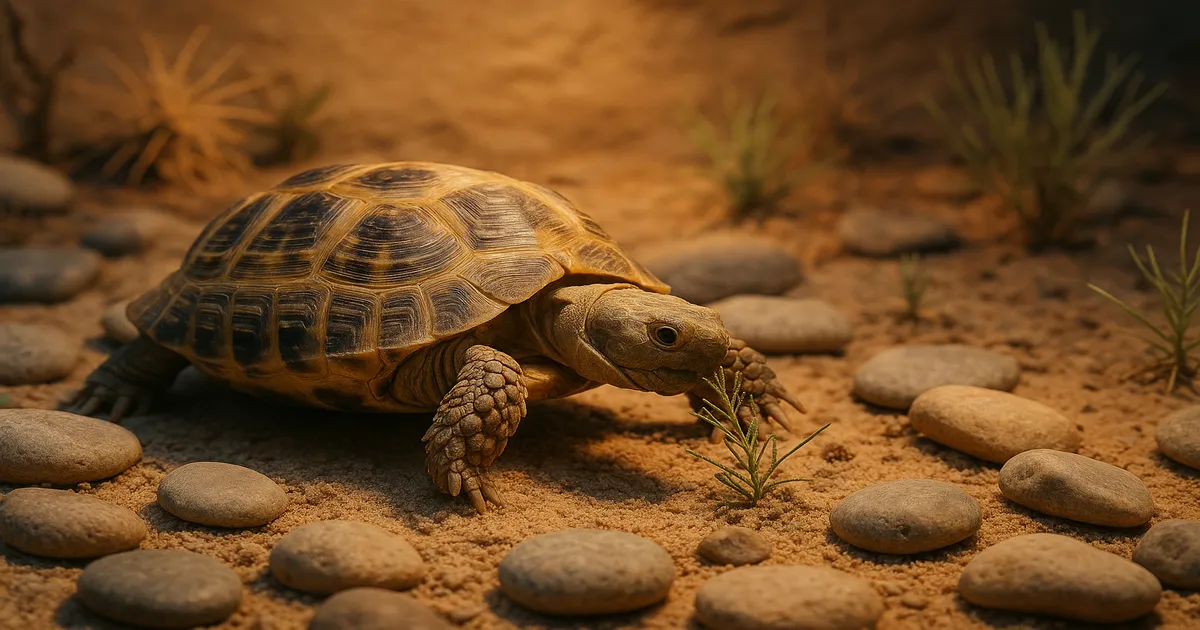
Greek tortoises come from dry Mediterranean scrubland, rocky hillsides, and maquis — warm, sunny environments with seasonal variation. That context should shape how you build their enclosure: strong light, a real temperature gradient, and substrate deep enough to partially burrow into.
They’re not desert animals, though. That’s a common misconception that leads to chronically dehydrated tortoises. Wild Greek tortoises experience morning dew, seasonal rains, and humid microclimates under rocks and vegetation. The goal is Mediterranean, not Saharan.
Hatchling Size and What to Expect
Hatchlings emerge at 1–1.5 inches (2.5–4 cm) and weigh just 8–15 grams depending on subspecies. Growth is slow and steady when husbandry is correct — and that’s exactly what you want. Rapid growth is a red flag, not a sign of health.
Plan for the long haul. Greek tortoises routinely live 50–100+ years. This isn’t a starter pet.
Always Buy Captive-Bred
Testudo graeca is listed on CITES Appendix II. Wild-caught importation is regulated, but that doesn’t stop it from happening. Always buy captive-bred animals from a reputable breeder and ask for documentation. Wild-caught tortoises carry a much higher parasite load, stress poorly, and often arrive in compromised health. A good breeder will know the subspecies, the hatch date, and the parents’ history. If someone can’t tell you any of that, keep looking.
Setting Up a Baby Greek Tortoise Enclosure
Enclosure Type
Four options are worth considering:
- Tortoise table (open-top wooden enclosure) — the preferred choice for most experienced keepers. Better airflow, easier access, more natural behaviour. DIY versions are cost-effective.
- 40-gallon (150L) breeder glass tank — acceptable for hatchlings but needs a screen top and active humidity management. Can get stagnant.
- Plastic storage tubs (Sterilite, Rubbermaid) — budget-friendly and surprisingly effective for hatchlings. Cut ventilation holes in the lid and sides.
- Indoor grow tents — good for more experienced keepers who want better humidity control and height for live plants.
Avoid anything with a glass lid (no airflow), wire mesh flooring (injures feet), or toxic sealants.
Size Requirements
The absolute minimum for a hatchling is 2×2 ft (60×60 cm) of floor space. I’d push for 3×2 ft (90×60 cm) if you can manage it — these animals are more active than most people expect. By the juvenile stage (1–3 years), you’re looking at 4×2 ft (120×60 cm) minimum. Bigger is always better; a larger footprint is what allows a proper temperature gradient.
Substrate
The gold standard is a 50/50 mix of additive-free topsoil and play sand, at a minimum depth of 3–4 inches (7–10 cm). This mix holds burrows, retains some moisture, and drains well enough to prevent waterlogging. A 60/40 coconut coir and sand mix works well too.
What to avoid:
- Pure sand (impaction risk, no moisture retention)
- Pine or cedar shavings (toxic — the aromatic oils cause respiratory damage)
- Reptile carpet (bacterial buildup, nail injuries)
- Paper towels as a long-term substrate (too dry, no enrichment)
Hides, Rocks, and Plants
Provide at least two hides — one on the warm side, one on the cool side. The hide should fit the tortoise snugly; too large and it won’t feel secure. Cork bark flats and half-logs both work well.
Flat slate rocks placed directly under the basking lamp serve double duty: they absorb and radiate heat, and they naturally wear down the beak and nails over time. I keep a few different-sized pieces in every setup I run.
If you want to plant directly into the substrate, dandelion, clover, and plantain (Plantago spp.) are all tortoise-safe and edible. Skip anything in the lily family or any plant you can’t positively identify as safe.
Temperature, Humidity, and Lighting
Temperature Gradient
Measure your basking temperature at substrate level, directly under the lamp — not at bulb height. You’re aiming for 95–105°F (35–40°C), with 100°F (38°C) as a reliable target. The warm ambient side should run 85–90°F (29–32°C), and the cool side needs to stay around 70–75°F (21–24°C).
That cool zone isn’t optional. Tortoises thermoregulate by moving between temperature zones. If the whole enclosure is warm, they can’t do that.
Don’t let temperatures drop below 65°F (18°C) for hatchlings at night. If your room gets cooler than that, add a ceramic heat emitter (CHE) on a thermostat — CHEs produce no light, so they won’t disrupt the day/night cycle. Heat mats aren’t recommended as a primary heat source; tortoises sense radiant heat from above far more effectively than from below.
Humidity
Aim for 40–60% humidity in the main enclosure during the day. The hide should run slightly higher — 60–70% — which you can achieve by keeping the substrate under the hide a bit more moist.
Don’t let humidity sit above 70–75% uniformly throughout the enclosure. That’s where respiratory infections and shell rot start. The gradient approach — drier in the open, more humid in the hide — mimics wild conditions and keeps both risks in check.
UVB: Non-Negotiable
Without adequate UVB, a baby Greek tortoise can’t synthesise vitamin D3, which means it can’t properly metabolise calcium. The result is metabolic bone disease — soft, deformed bones and shell — and it happens faster in hatchlings than you’d expect. This isn’t a “nice to have.” UVB is as essential as food and water.
T5 HO linear tubes are the only type I’d recommend. Compact coil bulbs don’t produce enough UV output across a wide enough area to be reliable. (Arcadia ProT5 Kit 24W)
Good bulb options:
- Arcadia 6% T5 HO — mount 8–12 inches (20–30 cm) from the tortoise
- Arcadia 12% T5 HO — mount 12–18 inches (30–46 cm) away; better for larger enclosures
- Zoo Med Reptisun 10.0 T5 HO — a solid alternative
Target UVI 3.0–5.0 in the basking zone. A Solarmeter 6.5 is the tool for actually verifying this — guessing based on distance alone isn’t reliable. Replace bulbs every 6–12 months even if they still emit visible light; UV output degrades well before the bulb burns out.
Run 12–14 hours of light during summer simulation and drop to 10–11 hours in winter if you’re not hibernating your tortoise. A digital timer or smart plug makes this effortless.
Feeding a Baby Greek Tortoise
The Core Diet
Wild Greek tortoises eat dozens of plant species. Captive diets should rotate through at least 8–10 different plants — dietary monotony leads to nutritional imbalances even when the individual foods are healthy.
Core foods (80–90% of the diet):
- Dandelion leaves and flowers
- Plantain (Plantago spp.)
- Clover
- Hawkbit
- Sow thistle
- Chicory
- Endive and escarole
- Spring mix (without spinach)
The remaining 10–20% can include hibiscus flowers and leaves, mulberry leaves, opuntia cactus pads (spines removed), grape leaves, and rose petals.
What to Avoid
- Fruit — too high in sugar; disrupts gut flora
- Spinach, kale, broccoli in large amounts — high oxalates and goitrogens
- Iceberg lettuce — nutritionally empty
- Any animal protein — Greek tortoises are strict herbivores; protein overload causes serious organ damage
- Dog or cat food — occasionally recommended in old-school care guides; completely wrong
Calcium and Vitamins
Dust food with calcium carbonate (without D3) three to five times per week. Also keep a cuttlebone in the enclosure at all times — tortoises will self-regulate and gnaw on it when they need it.
If your tortoise is under properly placed T5 HO UVB, a reptile multivitamin once every 2–4 weeks is sufficient. Without adequate UVB, bump that to once every 1–2 weeks. Don’t over-supplement — more isn’t better with fat-soluble vitamins.
Feeding Frequency and Portion Size
Feed hatchlings and juveniles daily. A rough guide for portion size: roughly the volume of the tortoise’s shell per feeding. They should eat enthusiastically — if a hatchling is consistently ignoring food, that’s worth investigating.
Soaking and Hydration
How to Soak Correctly
Use lukewarm water at 85–90°F (29–32°C) — test it on your wrist like you would a baby’s bath. The water should come no higher than the tortoise’s chin. Soak for 15–20 minutes, two to three times per week. Never walk away during a soak — hatchlings can drown in surprisingly shallow water.
Soaking does three things: it prevents dehydration, stimulates urination and defecation (which flushes uric acid buildup), and encourages drinking. Many hatchlings won’t drink from a dish reliably, so the soak is often their primary hydration source.
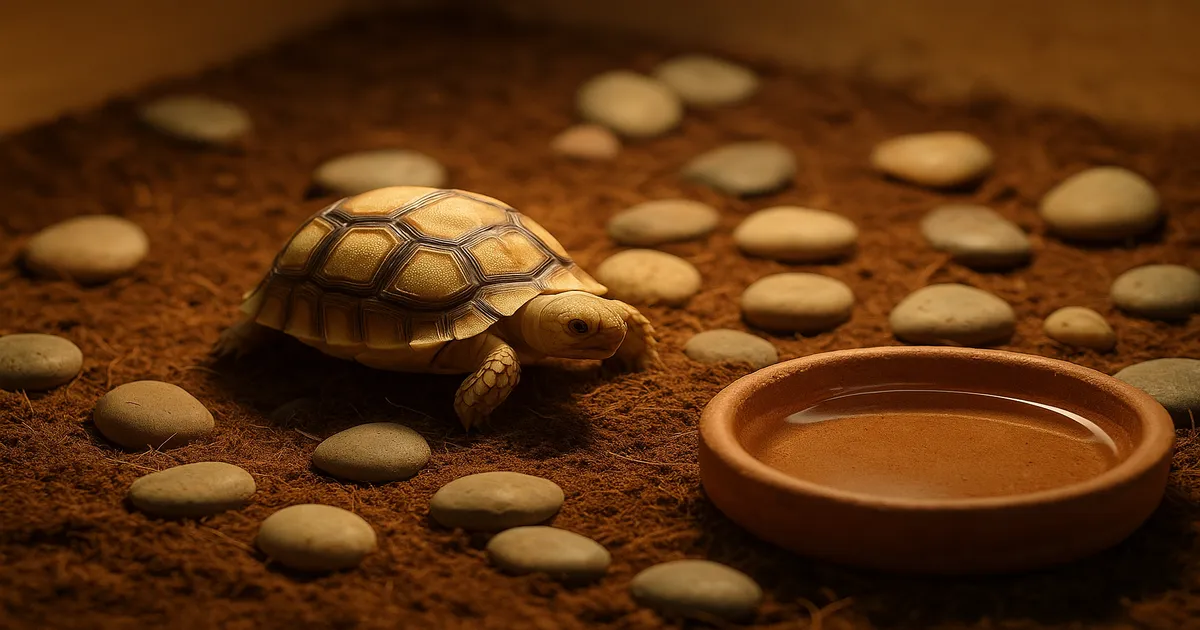
If you do offer an in-enclosure water dish, keep it no deeper than 0.5 inches (1.2 cm) and clean it daily. For very young hatchlings, I’d honestly skip the dish entirely and rely on regular soaking — it’s just safer.
Signs of Dehydration
- Sunken or dull-looking eyes
- Dry, flaky skin around the neck
- White, chalky urates (healthy urates are a white paste, not dry powder)
- Lethargy and appetite loss
If you’re seeing multiple of these, increase soaking frequency immediately and review your enclosure humidity.
Common Baby Greek Tortoise Care Mistakes
Humidity errors. The “Mediterranean equals desert” assumption is probably the single most common mistake with this species. Too dry and you’ll end up with a chronically dehydrated tortoise, poor shell growth, and pyramiding. Too uniformly humid and you’re looking at respiratory infections and shell rot. The answer is the gradient — not a compromise, but an actual difference between the open enclosure and the hide.
UVB failures. Cheap coil bulbs, bulbs mounted too far away, and expired bulbs that still glow but produce no UV are all common culprits. MBD in hatchlings moves fast. By the time you notice soft shell or limb deformities, significant damage has already occurred. Invest in a quality T5 HO setup from the start and verify output with a UV meter.
Pyramiding. Raised, peaked scutes are caused by a combination of rapid growth from overfeeding, insufficient humidity, and inadequate UVB. The first two to three years are when shell growth patterns are established. Once pyramiding sets in, it’s permanent. Slow, steady growth on a varied diet with proper humidity and strong UVB is how you prevent it.
Temperature errors. A basking spot below 90°F (32°C) impairs digestion and immune function. Above 110°F (43°C) and you risk heat stress. Make sure there’s a genuine cool zone — centering the heat lamp or using only an under-tank heater eliminates the tortoise’s ability to thermoregulate.
Dietary monotony and overfeeding. Feeding the same two or three foods every day, even good ones, leads to nutritional gaps. Rotate through 8–10+ species. Skip fruit entirely. Don’t skip calcium supplementation just because you have a UVB bulb — growing hatchlings need both.
Too much handling, too soon. Give a new hatchling at least two to four weeks to settle in before you handle it. Stress suppresses immune function in tortoises, and a stressed hatchling is a vulnerable one. Once they’re settled, keep sessions short and infrequent — these aren’t cuddly animals, and they don’t benefit from socialisation the way mammals do.
Baby Greek Tortoise Care FAQ
How often should I soak my baby Greek tortoise? Two to three times per week for 15–20 minutes in shallow, lukewarm water (85–90°F / 29–32°C). Hatchlings dehydrate quickly and many won’t drink reliably from a dish, so regular soaking is essential — not optional.
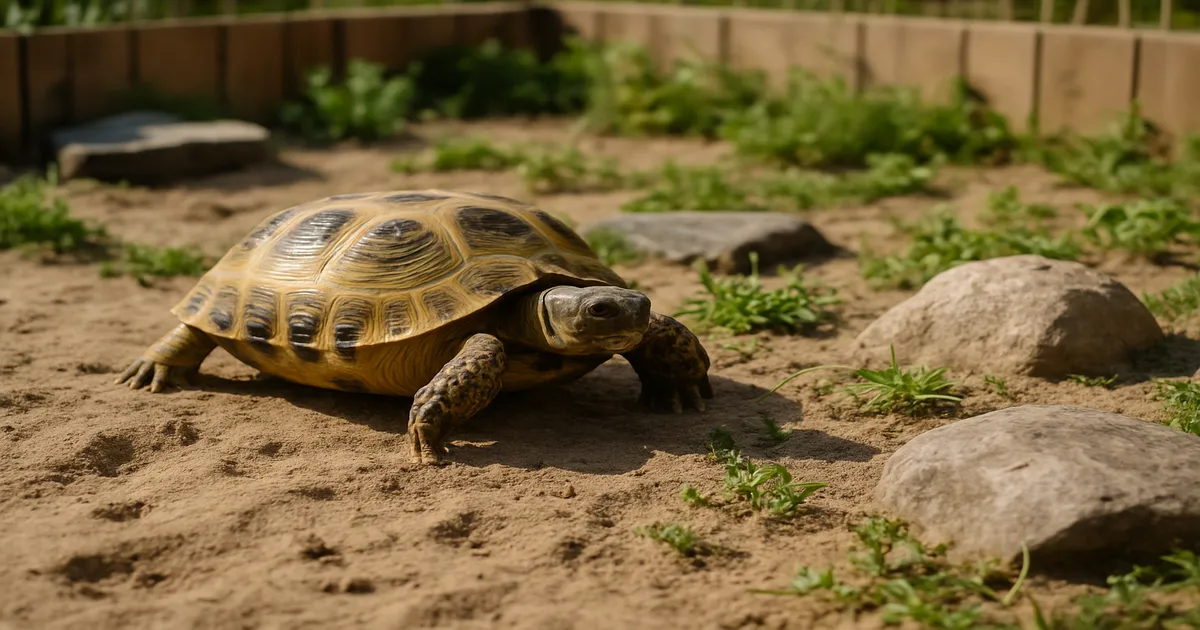
Can a baby Greek tortoise live outside? In warm climates (consistent daytime temps above 70°F / 21°C), supervised outdoor time is excellent for hatchlings. Full outdoor housing is risky until the tortoise is larger and more robust — hatchlings are vulnerable to predators, temperature swings, and escape. Most keepers wait until the tortoise is at least 3–4 years old and several inches in length before transitioning to a permanent outdoor setup.
How fast do baby Greek tortoises grow? Slowly — and that’s a good thing. A well-kept hatchling might gain 5–15 grams per month in the first year. Rapid growth is associated with pyramiding and long-term health problems. If your tortoise is growing noticeably fast, reduce feeding frequency and review your diet variety.
Do baby Greek tortoises need to hibernate? Captive-bred hatchlings under one year old are generally not hibernated in their first winter — the risk of a hatchling entering hibernation underweight or in poor health is significant. From year two onward, many keepers do hibernate their tortoises, but it requires careful preparation, weight monitoring, and appropriate temperatures (34–50°F / 1–10°C). If you’re new to this, research hibernation thoroughly before attempting it.
What’s the difference between a Greek tortoise and a Hermann’s tortoise? The easiest tell is the thigh spur — Greek tortoises have a small conical spur on each hind thigh; Hermann’s tortoises don’t. Hermann’s also typically have a more distinctly patterned shell and a divided supracaudal scute (the scale above the tail). Care requirements overlap significantly, but Hermann’s tortoises tend to tolerate slightly higher humidity and are generally considered a bit hardier for beginners.