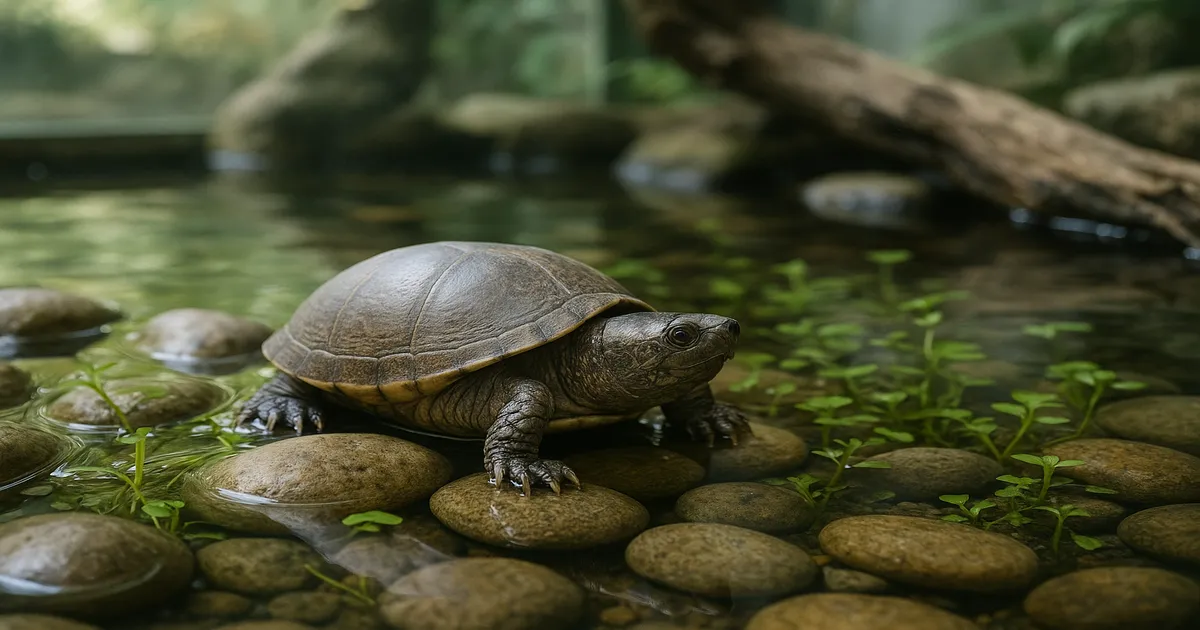
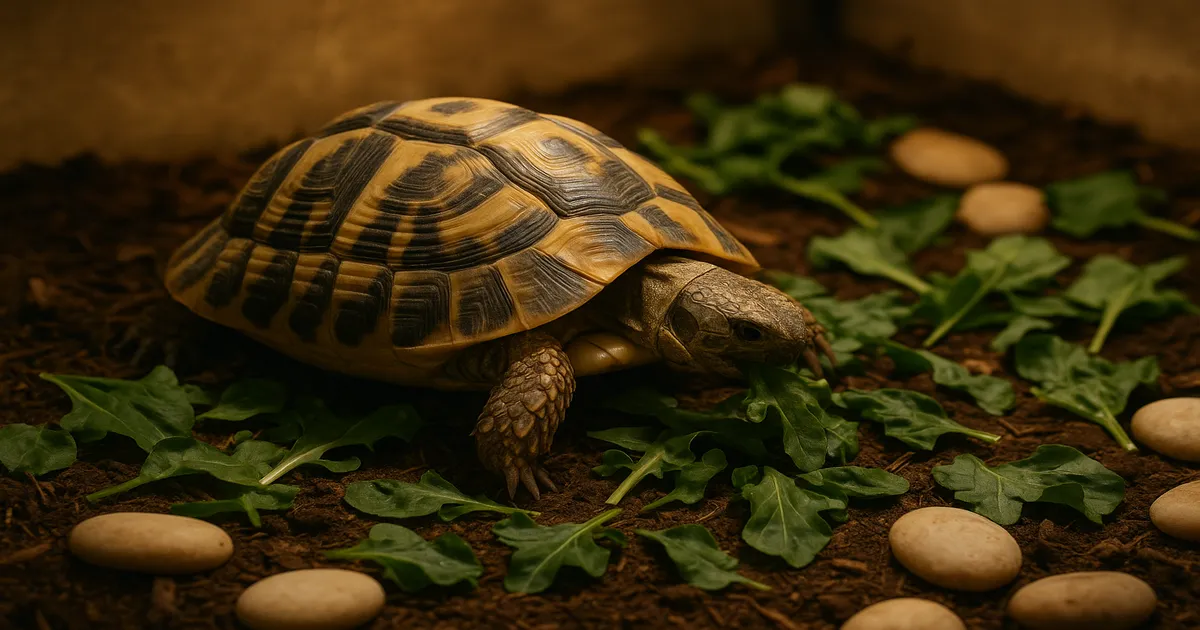
Quick Answer: Feed adult Hermann’s tortoises 4–5 days per week, offering a portion roughly the size of their head imagined as a hollow container. Hatchlings can eat daily. The single biggest mistake keepers make is overfeeding — a tortoise that finishes its meal in under 30 minutes and still seems hungry is not necessarily underfed; it’s just a tortoise.
If you’ve been trying to figure out how much to feed your Hermann’s tortoise, you’ve probably already discovered that the internet gives you about five different answers. Some say daily, some say every other day, some give you a formula involving shell length. Here’s the thing: the core principles aren’t that complicated once you understand how these animals actually work.
Hermann’s tortoises are Mediterranean grazers with slow metabolisms and a gut transit time of 3–7 days. They are not dogs. Their appetite doesn’t switch off when they’ve had enough — they’ll eat themselves into poor health if you let them, because in the wild, food isn’t always available and opportunistic eating is survival. In captivity, that drive becomes a liability.
How Much Should I Feed My Hermann’s Tortoise?
The Head-Size Rule
The most practical guideline I’ve found — and the one I actually use — is the head method: offer a pile of food roughly the size of your tortoise’s head if it were a hollow container. It’s not a lab measurement, but it scales naturally across ages and sizes without needing a formula. Some keepers use the shell as an upper limit instead. Either works. The point is you’re thinking in terms of modest portions, not heaping salad bowls.
Feeding Frequency by Life Stage
| Life Stage | Age | Frequency |
|---|---|---|
| Hatchling | 0–12 months | Daily |
| Juvenile | 1–5 years | 5–6 days per week |
| Sub-adult | 5–10 years | 4–5 days per week |
| Adult | 10+ years | 4–5 days per week |
| Gravid female | Any | Daily + extra calcium |
Hatchlings (0–12 months): Daily feeding of finely chopped weeds and greens. They’re growing fast and have tiny digestive systems. Offer food in a shallow dish rather than directly on substrate — ingesting grit at this size is a real risk.
Juveniles (1–5 years): Drop to 5–6 days per week. Growth is still happening but the frantic pace of year one has slowed. Diet quality matters enormously here — a juvenile fed mostly grocery store lettuce is quietly setting itself up for shell problems.
Sub-adults and adults (5+ years): Four to five days per week, or the popular “5 days on, 2 days off” schedule. This loosely mirrors the natural feast-and-fast cycles of wild Mediterranean tortoises, gives the gut time to fully process food, and prevents the slow creep of overfeeding that happens when keepers feed every day out of habit.
Gravid females: Daily feeding with noticeably more calcium. Egg production is metabolically demanding. A gravid female pulling calcium from her own bones is a female with health problems waiting to happen. Keep free-choice cuttlebone in the enclosure at all times.
What to Feed: Diet Composition
Think Mediterranean hillside, not supermarket salad bar.
| Food Category | Target % of Diet | Best Options |
|---|---|---|
| Grasses & hay | 40–60% | Timothy hay, orchard grass, fresh lawn grasses |
| Broadleaf weeds | 30–40% | Dandelion, plantain, clover, sow thistle |
| Leafy greens | 10–20% | Endive, escarole, radicchio |
| Flowers & treats | Under 10% | Hibiscus, dandelion flowers, rose petals |
| Fruit | Under 5% | Occasional fig, strawberry, melon |
Grasses and hay (40–60%): This is the part most people skip, and it’s the most important. High-fiber grasses and hay mirror what Hermann’s tortoises spend most of their day eating in the wild. Timothy hay and orchard grass should be available in the enclosure at all times — not as an occasional add-on, but as a permanent fixture.
Broadleaf weeds (30–40%): Dandelion is the gold standard. The whole plant — leaves, stems, flowers, even the root — is nutritious, has a calcium-to-phosphorus ratio of around 2.8:1, and tortoises go absolutely crazy for it. Plantain (Plantago spp.), clover, and sow thistle round out a solid rotation. If you can grow these yourself, do it.
Leafy greens (10–20%): Endive, escarole, and radicchio are your best grocery store options. Romaine is acceptable occasionally. Keep kale to a strict minimum — it contains goitrogens that interfere with thyroid function when fed regularly — and drop spinach entirely due to oxalate content that binds calcium.
Flowers and fruit (under 10%): Hibiscus flowers, dandelion flowers, and rose petals are genuinely nutritious. Fruit is fine as an occasional treat — a small piece of fig or strawberry once a week won’t hurt anything — but excess sugar disrupts gut flora and causes fermentation and bloating.
Foods to avoid completely:
- Spinach, beet greens, chard — oxalates block calcium absorption
- Kale, broccoli, cabbage — goitrogens in regular quantities
- Iceberg lettuce — nutritionally worthless, causes loose stools
- Dog food, cat food, any meat — causes kidney damage and pyramiding
- Avocado, rhubarb, daffodil, buttercup — toxic
- Excess fruit — high sugar, gut flora disruption
Calcium and Supplements
Calcium: Free-choice cuttlebone left permanently in the enclosure is my preference — it lets the tortoise self-regulate and removes the guesswork of dusting. If you prefer powder, use plain calcium carbonate (no phosphorus) 3–5 times per week.
Vitamin D3: If your tortoise has proper UVB lighting — which it should — D3 needs are largely covered. Only add a D3-containing supplement once weekly if your UVB setup is marginal. Over-supplementing D3 is a real and avoidable problem.
Multivitamins: Once every 2–4 weeks is plenty. Fat-soluble vitamin A toxicity causes skin and eye problems and is entirely preventable — just don’t dust every meal.
Ca:P ratio: Target 2:1 or better. Dandelion, plantain, and most broadleaf weeds naturally hit this. It’s primarily when you lean too heavily on grocery store produce that the ratio goes sideways.
Temperature, UVB, and Feeding
A tortoise that hasn’t warmed up properly can’t digest food. Feed a cold tortoise and you’re not doing it a favour — you’re risking impaction and bacterial fermentation in the gut. Let your tortoise bask for 1–2 hours before offering food.
Temperature targets:
- Basking spot: 95–105°F (35–40°C)
- Warm side ambient: 80–90°F (27–32°C)
- Cool side ambient: 70–75°F (21–24°C)
- Nighttime minimum: 60°F (15°C); 65°F (18°C) for juveniles
A good infrared temperature gun (Etekcity Lasergrip 774) lets you spot-check the basking surface in seconds.
Tortoises kept under inadequate UVB become lethargic and lose their appetite — often before any visible signs of metabolic bone disease appear. Use a T5 HO 12% or 10.0 UVB tube mounted 10–12 inches (25–30 cm) above the shell, and replace it every 12 months even if it’s still producing visible light.
Run 12–14 hours of light in summer, 10–12 in winter. The natural reduction in photoperiod will slightly reduce your tortoise’s appetite in autumn — and that’s correct. Don’t try to override it.
Hydration and Digestion
Soak hatchlings and juveniles 2–3 times per week; adults 1–2 times per week. Use shallow, lukewarm water at 85–90°F (29–32°C) for 15–20 minutes. Soaking before the first meal of the day hydrates the tortoise, stimulates the gastrocolic reflex, and helps ensure the gut is clear before new food goes in. Tortoises often defecate during soaks — that’s exactly what you want.
If your tortoise is refusing food and temperatures are correct, check for sunken eyes, dry skin around the neck, and thick, stringy saliva. Dehydration is a surprisingly common cause of appetite loss. Increase soak frequency before assuming something more serious is wrong.
Common Feeding Mistakes
Overfeeding. Tortoises are hardwired to eat opportunistically. In captivity, that drive doesn’t switch off. Overfeeding leads to rapid shell growth, pyramiding, organ stress, and a shortened lifespan. A tortoise that always seems hungry isn’t being underfed — it’s being a tortoise.
Relying on grocery store produce. Romaine and kale are fine occasionally but terrible as staples. Grocery produce is too watery, too low in fiber, and often has a poor Ca:P ratio.
Ignoring seasonal rhythms. If you’re feeding your adult the same amount in October as you were in June, something’s off. Natural light and temperature reductions in autumn should be reflected in the enclosure, and feeding frequency should drop accordingly. A tortoise going into brumation with undigested food in its gut is in serious danger.
Offering animal protein. This one still appears in old care sheets and it needs to go away. Dog food, cat food, mealworms — even small amounts over time cause visceral gout and kidney damage. Hermann’s tortoises are herbivores. Full stop.
Practical Tips for Getting Feeding Right
Weigh monthly. A digital kitchen scale accurate to 1 gram is one of the most useful things you can own as a tortoise keeper. Log the weight in a spreadsheet and aim for very slow gain during active months. You can’t eyeball a 5-gram change over six weeks — a scale will catch it.
Grow your own weeds. Dandelion, plantain, and clover grow easily in pots under a basic grow light indoors during winter. It solves the “I can’t find weeds in January” problem, guarantees pesticide-free food, and costs almost nothing once you have the setup.
Use the 30-minute rule. Put the food in, set a timer. Significant food left after 30 minutes means you’re offering too much — reduce the next portion by about 20% and reassess. Food gone in under 5 minutes with your tortoise still actively searching? Nudge portions up slightly.
Rotate variety weekly. Don’t stress about hitting a perfect nutritional profile every single day. A varied week — different weeds, different grasses, occasional flowers — covers nutritional gaps naturally and is far better than a “perfect” salad served identically every morning.
Adjust for pre-hibernation. Starting in September or October (Northern Hemisphere), reduce feeding frequency and portion size by about 25–30%. Stop feeding entirely 4 weeks before hibernation begins, but continue offering water and soaks to help flush the gut.
Western vs. Eastern subspecies. Western Hermann’s (T. h. hermanni) are smaller — typically 5–7 inches (13–18 cm) as adults — and more sensitive to overfeeding than Eastern Hermann’s (T. h. boettgeri), which can reach 9–11 inches (23–28 cm). If you have a Western, be especially conservative with portions. The head-size rule still applies; the head is just smaller.
Frequently Asked Questions
How do I know if I’m overfeeding my Hermann’s tortoise?
Consistent leftover food after 30 minutes, rapid shell growth, and pyramided scutes are the clearest signs. Monthly weigh-ins are the most reliable long-term check — if your tortoise is gaining more than a few grams per month during the active season, portions are probably too large.
Can Hermann’s tortoises eat fruit?
Yes, but only occasionally — less than 5% of the overall diet. A small piece of fig, strawberry, or melon once a week is fine. More than that and the excess sugar disrupts gut flora, which can cause fermentation, bloating, and loose stools.
How long can a Hermann’s tortoise go without eating?
A healthy adult can skip 1–3 days without any concern. If your tortoise refuses food beyond that, check temperatures first — a basking spot that’s too cool is the most common culprit. Appetite also naturally drops in autumn and during any significant environmental change.
Should I feed my Hermann’s tortoise every day?
Only hatchlings under 12 months need daily feeding. Juveniles do well on 5–6 days per week, and adults are best served by a 4–5 day schedule. Daily feeding of adults is one of the most reliable paths to overfeeding, pyramiding, and long-term health problems.
What’s the single best food for a Hermann’s tortoise?
Dandelion — the whole plant. Pair it with plantain, clover, Timothy hay, and orchard grass and you’ve built a diet that closely mirrors what these tortoises evolved to eat. Everything else is supplementary.