Quick Answer: Mexican Black Kingsnakes (Lampropeltis getula nigrita) are hardy, personable snakes that thrive in a 4’×2’×2’ enclosure with a temperature gradient of 72–92°F (22–33°C) and 40–50% humidity. Adults eat frozen/thawed rodents every 10–14 days and typically live 15–25 years in captivity. They’re one of the best first or second snakes you can buy.
Mexican Black Kingsnake Care Sheet
Species Snapshot
| Parameter | Value |
|---|---|
| Adult Size | 3.5–5 ft (1.1–1.5 m) |
| Lifespan | 15–25 years |
| Min. Adult Enclosure | 4’×2’×2’ (120×60×60 cm) |
| Basking Spot | 88–92°F (31–33°C) |
| Warm Side Ambient | 80–85°F (27–29°C) |
| Cool Side Ambient | 72–76°F (22–24°C) |
| Nighttime Temp | 68–72°F (20–22°C) |
| Humidity | 40–50% (55–65% during shed) |
| Feeding Schedule | Every 10–14 days (adults) |
| Prey Type | Frozen/thawed mice or small rats |
Is the Mexican Black Kingsnake Right for You?
Learning how to care for a Mexican Black Kingsnake is genuinely straightforward — they eat reliably, handle well, stay a manageable size, and don’t need complex humidity or lighting setups. That’s a big part of why they’re so popular.
But 15–25 years is a real commitment. If you want a display animal that’s also interactive, an MBK delivers. If you’re hoping for something you can mostly ignore, no snake fits that description.
Species Overview
Natural Habitat and Range
MBKs are native to the Mexican states of Sonora and Sinaloa, with a narrow range extension into extreme southern Arizona. Their habitat covers arid scrubland, rocky hillsides, desert margins, and riparian corridors — they’re often found near water despite being desert-adapted. That combination of hot, exposed terrain and cool, shaded retreats is exactly what you need to replicate in captivity.
Size, Coloration, and Lifespan
Most adults settle between 3.5 and 5 feet (1.1–1.5 m). Females tend to run slightly longer and heavier-bodied than males. The occasional individual pushes 6 feet (1.8 m), but that’s not typical.
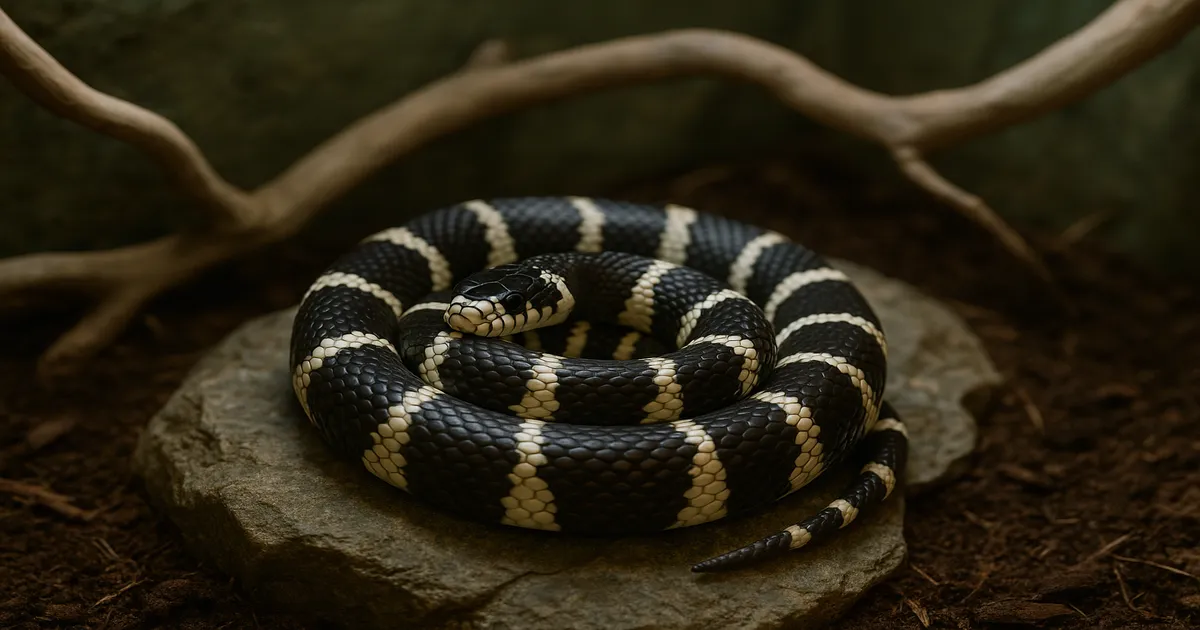
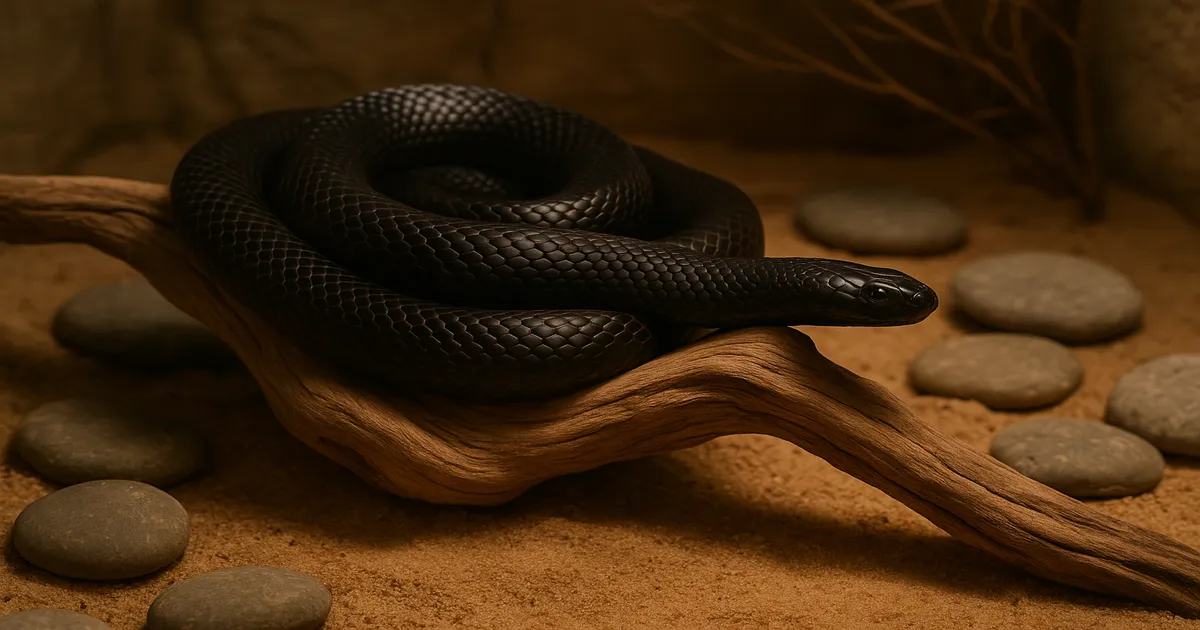
The color transformation is one of the things that makes this species so striking. Hatchlings emerge with faint yellow or white speckling; by 1–2 years of age that fades completely into a deep, glossy jet-black. A well-fed adult MBK under good lighting is genuinely one of the best-looking snakes in the hobby.
Temperament
MBKs are curious and alert rather than defensive, and most individuals calm down significantly with regular handling. Juveniles can be nippy — that’s normal, not a character flaw — but I’ve yet to meet an adult that stayed defensive with consistent, calm interaction.
One thing worth knowing: like all kingsnakes, MBKs are ophiophagous. They eat other snakes in the wild and are immune to pit viper venom. Fascinating natural history, but it also means you should never house them with other reptiles.
Always buy captive-bred. CB animals are well-started on frozen/thawed prey, parasite-free, and don’t carry the stress baggage of wild-caught imports. Any reputable breeder should be able to tell you the animal’s full feeding history.
Enclosure Setup for Mexican Black Kingsnakes
Enclosure Type
PVC enclosures are my first recommendation for adult MBKs. They insulate well, hold humidity better than glass, weigh less than wood, and most have front-opening doors that make interaction less stressful for the snake. (Animal Plastics T8)
Glass terrariums work fine for juveniles but lose heat and humidity quickly through screen tops — cover most of the screen with foam or a glass panel if that’s what you’re using. Wooden enclosures are a solid middle ground if they’re properly sealed. Rack systems are efficient for breeders but aren’t ideal if you actually want to observe your snake.
Enclosure Size by Age
- Hatchlings (0–12 months): 24”×12”×12” (61×30×30 cm). Smaller spaces reduce stress and make prey easier to locate.
- Juveniles (1–2 years): 36”×18”×18” (91×46×46 cm).
- Adults: 4’×2’×2’ (120×60×60 cm) minimum. Treat that as a floor, not a goal — bigger is always better.
MBKs are terrestrial, so prioritize floor space over height. They’ll occasionally use low climbing structures, but they’re not climbers.
Substrate
Depth matters as much as material. MBKs burrow actively, so aim for at least 3–4 inches (7–10 cm) of substrate.
Good options:
- Aspen shavings — holds burrows well, easy to spot-clean; avoid in high-humidity setups as it molds quickly
- Cypress mulch — resists mold, retains moisture, great for humid hides
- Coco coir — works well mixed with topsoil and sand for naturalistic setups
- Bioactive mix (60% topsoil / 30% sand / 10% organic matter) — best for long-term planted setups with a cleanup crew
- Paper towels — quarantine and hatchlings only
Never use cedar or pine. The aromatic phenols are toxic to snakes and cause respiratory damage with prolonged exposure.
Hides and Décor
Two hides minimum — one on the warm side, one on the cool side. Snug-fitting hides matter more than people realize. A hide that’s too large doesn’t give the snake that enclosed, secure feeling it needs, and you’ll end up with a stressed animal that glass-surfs constantly.
Add a third humid hide on the cool-to-mid side, packed with damp sphagnum moss — worth keeping in permanently, not just during sheds. Cork bark tubes, stacked flat rocks, and driftwood round out the setup. A heavy ceramic water bowl large enough for the snake to soak in goes on the cool side.
Temperature and Heating
The Temperature Gradient
Here’s something that trips up a lot of new keepers: MBKs are a desert species, but they didn’t evolve to sit in the heat. They evolved to exploit it briefly and then retreat into cool burrows and rock crevices. An enclosure that’s uniformly hot is actually more dangerous than one running slightly cool.
- Basking spot: 88–92°F (31–33°C)
- Warm side ambient: 80–85°F (27–29°C)
- Cool side ambient: 72–76°F (22–24°C)
- Nighttime: 68–72°F (20–22°C)
Don’t let warm-side ambient exceed 90°F (32°C). A cool retreat is non-negotiable.
Heating Equipment
For PVC or wooden enclosures, a radiant heat panel mounted inside the top is the cleanest solution — efficient, no hotspots, and safe for the snake. Under-tank heaters work well for glass enclosures, but only under one end to preserve the gradient.
A 25–50W halogen or incandescent bulb creates a defined basking zone and doubles as your daytime light source. For nighttime heat without light, a ceramic heat emitter handles it cleanly.
Thermostats Are Not Optional
An unregulated UTH can hit 120°F (49°C) or higher. Thermal burns on the ventral surface are one of the most common — and most preventable — injuries in captive snakes, and they’re often well-advanced before you notice them. Every heat source needs a thermostat.
For precision, a proportional or PID thermostat like the Herpstat or Vivarium Electronics VE-300 is excellent. On/off thermostats like the Inkbird ITC-306 are budget-friendly and perfectly adequate for UTHs.
Dropping to 68–72°F (20–22°C) at night isn’t just about mimicking nature — it supports digestion and helps maintain the rhythms that keep snakes healthy long-term. Running the same temperature 24/7 is one of those low-grade mistakes that doesn’t cause an obvious crisis but quietly affects the animal over years.
Humidity and Lighting
Humidity
Baseline 40–50% is where you want to be day-to-day. That’s achievable in most homes without much active management. If you’re in a naturally humid region like the southeastern US or the UK, you may actually need to reduce humidity — sustained levels above 70% cause respiratory infections and scale rot.
A digital hygrometer with a remote sensor makes monitoring effortless.
When your snake goes into pre-shed — eyes turn opaque or bluish, skin looks dull — bump humidity to 55–65%. A humid hide packed with damp sphagnum moss usually handles this without raising ambient humidity throughout the whole enclosure. A complete shed in one piece means your humidity is right. Patchy or retained shed means it was too dry. Retained eye caps need a vet visit, not a DIY fix.
UVB and Photoperiod
MBKs can survive without UVB, but the evidence for welfare benefits keeps getting stronger — better activity levels, more natural behavior, and likely improved vitamin D3 synthesis. I’ve added UVB to most of my setups and I think it’s worth it. Use an Arcadia 6% Forest Canopy or Zoo Med Reptisun 5.0 T5 HO, running 10–12 hours daily. Verify actual output with a Solarmeter 6.5 — packaging claims aren’t reliable.
For photoperiod, aim for 12–14 hours of light in summer and 8–10 in winter. A simple outlet timer handles this automatically. If you’re planning to breed, this seasonal variation isn’t optional — it’s part of what cues reproductive behavior.
Feeding Your Mexican Black Kingsnake
Prey Type and Sizing
Frozen/thawed or pre-killed only. MBKs take F/T readily, and there’s no good reason to feed live — a mouse or rat will bite and scratch, sometimes causing injuries that get infected. The risk isn’t worth it.
Prey size should leave a slight visible lump after swallowing. Match prey width to the widest point of the snake’s body, not the head, which can stretch considerably more.
Feeding Schedule
- Hatchlings: Pinky mice every 5–7 days
- Juveniles: Fuzzy to hopper mice every 7 days
- Adults: Adult mice or small-to-medium rats every 10–14 days
Use 12–16 inch stainless steel feeding tongs to keep your hand clear of the strike zone.
Refusals and F/T Conversion
A refusal from an MBK is worth paying attention to — they’re usually enthusiastic feeders. Check temperatures first, then rule out an upcoming shed. If neither explains it, cut handling back for a week and try again.
For snakes that resist frozen/thawed, scenting works well: rub the thawed mouse with a live mouse before offering it. Most holdouts convert within a few attempts. Don’t give up and switch to live — that just reinforces the preference.
Avoiding Obesity
Kingsnakes will eat every single time you offer food, and obesity is a genuine welfare issue — it leads to fatty liver disease and cuts years off a snake’s life. Feed on a schedule, not based on how enthusiastically the snake is hunting the glass. A healthy adult MBK should have visible muscle tone, not a rounded, doughy midsection.
Wait at least 48 hours after feeding before handling. Regurgitation is physically taxing and can cause esophageal damage if it happens repeatedly.
Common Mexican Black Kingsnake Care Mistakes
Heating errors:
- Running a UTH without a thermostat
- No cool retreat — a snake that can’t escape heat is chronically stressed
- Ambient temps above 90°F (32°C) throughout the enclosure
- No nighttime temperature drop
Enclosure and husbandry pitfalls:
- Housing hatchlings in oversized enclosures — they stop eating and become hard to monitor
- Hides that are too large to feel secure
- Cedar or pine substrate — toxic, full stop
- Humidity consistently above 70%
- Neglecting the water bowl — snakes defecate in them regularly, and stagnant water spreads disease fast
Feeding mistakes:
- Feeding live prey
- Overfeeding — follow the schedule, not the snake’s appetite
- Handling within 48 hours of feeding
- Giving up on F/T conversion too quickly
Health and handling oversights:
- Skipping quarantine — 90 days minimum for any new acquisition, with fecal parasite testing
- Handling during shed
- Writing off a nippy juvenile as permanently aggressive and giving up on socialization
- Not finding a reptile-experienced vet before something goes wrong
Pro Tips for Mexican Black Kingsnake Keepers
Use a Hook to Separate Feeding Mode from Handling Mode
MBKs can be food-aggressive, especially younger animals. Always open the enclosure with a snake hook if you’re not sure whether the snake is in hunting mode. A gentle tap on the body signals “this is handling time” — most snakes shift out of feeding mode quickly with that cue. It sounds minor, but it dramatically reduces accidental strikes and makes the whole interaction calmer for both of you.
Build Trust Through Consistent Handling
Short, calm sessions beat infrequent long ones. Start with 5–10 minutes a few times a week for juveniles, and let the snake set the pace. If it’s tense and trying to escape, end the session — don’t force it. Consistent positive interaction almost always produces a calm adult, even from a nippy juvenile.
Know What Healthy Looks Like
A healthy MBK has clear, bright eyes (outside of shed), smooth scales with no retained shed, firm muscle tone, a regular feeding response, and active exploratory behavior in the evening hours. Wheezing, mucus around the mouth or nostrils, persistent lethargy outside of shed, or unusual lumps all warrant a vet visit. Don’t wait to see if it resolves on its own.
Frequently Asked Questions: Mexican Black Kingsnake Care
How long do Mexican Black Kingsnakes live in captivity?
With proper care, 15–25 years is typical. Some individuals exceed that. Lifespan is heavily influenced by husbandry quality — appropriate temperatures, healthy body weight, and regular veterinary checkups all make a measurable difference.
How big do Mexican Black Kingsnakes get?
Most adults reach 3.5–5 feet (1.1–1.5 m). Females tend to be slightly longer and heavier-bodied than males. The occasional individual hits 6 feet (1.8 m), but that’s the exception rather than the rule.
Are Mexican Black Kingsnakes good for beginners?
Yes — they’re one of the better beginner choices in the hobby. They’re hardy, eat reliably, tolerate handling well, and don’t require the complex humidity or temperature setups that some species demand. The main caveat is the 15–25 year lifespan, which is a serious long-term commitment.
Can Mexican Black Kingsnakes be housed together?
No. MBKs are ophiophagous — they eat other snakes in the wild. Housing them together risks cannibalism, even between individuals of similar size. Always keep them in separate enclosures.
How often should I handle my Mexican Black Kingsnake?
For juveniles, 3–4 short sessions per week (5–10 minutes each) is a good starting point. Adults can handle longer sessions once they’re well-established. Avoid handling for 48 hours after feeding, during shed, and for at least two weeks after bringing a new animal home.