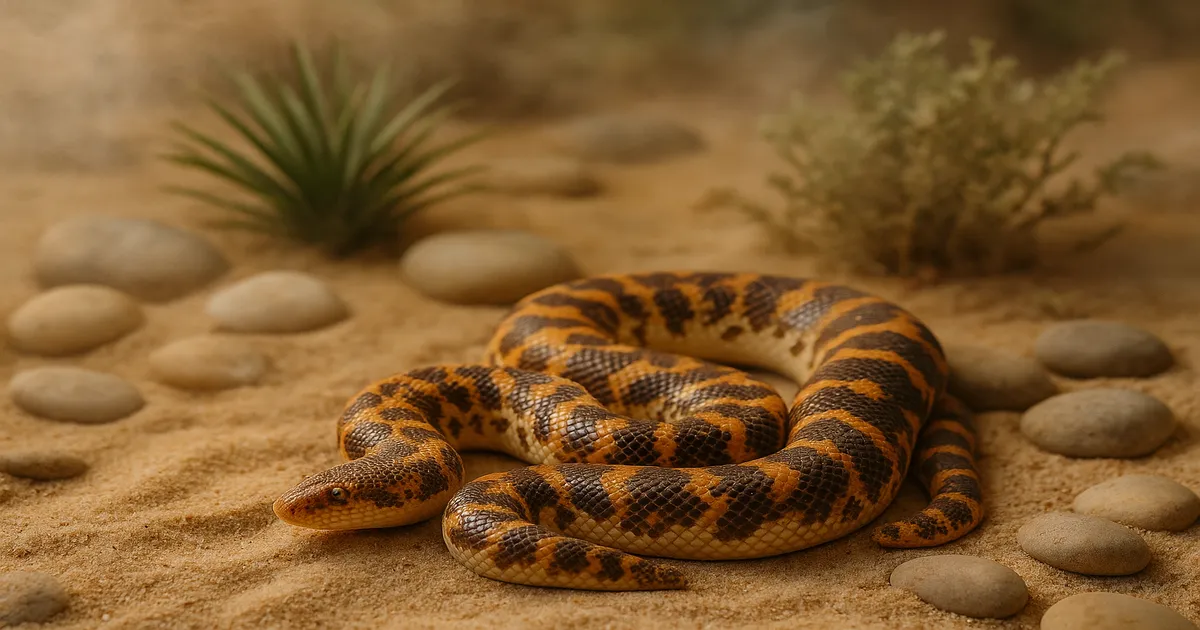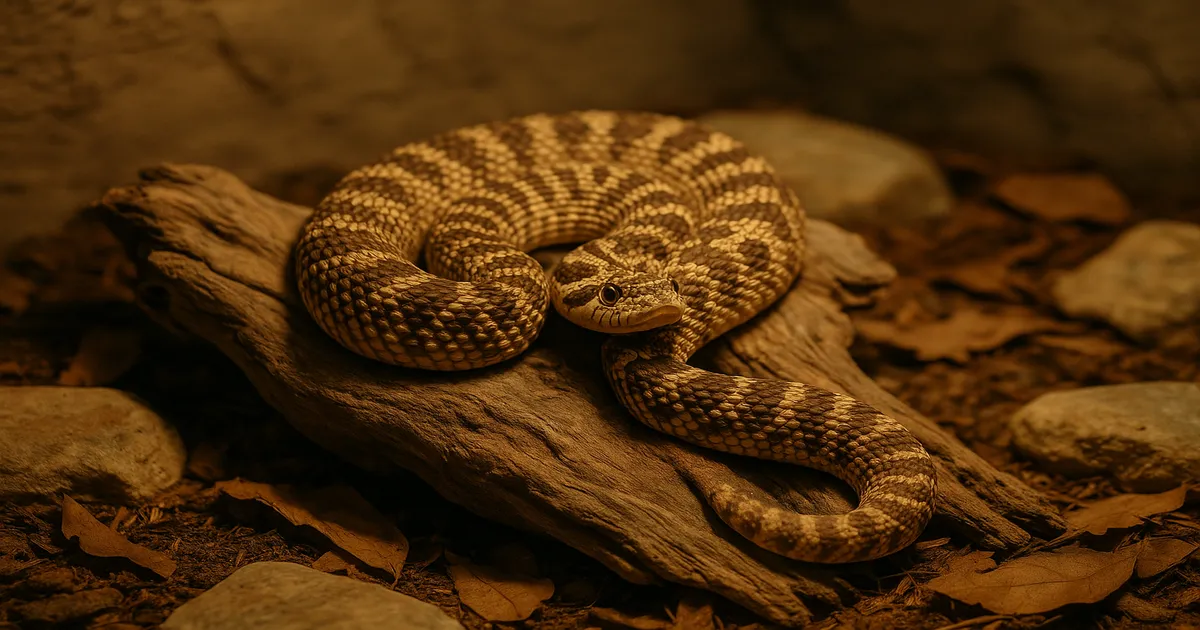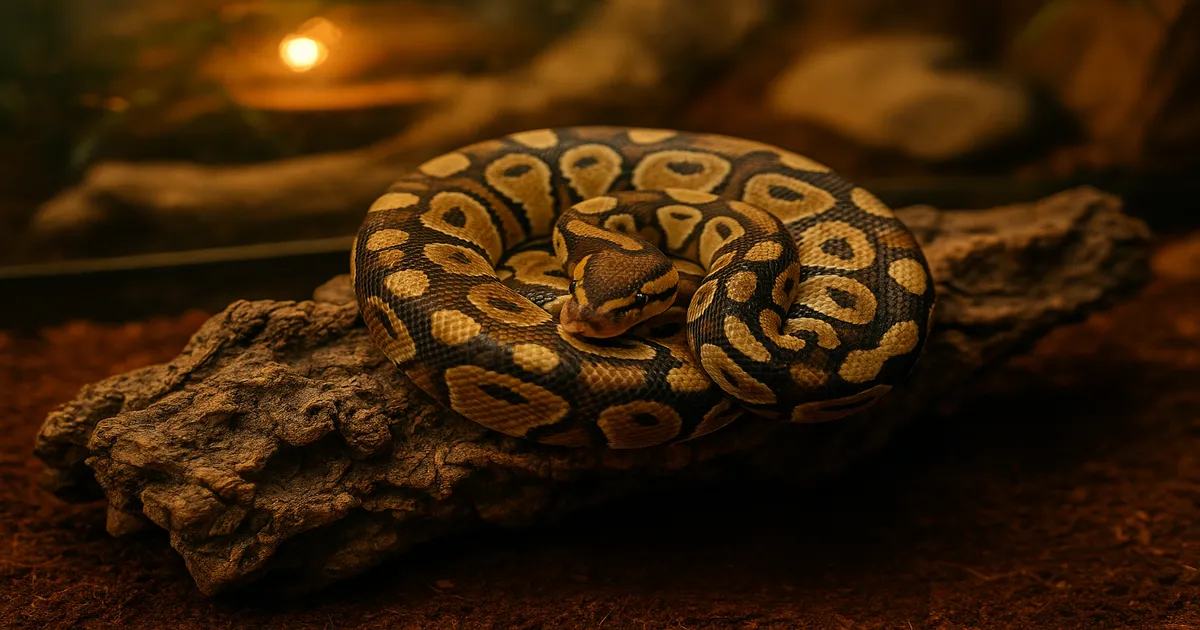
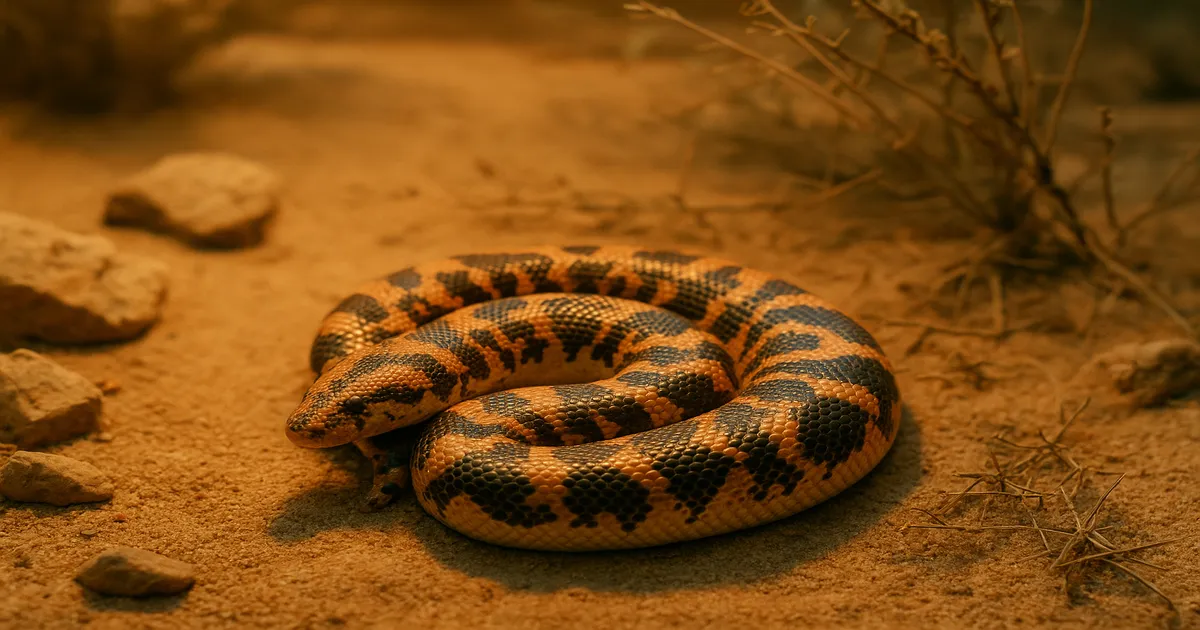
Quick Answer: Kenyan sand boas are small, docile, fossorial snakes that thrive on deep sandy substrate (4–6 inches minimum), warm-side substrate temps of 90–95°F (32–35°C), and low humidity of 30–40%. Feed adults a properly sized mouse every 10–14 days, run an under-tank heater on a thermostat, and you’ve covered the bulk of what this species needs to stay healthy for 20+ years.
Knowing how to care for a Kenyan sand boa correctly comes down to one thing most people underestimate: the substrate. Everything else — temperatures, feeding, humidity — is fairly straightforward once you understand it. But get the substrate wrong and you’ll have a stressed, inactive snake that won’t eat. Get it right and you’ll watch one of the most behaviorally fascinating small snakes in the hobby disappear into a tunnel system it built itself.
Kenyan Sand Boa Care at a Glance
Size, Lifespan, and Temperament
Sexual dimorphism in this species is dramatic. Females reach 24–36 inches (61–91 cm) and get noticeably thick-bodied; males top out at 15–20 inches (38–51 cm) and stay slender their whole lives. Captive lifespan is typically 15–20 years, with documented females pushing past 30.
Temperament-wise, these snakes are about as laid-back as they come. Hatchlings can musk and bluff-strike when first handled, but that fades quickly with regular interaction. Adults are genuinely calm, handleable snakes — not just “tolerant,” actually calm.
I’d put them alongside ball pythons as one of the best first snakes, but honestly they’re less finicky about humidity and feeding than balls can be. Hardy, widely available in captive-bred form, and their feeding response is almost absurdly reliable.
Natural History: Why It Matters for Care
Eryx colubrinus loveridgei (sometimes classified as Gongylophis colubrinus) is native to arid and semi-arid East Africa — Kenya, Tanzania, Ethiopia, Sudan, and Egypt. Rocky desert, dry savanna, scrubland. They’re listed on CITES Appendix II, but the vast majority of animals in the hobby are captive-bred, which is good for both conservation and keeper outcomes.
These snakes spend most of their lives underground. Not under a hide — in the substrate. That single fact should shape every decision you make about their enclosure. A Kenyan sand boa on two inches of sand is like keeping a fish in a puddle. It technically survives, but it’s not living the way it should.
In the wild, a sand boa lies buried with just its head exposed, waiting for a small mammal or lizard to wander within striking range. Once it strikes, it pulls prey underground and uses the substrate itself as a brace for constriction. You’ll see this exact behavior in captivity if the setup is right.
How to Care for Kenyan Sand Boas: Enclosure Setup
Choosing the Right Enclosure Type
- Glass aquariums: Readily available and fine for most keepers. Heat and humidity loss through screen lids is the main downside — partially covering the screen with a glass panel or foil helps.
- Plastic tubs (Sterilite, IRIS): My honest recommendation for most people. Better heat retention, easier to clean, and opaque sides reduce stress. Drill small ventilation holes on the sides, not the top.
- PVC enclosures: Premium option with excellent insulation. Worth it if you’re serious about the hobby.
- Rack systems: Best for breeders keeping multiple animals. Heat tape runs through the rack; very efficient at scale.
Enclosure Size by Age and Sex
| Life Stage | Recommended Size |
|---|---|
| Hatchling | 10-gal (38L) / 20×10×12 in (51×25×30 cm) |
| Juvenile female | 20-gal long (76L) / 30×12×12 in (76×30×30 cm) |
| Adult female | 20–40 gal (76–151L), min 36×18 in (91×46 cm) footprint |
| Adult male | 10–20 gal (38–76L) |
Floor space matters far more than height. Don’t start hatchlings in oversized enclosures — small spaces help them locate food and feel secure.
Substrate: The Most Important Part of the Setup
The best substrate for a Kenyan sand boa is a blend of 60–70% dry play sand mixed with 30–40% organic topsoil (no fertilizers, no perlite). This mix holds burrow structure in a way that pure sand simply doesn’t. Keepers who make the switch consistently report more active, behaviorally complex snakes — the difference is often visible within days.
Minimum depth: 4 inches (10 cm). Ideal: 5–6 inches (13–15 cm).
Avoid these entirely:
- Calcium sand (Vita-Sand) — clumps when wet, impaction risk
- Cedar or pine shavings — toxic
- Walnut shell — sharp edges, impaction risk
- Coco fiber alone — retains too much moisture
Aspen shavings work as a budget option and they’ll burrow in it, but it doesn’t hold tunnel structure. It’s a compromise, not a solution.
Hides and Water Dish Placement
Provide at least two hides — one warm side, one cool side. They should be snug: the snake should feel contact on all sides. During pre-shed, add a humid hide on the warm side (a plastic container with a lid and damp sphagnum moss inside).
Decor is mostly for the keeper. These snakes are buried 90% of the time, so an elaborate setup doesn’t benefit them much. Prioritize substrate depth over aesthetics. Use a small, heavy ceramic crock on the cool side for water — something that won’t tip when the snake pushes through the substrate underneath it.
Temperature and Heating
The Thermal Gradient
- Warm-side substrate (2–3 inches deep): 90–95°F (32–35°C)
- Ambient warm side: 80–85°F (27–29°C)
- Cool side: 70–75°F (21–24°C)
- Nighttime minimum: 65–68°F (18–20°C)
For a fossorial species, belly heat is everything. A snake sitting in 85°F air on cool substrate is cold. A snake buried in substrate heated to 92°F is comfortable. Ambient air temperature is almost irrelevant if the substrate isn’t warm.
Heat Sources
Under-tank heaters (UTH) are the primary choice for most setups. (Ultratherm UTH Pad) Place under one end of the enclosure to create a gradient, and elevate the enclosure slightly on foam risers to allow airflow and prevent the UTH from overheating.
Heat tape is ideal for rack systems. Radiant heat panels work well in glass or PVC enclosures mounted inside the lid. Ceramic heat emitters (CHE) can supplement heating but shouldn’t be your only source — they heat air, not substrate.
Thermostats Are Non-Negotiable
Running any heat source without a thermostat is how you cook your snake. Unregulated UTHs can push substrate temperatures above 110°F (43°C). That’s fatal, and it happens faster than you’d think.
- Dimmer/rheostat thermostats work well for UTH and heat tape on a budget. (Inkbird ITC-306T)
- Proportional thermostats are more precise and better suited for CHEs and radiant heat panels. (Herpstat 1)
How to Measure Substrate Temperature Correctly
Don’t measure temperature at the substrate surface — probe 2–3 inches deep where the snake actually sits. An infrared temp gun (Etekcity Lasergrip 800) is useful for spot-checking the surface, but you need a digital probe thermometer buried in the substrate for accurate ongoing readings.
Humidity, Lighting, and Environmental Conditions
Humidity
Target 30–40% relative humidity. These are desert animals — too much moisture is genuinely dangerous. Respiratory infections, scale rot, and dysecdysis (problem sheds) are all directly linked to excessive humidity. If you’re going to err one way, err dry.
Monitor with a digital hygrometer. In very dry climates where humidity drops below 20%, a small water dish will passively raise it slightly.
When your snake goes into pre-shed (eyes go blue/opaque, colors dull), add a humid hide with damp sphagnum moss. Don’t mist the whole enclosure — raise humidity locally, not globally. Target 50–60% inside the humid hide, then remove it once the shed is complete.
Lighting
UVB isn’t strictly required for Kenyan sand boas, but low-output UVB — an Arcadia 6% or Zoo Med T5 HO 5.0 — may offer long-term benefits for vitamin D3 synthesis. The research isn’t settled, but I lean toward offering it given how little downside there is.
Avoid bright overhead lighting. It stresses fossorial species and suppresses natural behavior. A 12-hour light/dark photoperiod using ambient room light is perfectly adequate if you skip UVB.
Feeding Your Kenyan Sand Boa
Prey Size and Feeding Frequency
Always feed pre-killed or frozen/thawed mice. Live prey can injure your snake, and there’s genuinely no benefit to it.
| Age | Prey Size | Frequency |
|---|---|---|
| Hatchling | Pinky mouse | Every 5–7 days |
| Juvenile | Fuzzy to hopper | Every 7 days |
| Adult | Adult mouse | Every 10–14 days |
Prey diameter should roughly match the widest part of the snake’s body. A slight lump post-feeding is normal.
Feeding Technique
Feed in the enclosure using tongs — no need for a separate feeding container. Place the prey near the substrate surface where the snake typically buries. The snake will do the rest. Never hand-feed; you’ll condition a feeding response to your fingers.
Handling Hatchling Refusals
Hatchlings commonly refuse for 2–4 weeks after their first shed. This is normal. Try the “wiggle technique”: gently move a frozen/thawed pinky at the substrate surface near where the snake is buried. The vibration mimics live prey and often triggers the ambush response.
For persistent refusers, try braining the prey (a small incision in the skull to expose brain tissue) or scenting it with lizard shed. Give it time before escalating.
The Overfeeding Problem
This is probably the most underappreciated health issue in the species. Kenyan sand boas will eat every single time you offer food — they have no self-regulation. Stick to the schedule above, don’t add bonus feedings, and watch your female’s girth. Obesity significantly shortens lifespan and causes serious reproductive complications.
Common Kenyan Sand Boa Care Mistakes
Husbandry errors:
- Shallow substrate (1–2 inches) — the most common mistake by far
- No thermostat on any heat source
- Measuring ambient air temp instead of substrate temp
- Starting hatchlings in enclosures that are too large
- Keeping humidity too high
Feeding mistakes:
- Overfeeding — stick to the schedule
- Prey too large — causes regurgitation; size down
- Handling within 48 hours of feeding — also causes regurgitation
- Giving up on hatchling feeders too early
Handling and behavior: Juvenile musking and defensive strikes are normal — it’s a startled response, not aggression, and it goes away with consistent handling. Don’t dig your snake up repeatedly to check on it. If it wants to stay buried, let it. And check your lid; these snakes are surprisingly strong and will find any gap.
Health and quarantine: Quarantine any new animal for 30–90 days minimum in a separate room with separate equipment. Weigh your snake monthly on a gram scale — if it loses more than 10% of body weight without an obvious reason, see a reptile vet. Mite treatment requires addressing the snake, stripping the entire enclosure, and treating the surrounding area simultaneously. Treating just the snake guarantees reinfestation.
Expert Tips for a Thriving Setup
Substrate moisture gradient: Lightly dampen the bottom third of the substrate while keeping the top 2–3 inches completely dry. This replicates what they experience in the wild — cool, slightly moist soil at depth, dry and warm near the surface. Snakes use this gradient to regulate both temperature and hydration, and it keeps the substrate from becoming dusty.
Monitor health through weight and behavior: A healthy sand boa that’s comfortable in its enclosure will regularly surface with its head at the substrate edge, actively hunting. A snake that never surfaces and stops eating is telling you something is wrong — usually temperature or stress. Weight loss is the first sign of almost every health problem, which is why a gram scale is one of the most valuable tools in your kit.
Recommended Equipment Checklist
- Enclosure (glass, tub, or PVC — appropriate size for age/sex)
- Under-tank heater (Ultratherm UTH Pad)
- Thermostat (dimmer or proportional) (Herpstat 1)
- Digital probe thermometers ×2 (warm and cool side)
- Infrared temperature gun (Etekcity Lasergrip 800)
- Digital hygrometer
- Gram scale (American Weigh Scales LB-3000)
- Two snug hides + humid hide container
- Small ceramic water crock
- F10SC disinfectant or diluted bleach for cleaning (avoid phenol-based cleaners like Pine-Sol or Lysol)
Frequently Asked Questions About Kenyan Sand Boa Care
How big do Kenyan sand boas get?
Females typically reach 24–36 inches (61–91 cm) and become noticeably thick-bodied with age. Males are much smaller — usually 15–20 inches (38–51 cm) — making this one of the most pronounced size differences between sexes of any snake in the hobby.
What is the best substrate for a Kenyan sand boa?
A blend of 60–70% dry play sand mixed with 30–40% organic topsoil (no additives), at a minimum depth of 4–6 inches (10–15 cm). This mixture holds burrow structure far better than pure sand and produces noticeably more natural behavior. Avoid calcium sand, cedar, pine, and walnut shell.
How often should I feed my Kenyan sand boa?
Hatchlings get a pinky mouse every 5–7 days; juveniles get a fuzzy to hopper every 7 days; adults eat an appropriately sized adult mouse every 10–14 days. Overfeeding is a real problem with this species — they’ll eat every time you offer, but obesity significantly shortens their lifespan.
Do Kenyan sand boas need UVB lighting?
It’s not strictly required, but low-output UVB like an Arcadia 6% or Zoo Med T5 HO 5.0 may support long-term health through vitamin D3 synthesis, and the emerging research leans that way. If you skip it entirely, ambient room lighting on a 12-hour cycle is sufficient.
Are Kenyan sand boas good pets for beginners?
Yes, genuinely. They’re hardy, captive-bred animals with a reliable feeding response, a docile temperament, and modest space requirements. The main learning curve is getting the substrate setup right — once you nail that, they’re one of the most forgiving and rewarding snakes a beginner can keep.