Quick Answer: If you find an injured garter snake, contain it gently in a pillowcase or cloth bag, do a quick visual assessment without excessive handling, and call a licensed wildlife rehabilitator or reptile vet immediately. If professional help is delayed, set up a clean, escape-proof recovery enclosure with paper towel substrate, a thermal gradient, and a shallow water dish — but the goal is always rehabilitation and release, not a new pet.
Finding an injured garter snake in your yard puts most people in an awkward spot. You want to help, but you’re not sure what actually helps versus what makes things worse. Knowing how to care for an injured garter snake properly — even just for the 24 hours before a vet can see it — can mean the difference between a snake that recovers and one that doesn’t. This guide covers everything from the first five minutes to release day.
What to Do First: Immediate Care for an Injured Garter Snake
The First 30 Minutes
Don’t rush to pick it up bare-handed. Grab a pair of nitrile gloves and work through this in order:
- Contain the snake safely. Guide it gently into a clean cotton pillowcase or breathable cloth bag. Darkness calms them down fast — far less stressful than open-hand transport.
- Do a quick visual assessment. Look for obvious lacerations, kinking in the spine, or blood. Don’t prod or stretch the animal to get a better look.
- Call a wildlife rehabilitator or reptile vet. This is step three, not step seven. The sooner a professional sees the snake, the better.
- Set up a basic holding enclosure only if a vet visit will be delayed. Details below.
When to Call a Wildlife Rehabilitator
A wildlife rehabilitator should be your first call in almost every situation. They have the permits, the equipment, and the experience. Find licensed rehabilitators through the National Wildlife Rehabilitators Association or your state’s fish and wildlife agency.
There’s also a legal angle: in most U.S. states and Canadian provinces, keeping a wild garter snake — even an injured one — without a rehabilitation permit is illegal. Good intentions don’t change that. The goal is rehabilitation and release.
Assessing the Injury
Common Causes of Injury
Lawnmowers are probably the most common culprit, followed by cars, cats, dogs, and garden tools. Cat bites deserve special attention — they look minor but introduce bacteria deep into tissue. A small puncture from a cat can become a serious systemic infection within 24–48 hours. If a cat was involved, a vet visit isn’t optional.
External vs. Internal Injuries
Surface wounds — lacerations, abrasions, skin tears — are visible and manageable with basic first aid. Internal injuries are a different story. A snake can have significant internal bleeding or organ damage and still move around. Moving doesn’t mean uninjured.
Signs of internal injury or spinal damage:
- Obvious kinking or deformity along the spine
- Inability to hold normal body posture
- Paralysis or weakness in the rear half of the body
- Bleeding from the cloaca or mouth
Neurological Red Flags
Stargazing — where the snake holds its head pointed upward at an unnatural angle — is a neurological emergency. So is corkscrewing (the body twisting on itself) and an inability to right itself when placed on its back. No amount of correct temperature or humidity fixes neurological damage. These animals need a vet, full stop.
Species Identification
The most common species you’ll encounter are the Common Garter Snake (T. sirtalis), Western Terrestrial Garter Snake (T. elegans), Ribbon Snake (T. sauritus), Checkered Garter Snake (T. marcianus), and Plains Garter Snake (T. radix). Humidity requirements differ — ribbon snakes need 60–80% relative humidity, while checkered garter snakes do fine at 40–60%. Getting this wrong won’t kill the snake in a week, but it matters for a longer recovery.
One more thing worth knowing: wild garter snakes almost universally carry internal parasites. A fecal exam from a reptile vet is strongly recommended before you consider the animal stable.
How to Care for an Injured Garter Snake: Setting Up a Recovery Enclosure
Enclosure Size and Type
Two options work well. A 20–30 gallon glass aquarium with a locking screen lid gives you good visibility and humidity control. An opaque Sterilite or Iris tub with drilled ventilation holes reduces visual stress on a wild-caught animal — many rehabilitators prefer these for exactly that reason.
For a severely injured snake that had surgery or can’t move well, a smaller 10-gallon setup actually reduces re-injury risk by limiting how far the animal needs to travel to reach food, water, and hides.
Substrate
Use white paper towels. That’s it. I know it looks clinical, but during recovery there’s no better option. Paper towels let you monitor wound discharge, feces, and parasite load at a glance, they’re easy to replace, and they don’t contaminate open wounds. Replace them daily or whenever soiled.
Loose substrate — coconut fiber, bark chips, sand — has no place in a recovery enclosure. Particles work into wounds and cause infections that are genuinely hard to treat.
Hides and Decor
Two hides: one on the warm side, one on the cool side. This isn’t optional. A garter snake that can’t hide is a stressed garter snake, and a stressed garter snake cannot heal effectively. Make the hides snug-fitting — garter snakes feel most secure when they’re tucked in tight. Small Tupperware containers work fine.
Skip rocks, driftwood, and anything rough-surfaced. Abrasive decor and healing wounds are a bad combination.
Temperature and Humidity
The enclosure needs a real thermal gradient:
- Warm side: 85–90°F (29–32°C)
- Ambient mid-enclosure: 70–80°F (21–27°C)
- Cool side: 65–72°F (18–22°C)
- Nighttime drop: 65–68°F (18–20°C)
If your snake is consistently sitting at the warm end, that’s behavioral fever — a legitimate immune response. Don’t reduce the heat. Let the animal self-regulate.
Skip overhead heat lamps for an injured animal; they dry out wounds and create hot spots a compromised snake may not be able to escape. Use an under-tank heater or a ceramic heat emitter mounted in a dome fixture. Either way, run it through a thermostat — an Inkbird ITC-306 or Herpstat 1 are both solid choices. Running a heater without a thermostat in a closed enclosure is how snakes die from heat stroke.
Humidity targets by species:
- Most Thamnophis species: 50–70%
- Semi-aquatic species (T. sirtalis, ribbon snakes): 60–80%
- Arid-adapted species (T. elegans vagrans, T. marcianus): 40–60%
Keep wound areas on the drier side — excess humidity around open wounds promotes bacterial and fungal growth. A humid hide filled with damp sphagnum moss lets the snake self-regulate without you soaking the whole enclosure.
A 5.0 UVB fluorescent or T5 HO 6% tube on a 12/12 photoperiod is worth setting up. UVB supports vitamin D3 synthesis and immune function — both matter when an animal is under physiological stress. (Arcadia T5 6% Forest 39W) For a recovery under two weeks, a basic full-spectrum bulb on a timer is acceptable if you don’t have UVB on hand.
One firm warning: never place the enclosure near a window where it gets direct sunlight. Temperatures inside a glass tank in direct sun can hit 120°F (49°C) within minutes. Fatal.
Wound Care and First Aid
What You Need Before You Start
- Nitrile gloves
- Chlorhexidine solution diluted to 0.05% in sterile saline
- Betadine (povidone-iodine) diluted to 0.5–1% as an alternative
- Sterile saline for irrigation
- Telfa non-stick pads
- Vetericyn Plus Reptile Wound & Skin Care Spray
- Manuka honey for antimicrobial wound coverage
- Sterile gauze and cotton swabs
Cleaning and Dressing a Wound
Work slowly and support the snake’s full body weight. Flush the wound gently with sterile saline first to remove debris. Apply diluted chlorhexidine with a cotton swab — work outward from the wound center, don’t scrub. Pat dry with sterile gauze, apply a thin layer of Manuka honey or Vetericyn if the wound is open, and cover with a Telfa pad if needed.
The dilution matters enormously. Full-strength betadine and hydrogen peroxide are both cytotoxic — they destroy healthy tissue along with bacteria. Dilute 2% chlorhexidine stock significantly with sterile saline to reach that 0.05% working concentration. When in doubt, go more dilute, not less.
Monitoring Wounds
Photograph the enclosure every day. White paper towels make discharge immediately visible — color, volume, whether it’s changing. A wound that’s healing should produce less discharge over time, not more.
Signs of infection: increasing swelling, discharge that turns yellow or green, foul odor, or visible tissue necrosis (blackening or sloughing). If you see any of these, the snake needs systemic antibiotics from a vet. There’s no over-the-counter fix for a systemic reptile infection.
Feeding and Hydration
Don’t offer food for at least 48–72 hours after initial stabilization. Digestion is metabolically expensive — it pulls resources away from immune function and wound healing. A snake that refuses food in the first few days isn’t failing to recover; it’s prioritizing correctly.
When you do start feeding, earthworms and small frozen-thawed fish (smelt, silversides, guppies) are your best options. They’re easily digestible and appropriate for virtually every Thamnophis species. Feed in a separate container, offer food every 3–5 days, and keep prey items small. If you’re transitioning to frozen-thawed prey, rub the thawed item with a live earthworm or briefly dip it in fish tank water — garter snakes are highly scent-driven, and this trick works well.
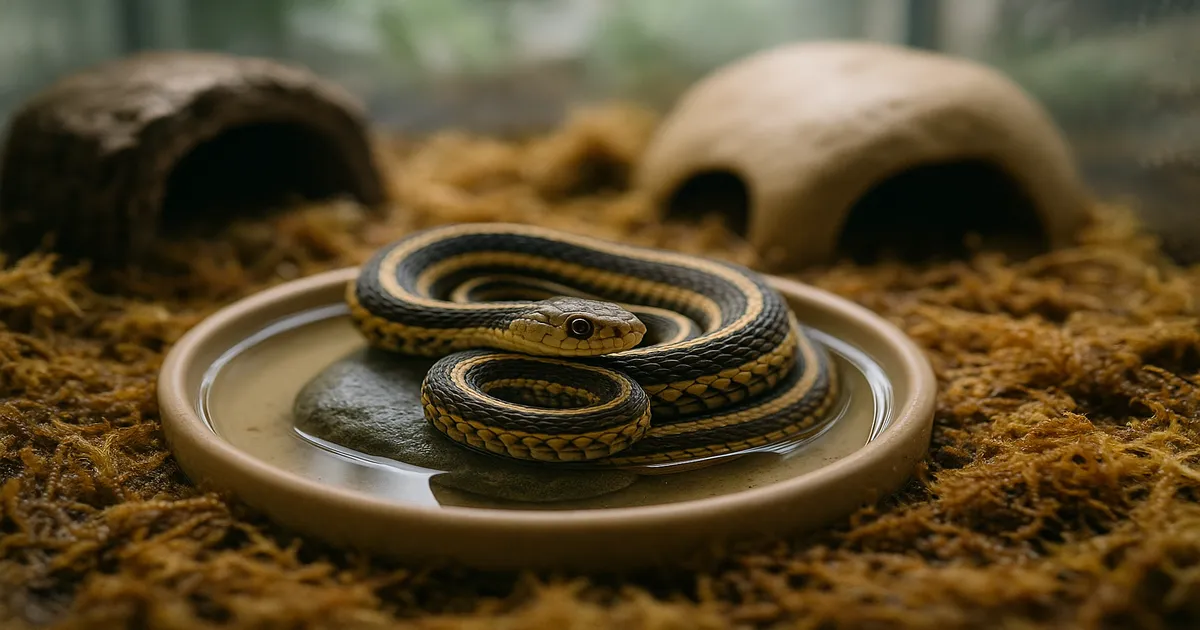
The water dish needs to be shallow — no deeper than 0.5–1 inch (1.3–2.5 cm). A compromised snake that can’t right itself can drown in a standard water dish. Change the water daily.
Here’s a simple diagnostic I’ve used for years: offer a live earthworm on a paper towel. A snake that strikes and eats it within 10–15 minutes is showing strong survival instinct. That’s one of the best early indicators that things are moving in the right direction.
Common Mistakes That Kill Recovering Garter Snakes
Overhandling. This is the most common reason injured wild garter snakes die in human care — and it’s entirely preventable. Handling elevates corticosterone and directly suppresses immune function. Limit contact to wound checks and feeding. If the snake musks and thrashes every time you open the lid, it’s telling you it needs less interaction, not more.
No thermostat. A heat lamp without a thermostat in a sealed enclosure will eventually kill a snake. Always use a thermostat. Run two thermometer probes — warm side and cool side — so you know what’s actually happening in the enclosure.
Deep water dishes. Keep the dish at 0.5–1 inch maximum. Check it every time you open the enclosure.
Loose substrate. Paper towels only until the animal is fully healed. Substrate particles in an open wound can go systemic fast.
Releasing too early or in the wrong location. Release within 100 meters of the original capture site whenever possible. Garter snakes have established home ranges — they know their territory’s thermal resources, food sources, and shelter sites. Releasing one across town isn’t a kindness.
Don’t release until the snake feeds independently, thermoregulates normally, and moves without assistance. A snake that fails any of those three criteria isn’t ready. Premature release in that condition is effectively a death sentence.
Frequently Asked Questions
What should I do if I find an injured garter snake in my yard?
Contain it in a pillowcase or cloth bag, then call a licensed wildlife rehabilitator or reptile vet before doing anything else. If professional help will be delayed, set up a holding enclosure with paper towel substrate, a thermal gradient, and a shallow water dish. Minimize handling.
Can I keep a wild garter snake I found injured without a permit?
In most U.S. states and Canadian provinces, no. Keeping a wild native snake without a wildlife rehabilitation permit is illegal even with good intentions. Contact your state or provincial fish and wildlife agency, and work toward rehabilitation and release rather than permanent captivity.
How do I clean a wound on a garter snake at home?
Flush the wound gently with sterile saline, then apply chlorhexidine solution diluted to 0.05% using a cotton swab. Never use hydrogen peroxide or full-strength betadine — both destroy healthy tissue. For open wounds, a thin layer of Manuka honey or Vetericyn Plus Reptile Spray provides antimicrobial protection between cleanings.
How do I know if an injured garter snake is getting better?
The clearest early indicator is feeding response — a snake that strikes and eats an earthworm within 10–15 minutes is showing strong recovery signs. Other positive indicators include normal thermoregulation behavior, reduced wound discharge, and the snake righting itself normally when placed on its back.
When is it safe to release a rehabilitated garter snake?
The snake should feed independently, move normally without assistance, and thermoregulate on its own before release. Release at or very near the original capture site in mild weather when daytime temperatures are consistently above 60°F (15°C). If you have any doubt, consult a wildlife rehabilitator first.