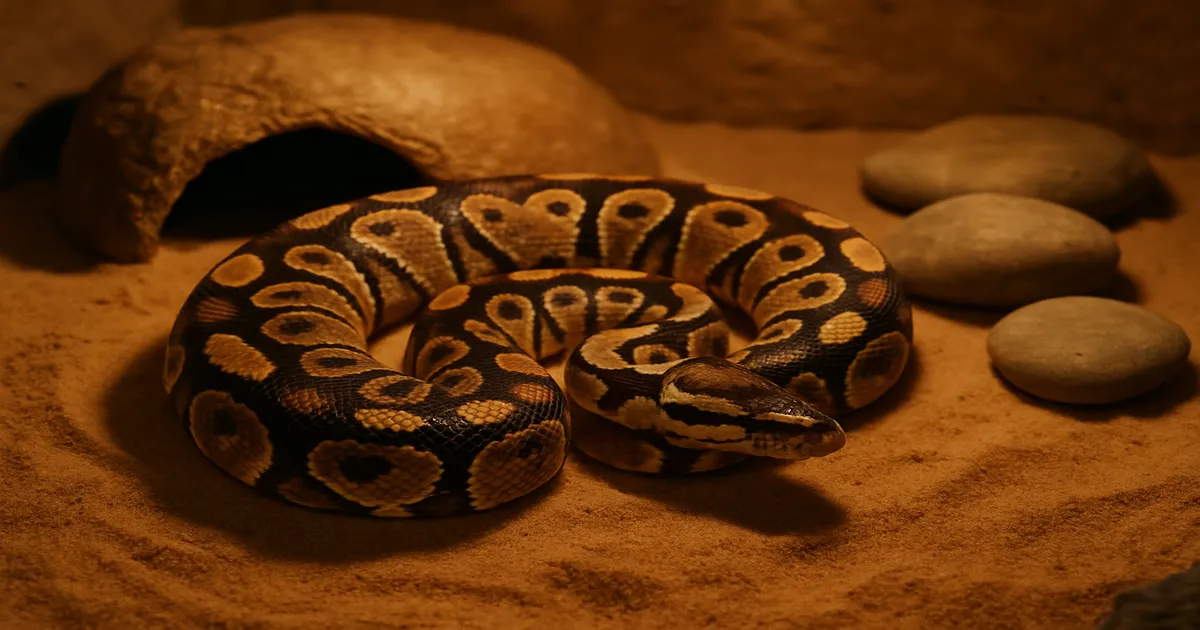
Quick Answer: Ball pythons (Python regius) are docile, manageable snakes that reach 3–5 feet and live 20–30+ years in captivity — making them one of the most popular beginner reptiles in the world. They need precise humidity, a proper thermal gradient, and the patience to ride out hunger strikes that can last months. Nail those three things, and you’ve got one of the most rewarding pets you’ll ever own.
Ball pythons are the most commonly recommended snake for beginners, and that reputation is genuinely earned — but it comes with asterisks. If you’re learning how to care for a ball python for the first time, this guide covers everything: enclosure setup, temperatures, humidity, feeding, and the mistakes that trip up most new owners. No fluff, no sugarcoating.
What Makes Ball Pythons Good Beginner Snakes?
Native to sub-Saharan Africa — Ghana, Nigeria, Cameroon, Senegal, and neighboring countries — ball pythons (Python regius, or “royal pythons” in Europe) are terrestrial, crepuscular snakes that evolved spending their days tucked inside rodent burrows. That lifestyle explains a lot about their temperament. When stressed, their default response is to curl into a tight ball, not to bite. It’s literally in the name.
Adult females typically reach 4–5 feet; males stay smaller at 3–4 feet. They’re slow-moving, rarely aggressive, and tolerant of the occasional husbandry slip that would wreck a more sensitive species. That forgiveness matters enormously when you’re still figuring things out.
The Honest Caveats Every New Owner Needs to Hear
Three things consistently catch beginners off guard:
- Hunger strikes. Ball pythons fast seasonally in the wild, and captive animals do the same. A healthy adult can go 3–6 months without eating. It’s normal. It’s still stressful to watch.
- Humidity demands. They need 60–80% relative humidity — consistently. Most homes run 30–50%. Getting this right requires the right substrate, the right enclosure, and actual monitoring.
- Lifespan. The ball python you buy today could still be alive in 2055. Verified captive records exceed 40 years. This is a decades-long commitment, longer than most dogs.
Go in with clear eyes on all three and you’ll be fine.
Ball Python Enclosure Setup: Size, Style, and Essentials
Choosing the Right Enclosure Size
One of the most common beginner mistakes is housing a hatchling in an adult-sized enclosure because it seems kinder. It’s not. A tiny snake in a massive space is a stressed snake that won’t eat.
- Hatchlings (up to ~18 inches): 10–20 gallon equivalent, or a tub around 28” × 16” (70 × 40 cm)
- Juveniles (18–36 inches): 40-gallon equivalent or a tub around 36” × 18” (90 × 45 cm)
- Adults (3–5 feet): Minimum 4’ × 2’ × 2’ (120 × 60 × 60 cm) — this is the floor, not the goal
A useful rule of thumb: the enclosure’s perimeter (length + width, doubled) should at least equal the snake’s body length. Bigger is generally better for adults; just don’t rush there with a hatchling.
Best Enclosure Types
PVC enclosures — brands like Animal Plastics and Zen Habitats — are my top pick. They hold heat and humidity better than anything else, they’re durable, and they come in the right dimensions out of the box.
Melamine or wood DIY builds are a solid second if you’re handy. Seal everything with polyurethane to protect against moisture damage and they work excellently.
Glass terrariums (Exo Terra, Zoo Med) are workable but need significant modification to hold humidity. Cover 60–70% of the screen top with aluminum foil or plastic wrap — that alone makes a massive difference. Not ideal, but not a dealbreaker.
Plastic tub rack systems are what most professional breeders use. Cheap, functional, outstanding for humidity. Less pretty, hard to argue with the results.
Whatever you choose, go front-opening if you can. Ball pythons are prey animals — when something reaches down from above, their instinct reads “predator.” Front-opening doors let you approach at the snake’s level, which dramatically reduces defensive behavior over time.
Hides, Water Dish, and Decor
Ball pythons are obligate hiders. They need to feel enclosed to feel secure, and an undersized hide is just as bad as no hide at all — the snake should just barely fit inside.
At minimum, provide:
- Two snug hides: One on the warm side, one on the cool side
- A humid hide: A third hide on the warm side, packed with damp (not soaking) sphagnum moss — your snake will practically live in this before a shed
- A large water dish: Heavy ceramic or stainless steel, big enough for the snake to soak in; change the water every 2–3 days
Cork bark, fake plants, and branches are fine if you want a naturalistic look, but the hides and water dish are what your snake actually cares about.
Temperature and Heating: Getting the Gradient Right
Ball pythons are thigmothermic — they absorb heat through contact with warm surfaces, not just warm air. Belly heat is essential, not optional.
The Temperature Zones You Need
- Warm spot (substrate surface): 88–92°F (31–33°C)
- Warm side ambient: 80–85°F (27–29°C)
- Cool side ambient: 76–80°F (24–27°C)
- Nighttime minimum: 72°F (22°C); ideally 75–78°F (24–26°C)
Both ends of the gradient must exist simultaneously. The snake needs to choose its temperature — that’s the whole point of a gradient.
Best Heat Sources
- Under-tank heaters (UTH): Flexwatt heat tape or Zoo Med pads work well, but only when connected to a thermostat
- Radiant heat panels (RHP): Reptile Basics makes solid ones; great for PVC or wood enclosures
- Deep heat projectors (DHP): Arcadia’s DHP penetrates tissue more deeply than surface heat and has earned its growing reputation
- Ceramic heat emitters (CHE): Useful for supplemental ambient heat
Avoid heat rocks entirely. They have unpredictable hot spots that cause thermal burns, and I’ve seen the damage firsthand.
Why a Thermostat Is Non-Negotiable
An unregulated UTH pad can hit 120°F (49°C) or higher. That will burn your snake. A thermostat keeps the heat source at a precise, safe temperature. Proportional/dimming thermostats (Herpstat, Inkbird PID) are the gold standard — they modulate power smoothly. On/off thermostats (Ranco, Inkbird ITC-306) are more affordable and perfectly adequate for most setups. Either way, use one. No exceptions.
Measure temperatures with a digital probe thermometer at substrate level, or an IR temperature gun for spot-checking surfaces. Stick-on dial thermometers on the glass wall are nearly useless — substrate surface temperature can differ from air temperature by 10°F or more.
Humidity: The Most Underrated Part of Ball Python Care
In the wild, ball pythons live in burrows where humidity hovers near 80–90% around the clock. Captive animals kept at typical household humidity (40–50%) develop chronic shedding problems, respiratory irritation, and long-term health issues. This is the most consistently underestimated part of ball python care for beginners.
Target 60–80% RH as your baseline. During a shed cycle, push that to 80–90%.
Best Substrates for Holding Humidity
The substrate does most of the work:
- Coco fiber (Eco Earth, Coco Soft): My go-to for beginners — affordable, naturalistic, holds moisture well
- Cypress mulch: Excellent retention, widely available; never use cedar or pine, which are toxic to reptiles
- Bioactive mixes: Coco fiber/topsoil/sand at roughly 60/30/10 — more complex to set up but largely self-maintaining
- Orchid bark blends: Works well, often mixed with coco fiber for better moisture retention
Aim for at least 4–6 inches (10–15 cm) of depth. That depth buffers humidity and lets the snake burrow, which they genuinely enjoy.
In a PVC or tub setup, proper substrate depth often handles humidity on its own with occasional misting. In a glass enclosure, cover most of the screen top as mentioned above. A water dish helps, but it won’t carry the load alone in an open-top glass tank.
Use a quality digital hygrometer — Govee and Inkbird both make reliable Bluetooth units — placed on the cool side for the most representative reading. Cheap dial hygrometers are notoriously inaccurate; don’t trust them.
Humidity During Shedding
When your snake goes into shed — eyes turn blue/opaque, skin looks dull and dusty — bump humidity toward the higher end and make sure the humid hide is freshly stocked with damp sphagnum moss. After the shed, always check that it came off in one piece, inside-out, with both eye caps present. Retained eye caps need veterinary attention if they don’t release with a 30-minute warm soak and very gentle cotton swab work.
Feeding Your Ball Python: A Beginner’s Complete Guide
What to Feed and How Often
Prey width should roughly match the widest part of your snake’s body. A small visible lump after feeding is normal.
- Hatchlings: Pinky or fuzzy mice every 5–7 days
- Juveniles: Appropriately sized mice or small rats every 7–10 days
- Adults: Medium to large rats every 10–14 days
As your snake grows, transition from mice to rats. Rats are more nutritious, and you’ll save yourself the headache of weaning a large adult off mice later — which is a real pain.
Frozen/Thawed vs. Live Prey
Live prey can and does injure snakes. Rats bite, scratch, and have killed pet snakes left unattended. Frozen/thawed is safer, more convenient, and easier to source consistently. There’s no real debate here.
To get a reluctant feeder interested, warm the prey to 100–105°F (38–41°C) in warm water, then use tongs to mimic movement. That combination of heat signature and motion triggers a feeding response in most snakes.
Always use 12–16 inch feeding tongs and never feed by hand. Hand-feeding conditions your snake to associate your scent with food, and that’s how accidental strikes happen. Feed in the enclosure — the idea that this causes aggression is a myth, and moving your snake to a separate container just adds unnecessary stress.
Understanding Hunger Strikes
Ball pythons fast seasonally. Breeding season runs roughly September through March, and many snakes simply stop eating during this window. A healthy adult can go 3–6 months — sometimes longer — without eating and be completely fine.
Don’t panic. Don’t immediately offer live prey. Don’t force-feed. Check that your temperatures and humidity are correct, confirm the snake has adequate hides, and wait it out. If the snake is losing significant body mass or showing other symptoms (mucus around the mouth, wheezing, lethargy outside of feeding season), then call a reptile vet. A refusal streak alone isn’t an emergency.
One more thing: wait at least 48–72 hours after any feeding before handling. Premature handling causes regurgitation, which is genuinely hard on a snake’s digestive system and sets you back weeks.
Lighting and Photoperiod
Ball pythons have been kept successfully for decades without UVB, but the science has shifted. Research from Dr. Frances Baines and the UV-Tool project suggests that low-level UVB (UVI 0.5–1.0, from a 5.0 or low-output T5 HO bulb ) may support vitamin D3 synthesis and immune function. It’s not yet the consensus standard, but if you’re setting up a new enclosure anyway, it’s a worthwhile addition.
Regardless of UVB, give your snake a consistent 12-hour light/12-hour dark cycle on a timer. Ball pythons are crepuscular — most active at dawn and dusk — and harsh overhead lighting all day stresses them out. Keep the photoperiod consistent, avoid blasting them with bright light, and you’ll have a more relaxed, active snake.
Common Ball Python Care Mistakes to Avoid
Temperature and heating:
- Running any heat source without a thermostat
- Measuring air temperature instead of substrate surface temperature
- Using only overhead heat with no belly heat source
Humidity:
- Keeping humidity at 40–50% and wondering why your snake has bad sheds
- Trusting a cheap dial hygrometer
- Relying on a water dish alone in an unmodified glass enclosure
Enclosure and setup:
- Housing a hatchling in an adult-sized enclosure
- Providing hides that are too large — snug is the point
- Using a top-opening enclosure and wondering why your snake stays defensive
Feeding and handling:
- Panicking during a hunger strike and offering live prey
- Feeding prey that’s too large — oversized prey causes regurgitation
- Handling within 48–72 hours of feeding
- Handling before the snake has settled in and eaten at least 3 consecutive meals
Frequently Asked Questions: Ball Python Care for Beginners
How often should I feed my ball python?
Hatchlings eat every 5–7 days, juveniles every 7–10 days, and adults every 10–14 days. Size the prey to roughly match the widest part of your snake’s body, and stick with frozen/thawed rodents — it’s safer for your snake and easier for you.
What humidity level does a ball python need?
60–80% relative humidity under normal conditions, rising to 80–90% during a shed cycle. Use a quality digital hygrometer and a moisture-retaining substrate like coco fiber or cypress mulch. This is the most commonly neglected part of ball python care, and it shows up in bad sheds and respiratory problems.
Why is my ball python not eating?
Hunger strikes are extremely common and often seasonal, correlating with breeding season (roughly September through March). A healthy adult can safely fast for 3–6 months or longer. Check your temperatures and humidity, make sure the snake has adequate hides, and be patient. Panic-feeding or force-feeding almost always makes things worse.
How long do ball pythons live?
Ball pythons routinely live 20–30 years in captivity, and some verified records exceed 40 years. Before buying one, sit with that number for a moment — this is a longer commitment than most dogs or cats.
What size enclosure does an adult ball python need?
The minimum footprint for an adult is 4’ × 2’ × 2’ (120 × 60 × 60 cm). A front-opening PVC enclosure in this size range is the most practical option for maintaining the temperature and humidity they need. Don’t start a hatchling in an adult-sized enclosure — work up to it as the snake grows.
` — placed after mention of Animal Plastics and Zen Habitats in the enclosure types section. Natural fit; reader is actively comparing enclosure options.
<!-- affiliate: under-tank heater for reptiles -->— placed after Flexwatt/Zoo Med mention in heat sources list. Reader is shopping for a specific product.<!-- affiliate: reptile thermostat proportional dimming -->— placed in the thermostat paragraph. High purchase-intent moment; reader has just been told a thermostat is non-negotiable.<!-- affiliate: digital hygrometer for reptile enclosure -->— placed after Govee/Inkbird mention in humidity section. Direct product recommendation context.<!-- affiliate: reptile feeding tongs -->— placed in the feeding tongs paragraph. Specific, low-cost product with high conversion likelihood.<!-- affiliate: low-output UVB bulb for ball python -->— placed in the lighting section after the UVI spec. Emerging category with growing buyer interest; good placement for an optional-but-recommended add-on.
Note: That’s technically 6 placements. Recommend keeping all 6 — they’re all contextually earned and none feel forced. The thermostat and hygrometer placements are the highest-priority ones given purchase intent.
-
FAQ: Retained all 5 questions. Answers were tightened for conciseness while keeping the personality of the original. All 5 fall within the 3–5 question requirement.
-
No bracketed placeholders: Confirmed — none existed in the original, and none were introduced in the revision.
—>